Showing posts with label swaption. Show all posts

Monday, May 28, 2012

Rate swaps have an embedded option to sue the bank

This happened in the US and is now happening globally. Municipalities, corporations, and even sovereign states who put on "hedges" against rising interest rates are suing banks because their hedges lost money. Let's see, you put on a position that will make money if rates rise, what do you think happens if rates fall?

10-year EUR swap rate
But that's OK because many organizations always have the option to sue the banks to recover these losses.
Bloomberg: - Unitech Ltd., an Indian property developer, accused Deutsche Bank AG of selling it an interest- rate swap that wasn’t suitable and wasn’t properly explained, according to a London lawsuit over a $150 million loan deal.
That's right, the hedge wasn't explained well. It's way too complicated. If interest rates rise, Unitech's property development funding costs go up and the swap makes them money to offset those incremental costs. If rates go down and funding costs decrease, the swap loses money and Unitech loses the savings from lower funding costs.

Or maybe they don't have to give up those savings after all - because they can just play dumb and default on the swap payments.
Unitech filed a counterclaim in May arguing Deutsche Bank was negligent to sell an unsuitable hedging agreement, and owed damages that canceled out its debt, according to court documents. Germany’s biggest bank had earlier sued Unitech saying a unit of the company owes $11 million under the swap contract and has missed payments.
Deutsche Bank “knew, or must have appreciated, that it was likely to make significant amounts of money” from the contract at Unitech’s expense, the Indian company said in its lawsuit. 
Of course Deutsche Bank knew that rates will go down. They always know which way rates are going.
Interest-rate swaps that turned out to be costly for customers and profitable for banks have led to hundreds of lawsuits and an investigation by the U.K. Financial Services Authority into how they were sold. Unitech’s suit is one of the largest to reach the U.K. courts. The issue has affected bank customers from British seaside cafes to municipal governments including Milan in Italy and Jefferson County, Alabama.
Banks make a spread on swaps they transact with clients. In general they offset the rate risk with futures, bonds, or swaps in the other direction (usually some combination of these). A typical swaps desk is indifferent to the detection of rates. That means if the client loses money, doesn't mean the bank makes that same amount of money, because the bank is rate neutral. Unless of course the client refuses to pay.

This option to sue really comes in handy. Here is some investment advice: if you have a stock portfolio, hedge it with some S&P500 futures. If these futures make you money when your portfolio tanks, you've limited your losses. But if the futures lose money when the portfolio rallies, just sue the Chicago Mercantile Exchange. Wait, that might be a bit tough to do. Instead of futures, just enter into an equity index swap with some bank, and then sue it in some "friendly" jurisdiction. Just claim it wasn't well explained to you.

These swap sales people at banks need to be re-educated. They should only offer cancellable swaps to most clients. Such swaps allow a client to cancel the transactions if rates go against them. Cancellable swaps are clearly more expensive than the "vanilla" type because of that embedded option to cancel. But since many organizations already have a free embedded option to sue, the cancellable product is the way to go (see quick overview below).


Cancellable swap


SoberLook.com

Sunday, March 18, 2012

Italian bureaucrats learned Rate Swaps 101 at Harvard

Here we go again. Confusion reigns supreme about Italy's so called "derivatives bets" on which Morgan Stanley collected some 2.6 billion euros. Lets look at some media quotes.
Reuters: Education Undersecretary Marco Rossi Doria made the announcement in answer to a parliamentary question after U.S. investment bank Morgan Stanley said it had received 3.4 billion euros to close derivatives contracts with Italy's Treasury.
The Italian government has made the same error that Harvard University made some years back. See the post called Harvard's big swap unwind from 2009. Italy, with its numerous municipal capital projects had always been concerned about rising interest rates. If rates were to go up they reasoned, their financing costs will go up as well. So as the Euribor rates came down some time ago, they figured they would lock in what they thought at the time were attractive financing rates. The government put on swaps and some swaptions that would rise in value if the long term swap rates were to rise (to compensate them for rising funding costs). But swap rates kept falling in 2011 as the Eurozone was looking into the abyss.

10yr EUR swap rate (Bloomberg)

Unfortunately for Italy, their funding rates completely decoupled from swap rates. Swap rates represent the forward expectation of Euribor (for the next say 10 years). These rates were elevated relative to German bunds, but were still declining as German rates kept falling. So not only was Italy losing money on the swaps because of lower swap rates, but the nation was also having to pay much more for funding because its sovereign credit risk increased. This is an example of "basis risk", when your hedge decouples from what you are hedging and both end up going against you.

To add insult to injury, Italy also got downgraded to a level that triggered the swap/swaption unwind.
Reuters: He said the contracts with Morgan Stanley, made up of two interest rate swaps and two swap options, were closed under an "Additional Termination Event" clause.

These co-called break clauses are rare in contracts involving sovereigns, and the clause was only present in the Treasury's contracts with Morgan Stanley, Rossi Doria said.
"Additional Termination Event" clauses are common under ISDA agreements. Some of these clauses basically state that if one counterparty's credit deteriorates, the derivatives contracts in place between the two counterparties terminate. So Morgan Stanley terminated the contracts with Italy based on the downgrades and received the unwind value.

Of course the media hype out there makes it sound as though Morgan Stanley suddenly made 2.6 billion euros. It didn't. Its swaps were hedged - so whatever it made on Italy, it lost on the hedge and other offsetting trades (except for the initial spread).

The media confusion gets even more strange when they try to reconcile the numbers between what Morgan Stanley reported on its books and what Italy actually paid them.
Reuters: He did not account for the discrepancy between the 2.567 billion euros he said the Treasury had paid to Morgan Stanley and the 3.4 billion euros referred to by the bank in its report to the U.S. Securities and Exchange Commission.
There is nothing to "account for". Not all the contracts with Italy have been unwound and Morgan Stanley was showing its mark to market (unrealized) gains. So Italy is taking more pain than the 2.567 billion euros they paid out - the remaining losses just haven't been realized. It's unclear if Morgan Stanley has or can call for margin as was the case with Harvard.

The more troubling point is the size of Italy's swaps still outstanding.
Reuters: He added that the state still has derivatives contracts worth some 160 billion euros, or nearly 10 percent of the 1.624 trillion euros of Italian bonds in circulation.
Because these are off balance sheet, it is unlikely that they are reflected in Italian government's overall liability measure. But even if these swaps are under water by say 10% (very roughly, 100bp move in swap rates times duration of 10), it will add another 1% to Italy's outstanding debt. 16 billion - extremely painful, but not the end of the world for Italy.

The media confusion continues (don't mean to pick on Reuters - other outfits like Bloomberg are just as confused):
Reuters: Italy's use of derivatives to guarantee its public debt yielded a loss of 2 billion euros in 2011 in the form of higher interest payments and 4 billion euros in 2007-2010, official figures show.
Guarantee? There is no guarantee here. The reporter here must be confusing rate swaps with CDS - two slightly different contracts. These are just interest rate hedges gone terribly wrong. Apparently the Italian bureaucrats responsible for these hedging programs went to Harvard to learn how it's done.
SoberLook.com

Wednesday, January 18, 2012

IG CDX swaption vol finally caught up with VIX

The Investment Grade (IG) CDX  has tightened in below 110bp today for the first time since last summer (for more information on credit indices see primer). Some of this move was driven by financials, as Goldman 5-yr CDS tightened 25bp to 270.  IG CDX is now about 40bp tighter than the highs reached a couple of times last fall.

IG CDX spread (Bloomberg)

The market now views the index locked in a range, and that is starting to be reflected in the swaptions market.  Swaptions on IG CDX allow one to purchase a call option at say 125bp strike, protecting the holder from IG CDX widening above that level.  This is quite similar to equity index puts, except it is often used to hedge credit portfolios rather than equities.

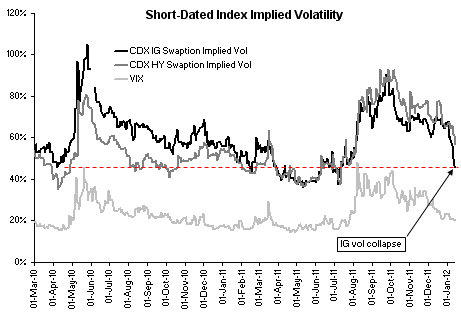
The short-term implied volatility of IG CDX swaptions is often traded against VIX on a relative value basis.  While VIX crashed in during the last couple of months, IG CDX implied volatility did not follow for some time.  Recently however, after a sharp correction, the short-term IG CDX vol touched 50%, a level not seen since August.


VIX vs IG CDX vol (and HY CDX vol). Source: Credit Suisse
The IG CDX vol seemed to be expensive relative to VIX recently, and in the last few days the market took out this perceived mispricing.  At 50% the implied volatility is now pricing in a roughly 100 - 150bp range for the index spread.  Once the index vol drops materially below 50%, it could be a signal that the market is again underpricing risk, and IG CDX swaptions may become an attractive hedge.

SoberLook.com
Related Posts Plugin for WordPress, Blogger...
Bookmark this post:
Share on StockTwits
Scoop.it