Showing posts with label Spain. Show all posts

Tuesday, June 3, 2014

Markets now expect shock and awe from the ECB

In recent months the ECB has been dismissing reports showing declining inflation in the Eurozone. Officials have been calling the situation "transient". "Just wait until after Easter," and all will be well... (see story). But today's inflation report out of Germany shows that there is nothing transient about euro area's disinflationary pressures.

Source: Investing.com

The ECB has little choice but to act at this point, and unless we see "shock and awe" from the central bank, global markets will be quite disappointed.

On a related note, the chase for yield and the anticipation of fresh monetary stimulus in the Eurozone has created a rather distorted global rates environment. Spanish 5-yr government bond yield is now below the 5-yr treasury yield. Real (inflation-adjusted) yields in Spain are of course still higher than in the US. But just to put things into perspective, almost exactly 2 years ago Spain was staring down a potential collapse of its banking system and was actively seeking bailout funds (see post).


Once again, without a "show of force" from the ECB, this is not going to end well.


SoberLook.com
IMPORTANT: We require that any re-published posts preserve ALL embedded links to previous Sober Look and Twitter posts. Sober Look represents an ongoing discussion which relies on continuity as well as references to key external materials.

From our sponsor:

Sunday, September 15, 2013

Spain-Italy 10-year spread drops below zero

In the spring of 2012, Spain's 4th largest bank Bankia requested a bailout of €19 billion and it became clear that the whole of Spanish banking system will need government support. The world's markets had suddenly shifted their attention from Italy to Spain as the next hot spot in the Eurozone crisis. Spain-Italy 10yr government bond spread spiked, quickly turning positive.

In recent days however the spread became negative again. Italy is now viewed as being riskier than Spain.


This trend seems a bit surprising since the fiscal situation of Spain is thought to be worse than that of Italy. While Italy's current debt levels are higher in absolute terms as well as a percentage of the GDP, Spain's government deficit is far worse.

Source: Scotiabank

At this stage however Italy's poor economic recovery and political mess make Spain a better risk - on a relative basis of course. Both nations are struggling with an extraordinarily long economic contraction that started in 2011. But it recently became clear that Italy's recovery is materially slower of the two.

Source: Eurostat

And last week Italy surprised the markets with a sharp downturn in industrial production that contributed to the poor result for the euro area as a whole (see Twitter chart).

Source: Eurostat

But how does one reconcile all this with the fact that Spain runs just over 26% unemployment rate, while Italy's rate is around 12%? This takes us back to the question of how Spain got its ridiculously high unemployment to begin with. It has to do with the nation's high temporary workforce which provides corporations with better labor flexibility (see post). And this ability to lay off workers and lower prices during a slowdown and quickly rehire them when the situation improves makes Spanish firms more competitive on average.  This competitive advantage is in part why Spain's export growth has outpaced that of Italy.

Source: Scotiabank

It also doesn't help Italy's case when political uncertainty raises the risk of another debt crisis flaring up. And as always, Italy's most powerful crook, Berlusconi (see post), is at the center of it all.
Reuters: - European Union officials warned Italy on Sunday not to let politics ruin recovery prospects and upset debt markets in a week that could signal the end of Erico Letta's fragile five-month-old government.
... 
"I believe it is of paramount importance to keep political stability in the country to ensure a recovery, mainly because the latest data show the economy remains relativity weak, without clearly indicating a return to growth," Rehn, the EU's top economic official, told Italian business daily Il Sole 24 Ore.

Italian industrial output was much weaker than expected in July, falling 1.1 percent and undermining expectations that the country might emerge from its longest post-war recession in the third quarter.

Political instability has thwarted attempts to make the economy more competitive and whittle down Italy's government debt burden, one of the world's biggest.

Berlusconi's centre-right allies have threatened to sink the government if Wednesday's vote goes against him.
While both nations are far from economic stability, political uncertainty and weak recovery make Italy's situation look worse than Spain's. Sensing this dynamic, markets took the Spain-Italy spread into negative territory.


SoberLook.com
From our sponsor:


Wednesday, August 28, 2013

Credit growth remains the weakest link in Eurozone's recovery

In spite of some positive economic signals out of the Eurozone (see Twitter chart), the area continues to struggle with credit growth. The latest loan growth measures still look quite bleak. We may however be seeing the first signs of the bottoming out of consumer credit, although the "improvements" are by no means compelling.

YoY loan growth to householdsadjusted for sales and securitizations
(source: ECB) 

This slight increase in consumer credit (above) is mostly due to lower declines in credit card and auto debt, as the euro area consumer is still deleveraging but at a slower rate.

YoY consumption loan growth to individuals (source: ECB)

Growth in the Eurozone mortgage loans however continues to weaken.

YoY loan loans for house purchase (source: ECB)

Not surprisingly a great deal of this weakness in mortgages is generated by Spain (chart below) and Italy to some extent. The collapse in mortgage growth from the peak of 27% per year during the pre-financial crisis years demonstrates the massive housing bubble that Spain is still unwinding.

YoY loans for house purchase in Spain (source: ECB)
Different time scale from the chart above

In contrast to household credit, which may have on aggregate bottomed out in June, corporate loan declines in the Eurozone have actually accelerated, generating a 1.4% total credit contraction in the area.

YoY loan growth to corporations adjusted for sales and securitizations
(source: ECB) 
The explanation for this trend is quite clear:
Reuters: - With much of the euro zone periphery still in recession, investment and spending is subdued, while banks are restraining lending to repair their balance sheets - a combination that risks condemning the bloc to an anemic and uneven recovery.

Adjusted for sales and securitization, the drop in loans to the private sector was 1.4 percent on an annual basis, the biggest on the record.

An ECB survey released in July showed that euro zone banks, facing tougher capital requirements, tightened lending standards for both companies and home loans in the second quarter even though their access to funding eased.
With credit still contracting, it was not unexpected to see growth in the area's broad money supply (M3) stalling. The ECB's extraordinary support for the banking system and low interest rates have not achieved the sufficient "monetary transmission" to stimulate lending.

Source: Econoday

None of this has been much of a surprise to economists, given the area's pressured banking system, weak corporate loan demand, and a relentless real estate-driven credit contraction in Spain. In spite of some recent progress (see Twitter chart on consumer confidence), it's going to be a tough and uneven road to recovery.


SoberLook.com
From our sponsor:

Friday, June 7, 2013

All is well in the euro land

It is remarkable just how much faith the markets are placing in the Eurozone's stability these days. This is especially surprising given that less than a year ago we were staring at the collapsing Spanish banking system and the nation's government's inability to roll its debt.

The ECB publishes a stress index of the euro area's financial system. The index consists of volatility measures from the bond markets, equity markets, market stress measures of banks, money markets, foreign exchange, as well as the correlation among these sub-indices. This "stress gauge" now shows a reading that is below the pre-recession average - in fact near the 2007 lows. Mario Draghi should certainly congratulate himself - this result has exceeded most economists' and market analysts' expectations. Enjoy it while it lasts.


SoberLook.com
From our sponsor:

Wednesday, April 24, 2013

With the ECB easing inevitable, periphery yields hit new lows

As France and Germany PMI measures converge on the rest of the Eurozone and with the area as a whole in a contraction mode, it is becoming increasingly clear that the ECB is likely to ease monetary policy further.

Composite Output PMI (reading below 50 indicates contraction; source: Markit)
Markit: - Activity fell sharply again in both manufacturing and services. While the former saw the steepest rate of decline for four months, the latter saw the downturn ease slightly compared with March.

New business fell for the twenty-first successive month, with the rate of deterioration accelerating for the third month in a row to signal the steepest decline since December. Marked falls were seen in both manufacturing and services.
Some have been hoping that the ECB will follow the Fed, the BOJ, and the BOE into the brave new world of QE on an unprecedented scale. The probability of such action is quite low however because the ECB does not have the dual mandate of the Fed and (for now) is only focused on price stability. The ECB also may hold back on buying periphery debt until/unless the nations request "assistance".

Even if the central bank commences some bond buying, it is unlikely to be large and would probably end up being sterilized. Nevertheless in preparation for this easing action by the ECB, yield hungry investors bought sovereign bonds across the board. Italian and Spanish yields dropped to the lowest level since 2010.


In an economy that may be close to becoming deflationary, the drive for yield seems to override sovereign risks. This move in yields is especially remarkable given that less than a year ago the Spanish banking system was teetering on collapse (see post).

SoberLook.com
From our sponsor:

Friday, April 5, 2013

Trends behind declining LTRO balances; Italy overtakes Spain as the largest LTRO borrower

As European banks find some private sources of capital to fund themselves, they continue to repay their ECB loans - particularly in the 3y LTRO program.
FoxBusiness: - Next week, nine banks will repay just over 4 billion euros ... in loans during the first round of three-year financing in late 2011, ECB data showed Friday. Eleven banks will repay just under EUR4 billion of the second borrowing spree in early 2012. Total repayment is just over EUR 1 billion more than was repaid this week.
LTRO balances in the Eurosystem (unit = €1mil; source: ECB)

Part of this repayment trend however is coming from over-borrowing in early 2012. As banks, particularly in Spain saw their deposits dwindle, they went into a panic mode, borrowing all they possibly could - particularly with Spain's government "encouraging" them to buy government paper. But as portions of the deposits came back (see post) and banks being able to sell some government paper (thanks to the ECB's commitment to buy it), they are repaying some central bank borrowings.

One of the issues Eurozone banks are facing is that they simply can't grow their assets - in fact balance sheets are shrinking. Due to tougher regulatory capital environment as well as general fear of extending credit, lending has been grinding to a halt. Loans to corporations have been declining steadily for some time.

Change in loan balances to companies year-over-year (source: ECB)

And loans to households are basically not growing.

Change in loan balances to households year-over-year (source: ECB)

With banks not willing to extend credit nor sit on cash, the only viable option is to repay some of the liabilities - hence the decline in LTRO balances.

Of course the repayment of LTRO has been uneven across the Eurozone.

Source: Credit Suisse

Spain, having been the largest borrower, also had the largest (in absolute terms) reduction. Clearly most German banks don't need this funding, given the growth in the nation's deposit base. Italy on the other hand remains a problem. In fact Italy is now the largest borrower from the Eurosystem, as Spain dropped to second place. Given the devastating recession and the political uncertainty Italy is facing, LTRO balances of Italian banks will be critical to watch going forward.


SoberLook.com
From our sponsor:

Tuesday, March 12, 2013

Good signs from Spain but full recovery is some time away

CNBC ran an interesting story today about the possibility that Spain may begin an economic recovery fairly soon. In particular, two items that are worth pointing out may provide some tailwinds for Spain's economy.

1. Exports:
CNBC: - ... a healthy export sector that has increased market share throughout the recession; of these exports, steel and chemicals make up for 26 percent of the total, followed by capital goods (20 percent) and automobiles (17 percent); food products, Spain's traditional source of foreign exchange, are now only 16 percent of the total. 
2. Improved competitiveness in the labor markets - something that France for example is struggling with (see post).
CNBC: - While public servants have had pay cuts of between 10 and 25 percent, cuts of 20 to 40 percent are not uncommon in the private sector. In short, Spain has regained competitiveness and is in a position to benefit from growth in her trading partners.
This second item is particularly interesting given Spain's large temp workforce which provides an additional level of flexibility (see discussion).

The one area the article didn't discuss in sufficient detail is Spain's banking system other than to say that the restructuring is nearly complete.
CNBC: - The restructuring of the banking system is nearly completed (partly at the cost of a higher public deficit), and de-leveraging of the banking sector is slowly proceeding (from 19 in 2007 to 16.7 in 2011)
Technically Spain has made the right moves toward stabilizing the banking system. More importantly the ECB has been instrumental in bringing some degree of confidence and stemming depositor flight out of the country (see discussion). But the Spanish banking system, especially among domestically focused institutions, still has a long way to go before it becomes fully functional. In particular analysts feel that the housing correction in Spain has not run its full course, which means that property loan portfolios have a long tail of failures (see post). Clearly Ireland's situation was different, but the comparison below leaves investors asking questions.

Housing price indices for Spain and Ireland (source: CS)

We are certainly going to see economic improvements in Spain in the next couple of years, but the full blown recovery may be some time away.


SoberLook.com
From our sponsor:

Thursday, February 28, 2013

Spain's banking system bleeding contained for now

Spain's banking system continues to struggle, with Bankia reporting more losses and tapping the government's bailout vehicle.
The Guardian: - Spain's answer to RBS – Bankia – published the worst results ever seen by a Spanish corporation, racking up 2012 losses of €19.2 bn (£16.6bn) as the nationalised bank drowned in a sea of toxic real estate left over from the country's burst housing bubble.

The figures confirmed the dire fortunes of a bank formed out of a merger of seven of Spain's ailing savings banks in 2010 as the government made a futile attempt to save them from disaster. Client flight during 2012 helped bring a 13% fall in total deposits.

Bankia became the focus of Spain's banking crisis last year after auditors refused to sign off on the accounts presented by company president Rodrigo Rato, a former finance minister from prime minister Mariano Rajoy's People's party (PP) and one-time head of the International Monetary Fund. It is now taking €18bn in bailout funds from the country's Frob bank restructuring fund, which had to borrow the money from the eurozone's bailout fund as part of a €40bn rescue of several struggling banks.
2012 has been particularly difficult for Spanish banks who relied on domestic deposits. Panicked depositors moved cash to Germany or even out of the Eurozone altogether to Switzerland. That forced the banks to tap the ECB's long and short-term lending programs for most of their funding needs.

But there may be some good news on the horizon. Some deposits are returning to Spain - cash flows recently turned positive. The flow data has a great deal of noise due to the effects of recent tax deposits as well as the issuance of commercial paper (pagares). The adjustment for pagares is shown below.

Source: Credit Suisse

Whatever the case, the "run on banks" taking place in Spain a year ago seems to have stopped - for now. That in turn slightly reduced banks' reliance on the ECB, particularly in the short-term funding program (MRO).


And as discussed before (see post), this reversal of flows should reduce Spain's TARGET2 liability - which is exactly what happened.


Clearly, both of these measures are highly elevated relative to historical levels, but nevertheless the "bleeding" has been contained.


SoberLook.com
From our sponsor:

Friday, December 7, 2012

Barclays more optimistic on Spain than Goldman; increased funding requirements however pose risks

Unlike Goldman, whose economists do not expect Spain's GDP growth to turn positive until 2015 (see post), Barclays is projecting a much quicker recovery. They take a somewhat "contrarian" approach to the Eurozone periphery.
Barclays Capital: - ... while fundamentals do not look great, the market’s expectations are already pessimistic. In the absence of a very weak global economic picture, growth might not worsen much more than current expectations, especially as ‘hard’ nominal budget targets have been broadly shifted into relative tightening targets. We expect growth to turn positive in Spain ... [starting] from Q1 2014...


Barclays however expects Spain's bonds to come under some pressure in 2013 because the financing needs may be higher than the government is currently projecting. The risks include the need for Spain to issue additional paper in order to fund the regions (see post) as well as the ECB requiring Spain to cut its dependence on short-term funding (via bills). Such scenarios would most certainly involve Spain activating the OMT program.
Barclays Capital: - ... there is a high risk that in 2013 regional issuance might be merged with that of central government, which might bring further upside risk to the government bond issuance. In our central scenario, we forecast bonos issuance for next year at c.€102bn and €40bn in gross and net terms, respectively. In a pessimistic scenario, in which the ECB is not happy with the excessive dependence on T-bills and there is upside issuance pressure from regions on the bonos issuance, we would expect the gross and net issuance numbers to be €130bn and €55bn...[that's the "Barclays worst case" below].

Source: Barclays Research


SoberLook.com
From our sponsor:

Friday, November 30, 2012

Goldman: No recovery for Spain until 2015

Spain's large temp labor force (see discussion) should help reduce unemployment quickly, once recovery takes hold. But given the sorry state of the banking system (see post), when do economists actually expect Spain's economy to begin growing again? The latest forecast from Goldman shows that it will be some three years before even a modest real GDP growth should be expected.

Purple = forecast (source: GS)

What's amazing is that earlier this year many mainstream economists were projecting a "short and shallow" recession (see discussion). In fact economists have been consistently lowering their forecasts all year. The chart below from Goldman shows the consecutive worsening of the 2013 forecast for Spain's GDP growth.

Source: GS

Given Spain's limited ability to grow its debt levels (simply because the market and the EMU will not let them), the debt to GDP ratio is expected to level off just under 100% on a gross basis. And simply for reference (and many people will take issue with this comparison), the US is already at 100% debt to GDP on a gross basis.

Purple = forecast (source: GS)


SoberLook.com
From our sponsor:

Thursday, November 29, 2012

How Spain ended up with 25% unemployment rate

The media has given a great deal of attention to Spain's extraordinarily high unemployment rate, which has exceeded that of the US during the Great Depression (see post). But how did Spain get from 8% unemployment in 2008 to 25% now?

Source: Tradingeconomics.com

The latest work from the NY Fed shows that two factors made Spain's labor force different from the rest of the Eurozone (including Greece).

1. Before the financial crisis almost 13% of Spain's labor force was in construction. That compares to roughly 8% in the Eurozone and under 6% in the US. The housing bubble and regional infrastructure "pet projects" (funded by cheap sovereign and regional debt financing) in Spain provided a great deal of support to the labor market. Just as a reference point, the US lost 29% of total construction jobs from the peak (45% of residential construction jobs). If the US had double the percentage of jobs in construction as Spain did, the results would have been devastating.

2. Spain had a uniquely large temp labor force, with some 32% of employees working under a temporary contract in 2007. Europe as a whole was half that. That allowed companies in Spain to quickly reduce staff by cutting temporary employees (a great deal of the temp employment was actually in construction). The layoffs provided Spanish firms with flexibility but also contributed to a much more rapid reduction in labor force than elsewhere in Europe.

Source: NY Fed

The hope is that Spain's labor force "flexibility", due to the nation's large temp labor force, should work well in recovery, as firms feel more comfortable taking on temp staffing.
NY Fed: - Spain’s employment experience relative to the rest of the euro area illustrates the cost to the economy of firms having such a high level of flexibility in how they manage workers. Going forward, the hope is that the benefits of such a flexible labor market will also become apparent as firms are quick to hire once the economy starts to make a meaningful recovery.
It may be a while however before we see signs of recovery, particularly given the poor state of the banking system (see story from Reuters).

SoberLook.com
From our sponsor:

Wednesday, November 21, 2012

Catalonia's independence is a pipe dream

Independence fervor in Spain's region of Catalonia is growing. Driven by severe austerity measures, the population believes that by breaking away from Spain, things will somehow get better. Catalonia's election will be taking place this Sunday.
Reuters: - Spain's wealthy but financially troubled region of Catalonia chooses a new government on Sunday in an election that could trigger a constitutional crisis over a resurgent Catalan breakaway movement.

Opinion polls show most Catalans will vote for pro-independence parties, either from the left or right, handing their leader a mandate to hold a referendum on succession, despite strong resistance from the Spanish government.
This desire for independence is a fairly new phenomenon in Catalonia. Being the wealthier region, Catalonia's citizens think that they are being asked to bear disproportionate burden of the nation's high taxes.
Reuters: - Like the Basque Country, which also borders France, Catalonia has its own language and sees itself as different from the rest of Spain.

Catalonia's busy Mediterranean ports, car factories, chemical plants and banks account for a fifth of Spain's economy. Until recently the region of 7.5 million people was content to push for greater self-governance - such as collecting and spending its own taxes - without seeking independence.

But Spain's recession, with 25 percent unemployment and drastic public spending cuts, has sharpened a Catalan perception that they are taxed unfairly.
The opinion has shifted drastically toward independence recently.

Catalonia's independence poll (Source: CS)

There are of course incredible obstacles to Catalonia's independence. Here are some of them:

1. Spain's constitution prohibits a referendum on independence. That means the best the region can do is hold a non-binding unofficial referendum.

2. The Eurozone is unlikely to accept Catalonia as a separate state, given it has a difficult enough time dealing with a number of highly indebted nations. The issue of maintaining the euro in the Spanish region may become untenable. And that, at least in the short term, could destroy the region's commerce.

3. Given that the region is a fifth of Spain's economy, the separation could spell disaster for Spain's plans to pull itself out of its economic and fiscal mess. In fact Spain would become one of the poorest states in the Eurozone. The nation will do whatever it takes to "preserve the union".

GDP per capita (Source: CS)

4. The biggest issue of course is Catalonia's debt. In spite of being the wealthiest region it is also the most indebted (22% of region's GDP). It certainly has no ability to roll its debt in the public markets without Spain's regional bailout fund (see discussion). And Spain's central government will threaten to pull the plug on this support should Catalonia move toward independence.

Catalonia stands a somewhat better chance of obtaining more autonomy over its finances - which may be good enough for its citizens. But a full independence will remain a pipe dream.


SoberLook.com
From our sponsor:

Wednesday, November 14, 2012

A "pat on the back" from the EC is an invitation for Spain to ask for OMT; Rajoy unlikely to budge

The EC today announced that Spain has met its economic and fiscal requirements put in place by the EU.
MNI: - The European Commission said Wednesday that Spain had fulfilled its economic and fiscal obligations under EU rules for this year and next but warned that it could need to take more action to hit targets in 2014 if the economy performs worse than the Spanish government expects.

"We have concluded that for 2012 and 2013 Spain has taken effective action to restore the sustainability of its public finances," EU Economic and Monetary Affairs Commissioner Olli Rehn told a press conference here.

Structural reforms to improve the flexibility of the Spanish labour market and open up closed professions "go a long way" towards meeting objectives set out for Spain by the Commission and EU governments, Rehn said.
This is quite surprising. After all, Spain is widely expected to overshoot its deficit target.
Barclays: - The outlook for the Spanish economy remains very subdued and we have revised our GDP growth forecast for 2013 down accordingly from -1.4% to -1.8%, below consensus, and broadly unchanged with respect to our current growth forecast for this year. We think that given some delay in the implementation of consolidation measures in the first half of this year and a weaker economic environment, the general government deficit will once again overshoot the target (Barclays: 7.0% of GDP this year and 5.0% of GDP in 2013 vs. Government: 6.3% of GDP this year, 4.5% of GDP in 2013).
Apparently the recent "structural reforms" put in place by Spain were enough to satisfy the EC. The arbitrary approach to governance in the EU is strange to say the least. Even the EC's own forecasts for Spain's deficits are far above targets (7.0% vs. 6.3% in 2012, 6.0% vs. 4.5% 2013, 6.4% vs. 2.8% 2014).
Merrill Lynch: - We are a bit puzzled with the conclusion. Despite Spain being compliant with the structural fiscal effort requested they are missing (or lack action) on the rest of recommendations. Headline deficit commission forecasts for 2012, 2013 and 2014 are well above budget deficit targets. Spain has not detailed enough measures for 2013 and, particularly, for 2014. Spain is still to deliver an independent fiscal council ensuring its full institutional and financial independence, something Spain has promised to put in place by Q1 2013.
Merrill's theory is that this strange "pat on the back" from the EC is an invitation for Spain to officially apply for the ECB's OMT Program (and still keeping Portugal out) before markets force Spain's hand. As Spain's economic conditions and deficit worsen, the risk increases that the OMT negotiations will have to be conducted under duress.
Merrill Lynch: - We view the Commission move as a potential invitation to apply for ECB OMT support. Negotiating conditionality of a programme would be easier in the current context, where Spain is delivering large structural fiscal efforts and there is still hope they can deliver on the rest of recommendations (not only those related to excessive deficit procedure but also to the macroeconomic imbalance procedure, i.e. the structural reforms). If Spain had failed to deliver on these by the time it asks for help we would envisage a tougher set of conditions that if Spain applied for help today. 
It seems however that in spite of this friendly gesture by the EC, Rajoy is going to hold off on officially requesting OMT. It is a dangerous game played by Spain's government that may end up costing them in the long run.
Mrrill Lynch: - ... we still think that the probability of a voluntary request is low at this point –given the political costs- and a request for help is unlikely without market pressure (see discussion).


SoberLook.com

Monday, November 12, 2012

Portugal shut out of OMT in order to keep Greece out

In late August JPMorgan argued that the ECB's OMT (Outright Monetary Transactions) program should start with Portugal (see discussion). The prediction was wrong - the ECB disqualified Portugal from participating. But why? After all Portugal has complied with multiple troika reviews and the monetary transmission mechanism in Portugal has clearly been broken. The chart below shows that Portugal's private sector has not benefited from the ECB's liquidity injections (LTRO) and the lower overnight rate (prime example of broken monetary transmission).

Source: JPMorgan

What's particularly strange is that the whole justification for the ECB launching this sovereign bond buying program to begin with had to do with problems of monetary transmission (see discussion) in the Eurozone.

Draghi's explanation for keeping Portugal out of OMT is that the nation lacks "complete market access" - meaning that it can't sell bonds in the market. And only the nations that have such access qualify for the program.
Draghi (ECB):  - "Portugal is an example of the significant progress that I have hinted at before, of the very, very significant progress that has been achieved. Moreover, the overall situation, politically speaking, is a strong situation. Obviously, we also fully share the concerns that have been expressed about the difficult social situation, but the reform agenda is firmly in place. The OMT would not apply to countries that are under a full adjustment programme until – and that is what I believe I said last time – until full market access, complete market access has been obtained. And this is because the OMT is not a replacement for a lack of primary market access. By the way, on this front, among several pieces of positive news that we have had in the last few days, we had one piece on Portugal, namely that, yesterday, for the first time, a three-year bond was issued, which is not complete market access, but it marks the beginning of complete market access, so that it is actually a reassuring bit of news."
This is quite strange. Portugal can in fact issue some short-term bonds, but that doesn't qualify as "complete" access to the market, shutting Portugal out of OMT. This past summer however Spain could not sell long term bonds either, focusing instead on issuing short-term paper. Yet somehow Spain qualifies? Now Spain has full access to the market, but ONLY because of the ECB's backstop. In fact if Portugal qualified for the OMT program, it would immediately gain full access to the market as well. This argument is a bit circular, isn't it?

One explanation that JPMorgan offers for this strange policy by the ECB has to do with Greece. If Portugal were allowed into the "OMT club", Greece would want in as well. The Eurozone leadership however (particularly in Berlin) has nightmares about the ECB buying Greek debt - and then risking restructuring (which is quite likely and in fact warranted - see discussion). The ECB has lost its independence and is now trying to maneuver the halls of Eurozone's politics.
JPMorgan: - So why did the ECB design the OMT this way? One possibility is that the ECB felt that applying the OMT to Greece would be inappropriate given questionable program compliance. And perhaps it was more convenient to apply a general stricture about market access, which would disbar Greece from OMT for the foreseeable future, than to state the ECB’s misgivings about Greek support openly.
This is rather sad. In order to appear apolitical, the ECB applies this strange general rule that would keep Greece out of OMT. And Portugal is sacrificed in the process.

SoberLook.com

Tuesday, October 30, 2012

What is Rajoy Waiting For ? Some Thoughts

Guest post by Marc Chandler (www.marctomarket.com)

Spanish Prime Minister Rajoy has continued to indicate that he will formally request more assistance when it is in the country's interest, which essentially means, when he is good and ready. And he is not now.

Following his meeting with Italy's Monti, Rajoy was quite candid. "The most important thing", Bloomberg quotes him saying, " is that the mechanism is there. He is acknowledging the actual value of the Outright Market Transactions (OMT) lies in its presence not operation.

Yet there is only so long that the market affections can be toyed with. The poor performance of Spanish bonds last week and the continued selling pressure today suggests investors patience is running thin. Draghi and the ECB had given Spain a reprieve in the form of the LTROs and the OMT.

Spanish bank deposits rose in September and anecdotal reports suggest a modest increase in foreign participation in the government auctions. Fitch's survey of the top ten US money market funds also found new exposure to European banks.

Rajoy is obviously and understandably reluctant to ask for broader assistance. And why should it? It still has access to the capital markets. That identifies the first condition that would likely force Rajoy's hand, namely, a dramatic rise in interest rates.

This is a distinct possibility, especially if one view the recent capital inflows as one-off adjustments, perhaps in part driven by benchmark/index considerations, as opposed to a reflection of new found confidence/optimism. The risk-reward has also shifted. Spain's 10-year generic bond yield has ranged between about 5.0% and 7.75%. The Draghi-induced rally saw the yield more than 200 bp to the lower end of the range (~5.25%). In addition, given the government's rosy forecast for only a 0.5% contraction next year, any signs of weaker growth trajectories could perversely weigh on bonds on account of the implication for the budget deficit. Typically, one expects weak or disappointing economic data to push yields lower, but in Spain, the dynamics may be overwhelmed by the fiscal impulses. Deeper economic contraction means large budget deficit and more debt.

The second condition that could force Rajoy's hand if he could not longer protect Spain's pensions. This is important in a country of 10 mln retired people in a country of 47 mln people.

It is the single biggest line item of the budget, accounting for 40% of spending and 9% of GDP (France 15% and Italy 13% for comparison). Given it size, it is clear that serious fiscal reform cannot take place without a discussion of pension. So far Rajoy has protected pensions in a way that Greece did not. In fact, the 2013 budget will fund a 1% increase in pensions by drawing down the fund's reserves.

Some reports suggest Spain's pensions also are part of the inter-generational transfer taking place. The government estimates that 1.7 mln of the 16 mln Spanish households have no salary income. Pensions in Spain appear to help support children and/or grandchildren.

Spain and Italy are on the same side of numerous debates in the euro area. They are both significant debtors and in the current environment this counts for a great deal. This is fine for the milquetoast joint press conferences, but below there surface there is a prisoners' dilemma game being played out and Monti is not cooperating.

It would be best for both if neither needed financial assistance.

Second best would be to ask jointly. Some Italian and French officials seem to think that if Spain were to formally request aid that it would help stabilize the financial markets. Monti may think Italy is being dragged down by Spain. However, the risk is that they are wrong: that if Spain gets assistance, the market, even if not immediately, will re-focus on Italy. What they do not seem to appreciate is the first mover advantage. A firewall is drawn and Spain in on one side and Italy on the other.

However, if Italy and Spain sought a precautionary facility simultaneously, it would reduce the stigma and be a stronger firewall. In fact, there might be nothing like a simultaneous French request in sympathy to solidify the firewall. France would not have to drawn on the line, of course. Precautionary lines of credit for Spain and Italy and France would do for sovereigns what the largely unused bilateral currency swap lines do for financial markets--ensured their ongoing operations.

The third permutation that might move Rajoy off the stick and on the ball is his friends in Europe would seek precautionary facilities at the same time. No one is talking about a package for Italy, but at the press conference after meeting with Rajoy, Monti again made a point of essentially saying that Italy was not Spain. It did not need assistance.

Given that Monti heads up an un-elected technocrat government, it would not appear he has a mandate to enter into a multi-year commitment with the Troika. However, a move in conjunction with Spain (and France), could be presented by multilateral initiative. An agreement with the Troika could help increase the odds that the successor government (next spring) does not unwind Monti's reforms.

It would allow Hollande to head up a faction to do what France an no longer do on its own and that is serve as a counter-weight to Germany. It would bring into better balance the interests of the creditors and debtors and sustaining that tension, without an all out victory for either side, is what it is all about.

Nor will the countries really be giving up anything that won't be taken away shortly. Schaeuble's proposal, endorsed by Draghi, for stronger and more invasive EU (Monetary Affairs Commissioner) oversight of national budgets, would further weaken fiscal sovereignty.

It is not clear what European officials mean when they say they will do anything it takes to save the euro. Does it mean asking for a precautionary facility? It is precautionary rather than reactive. The current strategy remains reactive. The Rajoy and Monti meeting was an opportunity to break this dynamic. If Monti (and Hollande) want Rajoy to take a package, there may be no better way to persuade him than by taking a package themselves.

The alternative, is succumbing to increased pressure, either directly through the markets, where the country faces record debt refinancing next year, or indirectly through the deterioration of the social fabric.

It is because Europe moves by crisis that the euro is may have to work its way lower still. Key support has been established near $1.2800 and there has been talk of official interest below $1.2900. Many suspect that the euro is in a lose-lose situation. The economic and financial fall out from US not being able to avoid the full force of the fiscal cliff is thought to make investors more risk averse, which is thought to help the dollar. Alternatively, the fiscal cliff is avoided or mitigate and a US recession is avoided, and the superior returns and unresolved European debt crisis weighs on the euro.
SoberLook.com

Tuesday, October 23, 2012

Moody's downgrade of Spanish regions should be a signal for Rajoy to request aid

Spanish regional downgrades should not have been a surprise. After all, regional credits are generally tied to the national rating in most rating agencies' methodologies. As the central government bonds got downgraded, regional debt was sure to follow - this was discussed in some detail here.
Moody's: - The ratings of the following five regions have been downgraded:

- Junta de Extremadura: long-term issuer rating downgraded by one notch to Ba1 from Baa3; negative outlook;

- Junta de Andalucia: long-term issuer and debt ratings downgraded by two notches to Ba2 from Baa3; negative outlook;

- Comunidad Autonoma de Murcia: long-term issuer and debt ratings downgraded by two notches to Ba3 from Ba1; negative outlook;

- Castilla-La Mancha: long-term issuer and debt ratings downgraded by one notch to Ba3 from Ba2; negative outlook;

- Catalunya: long-term issuer and debt ratings downgraded by two notches to Ba3 from Ba1; negative outlook;
Note that none of these bonds are now investment grade based on Moody's, which may ultimately impact their eligibility for the ECB collateral. What's troubling is that Moody's is basically looking beyond the internal rescue fund (called the FLA) set up by Spain to bail out the regions (see discussion).
Moody's: - Moody's decision to downgrade the ratings of the four Spanish regions of Andalucia (to Ba2 from Baa3), Castilla-La Mancha (to Ba3 from Ba2), Catalunya (to Ba3 from Ba1) and Murcia (to Ba3 from Ba1) was driven by the deterioration in their liquidity positions, as evidenced by their very limited cash reserves as of September 2012 and their significant reliance on short-term credit lines to fund operating needs.

In addition, Catalunya, Andalucia and Murcia face large debt redemptions in Q4 2012 when retail bonds issued in 2011 are due to mature. In this context, five regions -- namely, Catalunya, Andalucia, Murcia, Valencia and Castilla La Mancha -- have already requested liquidity support from the Fondo de Liquidez Autonomico (FLA) to cover their financing needs in the second half of 2012.

While the FLA greatly reduces the risk of a region's liquidity driven default in the short term, it does not address their fundamental economic and financial weaknesses, namely: (1) the significant uncertainty regarding viable long-term funding alternatives, and the resulting considerable reliance on government funding; and (2) the regions' significant difficulties in controlling their deficit and debt trajectories in an economic environment in which the implementation of cost-cutting measures to redress the regions' structural deficits will likely take longer than expected.
As discussed before (see this post), Spain's government is waiting for the market to force its hand before the officials finally request a bailout package from the ECB/EC. But Spain should use this downgrade as an opportunity to ask for help, since it may give politicians some cover. If Mariano Rajoy waits much longer, he may end up asking for aid under duress.

SoberLook.com


Wednesday, October 17, 2012

10am Madrid time

An important indicator will be released tomorrow at 10am Madrid time - the August proportion of bad residential and corporate loans in Spain. The number is important because it provides a signal of how dire the situation may get for the Spanish banking system. Specifically it could give us an indication if the Bank of Spain's assessment of bank recapitalization is correct or if the more conservative measure from Moody's is closer to reality (see discussion). This is reminiscent of the mortgage delinquencies in 2007-2009 in the US - no one really knew how bad it was going to get. The number may also give us a glimpse into how soon the Spanish government will officially ask for aid from the ECB. If delinquencies continue to rise, it may introduce a new wave of volatility into sovereign debt, which is heavily tied into the banking system. And the ECB's backstop is the only way at this stage to stem another potential selloff.


SoberLook.com

Tuesday, October 16, 2012

Spain's exposure to the rating agencies

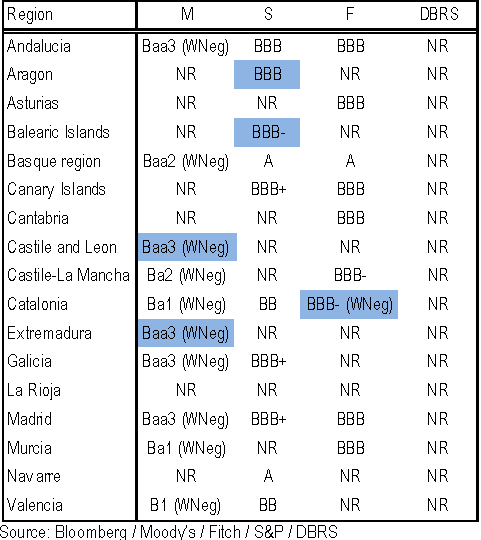
The recent downgrade of Spanish debt by the S&P is not going to have a significant effect on the bonds' eligibility as collateral at the ECB. The ECB takes the best of the four ratings of Moody’s, S&P, Fitch, and DBRS to determine the eligibility for repo collateral. DBRS currently has Spain as A−, making downgrades by other rating agencies irrelevant - for now. Private sector collateral requirements are based on different criteria (h/t Kostas Kalevras), but the impact of the private sector changing collateral requirements will be minimal. That's because Span's banking system is entirely dependent on the ECB for funding (€378 bn borrowed) - and the ECB criteria is what ultimately matters. Even if all the rating agencies (including DBRS) assign junk ratings to Spanish bonds, the ECB would make them eligible automatically as soon as Spain officially requests the bailout - which should be coming soon.

A DBRS downgrade, even by one notch, would however have an impact on haircuts. In the AAA to A- range the haircut is 1.5% for the shorter maturity bonds and 4% for the longer ones. In the BBB+ to BBB- range (DBRS is one notch above that, while the other rating agencies are already there), the equivalent haircuts go up to 6.5% and 9%. It's quite amazing how one relatively small rating agency in Canada has the power to increase the ECB repo haircut requirements by 5% for the whole Spanish banking system.

These relatively loose inclusion criteria by the ECB are only available for central government bonds. Local and regional bonds (the equivalent to municipal bonds in the US) do not qualify for such eligibility framework. The ECB will simply not accept junk-rated regional bonds. Moreover DBRS does not rate many regional bonds in Europe, leaving them exposed to the big three rating agencies.

What makes the situation tricky is that many Spanish banks use regional bonds as collateral at the ECB. And many of these bonds are on the cusp of losing their investment grade status. In fact if Spain's central government bonds are downgraded to junk, the regional debt will get downgraded immediately after. That's because rating agencies typically can not leave regional debt unchanged when the central government bonds have been downgraded (that criteria to some extent applies to banks as well - the S&P followed the downgrade of Spain with downgrades of Banco Santander SA and Banco Bilbao Vizcaya Argentaria, Spain's largest lenders).

As the table below from JPMorgan shows, a number of Spanish regional bonds are already at risk. It means that some Spanish banks may end up with collateral shortage, requiring emergency funding from the Bank of Spain via the ELA program. Rating agency risk remains quite real for Spain and its banking system.

Source: JPMorgan


SoberLook.com

Thursday, October 11, 2012

The Eurozone's commitment to supporting Spanish banks questioned by S&P, others

Kostas Kalevras had another good post on the latest data release from the Bank of Spain (here). The good news is that Spanish banks' borrowings from the ECB fell in September, following the ECB's commitment to do "whatever is necessary" to make sure Spain (and others) stay in the Eurozone - reducing the redenomination risk. Nevertheless the latest data from the nation's banking sector still shows declines in lending and losses associated with rising bad loan balances.

Source: Bank of Spain (here)

The collapsing property market is taking its toll. Much of the "corporate" debt in the chart below represents loans to property developers.

NPL = Non-performing loans (Source: BNP Paribas)

Independent analysts and rating agencies continue to be skeptical about a successful bailout of the Spanish banking system by the Eurozone governments. Estimates of the banking system's capital requirements vary considerably from the official figures, pointing to the fact that funds committed so far may be insufficient. And in spite of the commitments made back in June, not a cent of this aid has reached any of the Spanish banks, as key details of the bailout are sill being negotiated (see discussion).


In fact the S&P's downgrade of Spain's government debt was a direct result of the uncertainty around the use of ESM to support Spanish and other periphery banks.
S&P: - A policy setting framework among the eurozone governments that in our opinion still lacks predictability. Our understanding from recent statements is that the Eurogroup's commitment to break the vicious circle between banks and sovereigns [see post], as announced at a summit on June 29, does not extend to enabling the European Stability Mechanism to recapitalize large ongoing European banks. Our previous assumption (which was a key factor in our decision to affirm our ratings on Spain on Aug. 1, 2012) was that official loans to distressed Spanish financial institutions would eventually be mutualized among eurozone governments and thus Spanish net general government debt would remain below 80% of GDP beyond 2015.
S&P's downgrade was to BBB-, one notch above "junk". The impending Moody's action may not be so kind. With junk status, the use of Spanish bonds as collateral at the ECB will require special approvals while bank holders of such debt will be required to allocate more regulatory capital to these positions.


SoberLook.com

Wednesday, October 3, 2012

55 straight months of job cuts in Spain's service sector

With Spain's recession deepening, the nation's service sector continues to struggle. Service industries such as hotels and restaurants are caught between rising input costs and falling output prices, as margins become compressed.
Markit: - The Spanish service sector ended the third quarter of 2012 deep in contraction territory. Moreover, September data signalled faster reductions in both activity and new orders as the economic crisis in Spain continued. Higher fuel costs contributed to an acceleration in input price inflation to its fastest since July 2011. On the other hand, companies continued to lower their output prices, despite a rise in the rate of VAT limiting the extent to which they were able to do this.

Source: Markit

Driven by sharp declines in demand, employment is Spain's services sector has been hit especially hard. This is the 55th straight month of service jobs losses.
Markit: - With workloads falling, service providers lowered their employment accordingly, extending the current sequence of job cuts to 55 months. The sharpest reduction in staffing levels was at Renting & Business Activities companies, while Hotels & Restaurants was the only sector to take on extra staff.


SoberLook.com
Related Posts Plugin for WordPress, Blogger...
Bookmark this post:
Share on StockTwits
Scoop.it