Showing posts with label gasoline. Show all posts

Sunday, January 4, 2015

Energy price declines not limited to oil

With all the focus on falling crude oil prices (chart below) as well as sharp reductions in the cost of gasoline (including retail), jet fuel, and heating oil, it's easy to miss the fact that prices of other energy products have been hit quite hard as well

Source: barchart

Here are a few examples:

1. US natural gas price declines have been spectacular.

March 2015 futures contract (source: barchart)

Natural gas valuations are of course responding to the correction in oil. But other factors include strong US gas production and the normalization of gas inventories in storage after the harsh 2013-14 winter.


2. Coal prices have fallen sharply as well, particularly for Appalachian coal (see chart). Coal traded in Asia (chart below) has also been under pressure.

Source: barchart

3. Price declines have not been limited to fossil fuels. Even uranium futures have been selling off in spite of rising Japanese demand, as nuclear reactors go back online - see chart.

4. Expectations of weakening profitability for alternative energy sources, including wind and solar, are showing up in the significant share underperformance against the broader markets (which started with declines in crude prices).

          Red = solar shares; Blue = S&P500

           Red = wind energy shares, Blue = S&P500
Source: StockCharts.com

5. With major sources for power generation becoming cheaper, electricity prices (chart below) have declined as well.

January-2015 PJM Monthly On Peak (source: barchart)

As discussed before (see post), this is quite positive for the US (and global) economy. However a number of industries involved with products discussed above will be severely disrupted in 2015, resulting in debt restructuring, consolidation and some job losses.

_________________________________________________________________________


SoberLook.com
Sign up for our daily newsletter called the Daily Shot. It's a quick graphical summary of topics covered here and on Twitter (see overview). Emails are distributed via Freelists.org and are NEVER sold or otherwise shared with anyone.


Wednesday, November 19, 2014

Hidden story in US PPI increase

The US core PPI surprised to the upside yesterday.

Source: Investing.com

Improved pricing power for US firms? Hardly. Did you ever have the feeling of being ripped off at the gas station when oil prices are falling while prices at the pump barely move? Well, it’s not just a feeling.
GS: - The headline PPI rose 0.2% in October (vs. consensus -0.1%). The surprise was entirely due to core prices, which rose 0.4% (vs. consensus +0.1%), while energy prices declined 3.0%. Within the core, the volatile trade services category—which measures retail and wholesale margins—rose 1.5%, adding three-tenths to the core. Drilling down further, a sizable part of the jump in trade services came from a huge 26% month-on-month increase in fuel retail margins (i.e., gasoline stations). While counterintuitive in light of the decline in energy prices on the month, the increase in this category reflects retail prices declining more slowly than wholesale prices. On balance, we would heavily discount this month's report in light of the volatility in trade services. The core PPI according to the "old methodology"—finished goods less food and energy—increased a more modest 0.1%.
_________________________________________________________________________


SoberLook.com
Sign up for our daily newsletter called the Daily Shot. It's a quick graphical summary of topics covered here and on Twitter (see overview). Emails are distributed via Freelists.org and are NEVER sold or otherwise shared with anyone.


Sunday, October 19, 2014

The good, the bad and the ugly of falling energy prices

The recent correction in the price of crude oil should have an immediate positive impact on the US consumer as well as on a number of business sectors. However there also may be a significant economic downside to this adjustment. Here are some facts to consider.

1. The good:

The US consumer is not only about to benefit from materially lower gasoline prices (see chart), but also from cheaper heating oil.
Source: barchart

With wages suppressed, the savings could be quite impactful, particularly for families with incomes below $50K per year.
Merrill Lynch: - ... consumers will likely respond quickly to the saving in energy costs. Many families live “hand to mouth”, spending whatever income is available. The Survey of Consumer Finances found that 47% of families had no savings in 2013, up from 44% in the more healthy 2004 economy. Over time, energy costs have become a much bigger part of budgets for low income families. In 2012, families with income below $50,000 spent an average of 21.4% of their income on energy. This is almost double the share in 2001, and it is almost triple the share for families with income above $50,000.
Source: Merrill Lynch

Furthermore, with gasoline prices lower, it is unlikely that consumers will be buying significantly more of it than they have been. Historically when oil prices fell, gasoline consumption in dollar terms also fell. Dollars saved on fuel will be redirected elsewhere in the economy.

Source: Scotiabank

Moreover, suppressed oil prices will, at least in the near-term, keep inflation expectations lower. That means lower short-term rates for longer (see chart) and therefore lower home equity and adjustable rate mortgage monthly payments. It also means lower longer-term rates and cheaper fixed rate mortgages (see chart). We may even see some new refi activity.

Other benefits include cheaper transport (potentially lower travel costs) and shipping costs (lower UPS/Fedex surcharges), as well as cheaper PVC, nylon, polyester, foam, etc. - all of which should benefit the consumer.

2. The bad:

The US has become a major energy producer, with the sector partially responsible for improving economic growth and lower unemployment in recent years. As an example here is the GDP of Texas as a percentage of the US GDP. This trend is driven in part by the recent energy boom in the state.

Source: @M_McDonough

If oil prices remain under pressure, this boom could soon be in jeopardy. While large US energy companies are sitting on a great deal of cash, at some point they will begin to cut portions of the higher cost development and production. And private investment into energy and oil services firms, which has been brisk lately, is likely to moderate. For example, here is the private debt and equity capital flowing into various states last month.

Source: CAZ Investments

While, only a portion of the funds going to Texas is directly energy related, various other Texas firms funded by PE (including some real estate, manufacturing and financial companies) have been benefiting from the energy boom. Soon that flow of private capital may slow dramatically.

To put this into perspective, here are the jobs directly generated from Texas oil and gas extraction in recent years. And this does not include the thousands of jobs that support this industry. Such trend is unlikely to continue if oil prices remain at current levels or fall further.


In fact, while the overall industrial production growth in the US has been strong recently (see chart), a big portion of the gains are energy driven (see chart from Lee Adler). A slowdown in that sector will be quite visible across the US.

3. The ugly:

A significant number of middle market energy firms in the US - many funded via private capital (above) - are highly leveraged. The leveraged finance markets are becoming quite concerned about the situation - even for larger firms with traded debt. Here is the yield spread between the energy sector loans in the Credit Suisse Leveraged Loan Index and the index as a whole.

Source: Credit Suisse

Rumors have been circulating of a number of energy (and related services) firms getting ready to "restructure". There are also stories that some large funds are gearing up to scoop up distressed debt of levered energy firms. However, in spite of the ample liquidity out there, bets on companies with significant commodity exposure will be limited going forward - at least until stability returns to the oil markets. Defaults, layoffs, and cancelled projects in the energy space may be in store in the near-term. And that is sure to have a negative impact on the US labor markets and the economy as a whole.

Finally, this is terrible news for the development of alternative energy sources. At these prices, fossil fuels are becoming increasingly difficult to compete with.

___________________________________________________________


SoberLook.com
Sign up for our daily newsletter called the Daily Shot. It's a quick graphical summary of topics covered here and on Twitter (see overview). Emails are distributed via Freelists.org and are NEVER sold or otherwise shared with anyone.


From our sponsor:

Friday, April 11, 2014

Shifting bottlenecks in US energy markets

With the startup of TransCanada's Cushing Marketlink pipeline and increased rail shipping of crude directly to the US Gulf Coast (bypassing Cushing, Oklahoma), a new dynamic in the US energy markets is taking shape. The glut of crude at Cushing (see post form 2012) that used to put downward pressure on WTI is over.


With the transport backlog to the Gulf Coast diminishing, crude supplies at Cushing (the delivery point for WTI futures) fell significantly, once again contributing to tighter Brent-WTI spread. Lower supplies at Cushing raised WTI prices while Libya resuming crude exports lowered Brent prices.

Brent-WTI spread (source: Ycharts)

This development however created another bottleneck. The oversupply of crude has shifted from Oklahoma to the US Gulf Coast.

Source: EIA

Bloomberg: - Houston and the rest of the U.S. Gulf Coast have more crude oil than the region can handle. Stockpiles in the region centered on Houston and stretching to New Mexico in the west and Alabama in the east rose to 202 million barrels in the week ended April 4, the most on record, Energy Information Administration data released yesterday show.
One of the key issues is the US crude oil export restriction. Back in the 70s, the US Congress made it illegal to export domestically produced crude oil without a permit. And permits are tough to get these days, given how unpopular the notion of US oil exports seems to be. The Jones Act which restricts shipping among US ports is also adding to the bottleneck. 
Bloomberg: - Storage tanks are filling as new pipelines carry light, sweet oil found in shale formations to the coast and U.S. law keeps companies from moving it out. Most crude exports are banned and the 13 ships that can legally move oil between U.S. ports are booked solid. The federal Jones Act restricts domestic seaborne trade to vessels owned, flagged and built in the U.S. and crewed by citizens.
Now it's the refineries who will need to clear this inventory and ultimately export the excess product. And that's exactly what is taking place currently, as idle US refining capacity hits a multi-year low.

Source: EIA

SoberLook.com
From our sponsor:

Wednesday, January 1, 2014

US refineries' production hits a record; reasons for the increase misunderstood

During the month of December large money managers have been once again beefing up their long bets on crude oil.

This chart shows only the "large spec" net positions for WTI futures
Bloomberg: - Hedge funds increased bullish bets on crude oil to the highest level in three months as stockpiles dropped and the U.S. economy expanded more than forecast.

Money managers raised net-long positions, or wagers on rising prices for West Texas Intermediate crude, by 4.4 percent in the week ended Dec. 24, U.S. Commodity Futures Trading Commission data show. It was the fourth consecutive increase, the longest streak since July.
What's driving this push into crude? The media focus has been on the recent sharp decline in supplies, which some have attributed to improving economic conditions in the US.

Source: EIA
While the US economy is certainly showing signs of improvement, there is more to this story than the domestic demand for energy. This drawdown in crude was the result of US refineries firing on all cylinders, particularly in the Gulf Coast states. In fact refinery inputs have hit a new record.

Source: EIA

As discussed earlier (see post), US energy firms can export gasoline and jet fuel abroad but are restricted from easily exporting US crude. With domestic crude production at recent record levels (see Twitter chart), refining and selling abroad is the name of the game. And that is benefiting the US refinery sector. Just take a look at the outperformance of Valero Energy Corporation (VLO).

Blue = VLO, Red = S&P500

The mass media is looking for simple answers for these rising long bets and stronger prices on crude oil.
The Columbus Dispatch: - Oil finished the year with a gain of 7 percent with much of the gain coming this month on signs that an improving U.S. economy is leading to greater demand for gasoline and diesel fuel.
But the "US growth" explanation is not accurate. Over the past several years, US exports of refined products have tripled, going from about a million barrels per day to over 3 million. And bets on WTI crude are more about increased refinery capacity in the US and the resulting growth in exports.


SoberLook.com
From our sponsor:

Friday, November 29, 2013

Brent-WTI spread widens again as the discount shifts to the Gulf for the first time

The spread between crude oil traded in the international markets and the US benchmark, the so-called Brent-WTI spread has blown out once again. It's now approaching levels not seen since February.


What's going on? What happened to the Goldman's forecast of convergence between the two indices, as more US crude is pumped from the Midwest toward the Gulf of Mexico (see post)? In the past the bottleneck was in moving growing US supplies from Cushing, Oklahoma (where WTI settles) to the Gulf. While that problem has been at least partially solved, the oversupply of crude now simply shifted from Oklahoma to Louisiana.
FT: - Surging shale oil production along with severe restrictions on exports has led the US oil market to diverge from the global market in recent years. This week US benchmark West Texas Intermediate crude fell to a five month low of $91.77 per barrel, almost $20 per barrel less than the global marker Brent.

But until recent months infrastructure constraints have made it costly to move oil from inland shale formations to the country’s main refining hubs in Texas and Louisiana, limiting the benefits of low prices to the wider US economy. With more oil now able to flow through pipelines, the Gulf Coast market is also diverging from Brent. On Thursday, Louisiana Light Sweet, the Gulf Coast benchmark, hit a low for the year of $95.30 per barrel. Its discount of $16.01 per barrel to Brent, was easily the highest on record in Reuters data going back twenty years. Traditionally LLS has traded at a premium to Brent, reflecting its superior quality and the cost of shipping to the US.

Source: EIA

Surely at these spreads it is worth shipping US crude from Louisiana to Europe to sell at Brent spot prices. After all, US crude is of the quality that Europe needs (vs. the heavy Saudi crude). It's not so simple however. Back in the 70s, the US Congress made it illegal to export domestically produced crude oil without a permit. And permits are tough to get these days, given how unpopular the notion of US oil export seems to be. So much for the concept of "free trade". Instead US crude oil inventory continues to grow, widening Brent-WTI spread, as domestic production expands.

Source: EIA

And while there is a restriction on crude exports out of the US, selling refined products such as jet fuel and gasoline abroad is allowed.
FT: - The low prices are a boon to Gulf Coast refiners, which can pick up crudes at low local prices and then sell refined, products such as gasoline and diesel, which can be exported from the US freely, into the international market at high prices.

At about 3m barrels a day, exports of finished petroleum products from the US are running at three times the rate of eight years ago, according to US government data.
These changing dynamics in the US energy markets are having two major effects:

1. US refineries are loving this. The government is holding down domestic crude prices by limiting exports, while allowing refiners to sell as much gasoline abroad as they want. Refined products abroad are generally priced based on Brent, allowing the refineries to capture the spread. In effect the US government is subsidizing the refining business at the expense of crude oil producers. And here is how the stock market is reacting to these recent price changes.

TSO = Tesoro Corporation, a major refiner; XLE = diversified energy index ETF

2. This is putting pressure on nations who traditionally sell crude to the US. While in the past they were able to sell their crude close to international prices, they now get paid much less due to Louisiana Light Sweet becoming significantly cheaper than Brent.
FT: - Imports to the Gulf Coast tend to be priced off local benchmarks including LLS and the Argus sour crude index, a basket of four heavier Gulf Coast crudes. With Gulf Coast prices falling, exporters such as Saudi Arabia and Venezuela are receiving less revenue for their sales into the US.

The discounts of US crude show no sign of ebbing with oil inventories continuing to rise as production grows, and many refineries remaining closed for maintenance.
Needless to say, these nations are not happy with the US as they now have to find alternate buyers in order to get the full price for their product. And many in the US are quite happy with this outcome.

When Louisiana crude was trading at a premium to Brent, analysts thought that by improving the transport system from Oklahoma to the Gulf will eliminate the Brent-WTI spread. Instead it simply shifted the discount further "downstream". And with that came other unintended consequences that often result from uneven regulation.

SoberLook.com
From our sponsor:

Wednesday, July 17, 2013

Why crude oil inventories continue to decline?

US crude oil inventories fell sharply for a third week in a row, dipping materially below the levels from the same time last year. As a result WTI crude price remains firmly above $106.

Source: EIA

This drop in supplies is surprising because US crude production has recently spiked.
BW: - U.S. crude inventories were forecast to decrease by 2 million in the week ended July 12, according to a Bloomberg News survey of analysts. Stockpiles dropped more than three times that much, even as production surged to the highest since December 1990. The supply gain was offset as refineries processed 16.2 million barrels a day, the most since August 2005...
US refineries, particularly in the Gulf Coast, are operating near full throttle. While this time of the year is peak production for refineries, this year's crude oil demand is clearly outstripping last summer's. And the nation's inadequate oil transport system is not helping matters.

Source: EIA
EIA: - Crude runs at U.S. refineries have increased steadily since early March to reach some of the highest levels on record. At 16.1 million barrels per day (bbl/d) for the week ending July 5, U.S. crude oil runs were the highest for any week since 2007. This level represented a 2.1-million-bbl/d increase from the first week of March, the low point for the first six months of 2013. While the increase in crude runs since March reflects a particularly strong rebound from spring maintenance, an underlying combination of recent refinery capacity expansions and relatively healthy margins helped drive the absolute level of runs to a multiyear high.
As the EIA points out, the refinery demand is driven by larger capacity and "healthy margins". Indeed the gasoline to Brent spread is near a multi-year record. At these levels refineries are quite profitable and will try to sell as much gasoline as possible.


SoberLook.com
From our sponsor:

Friday, July 12, 2013

Watch gasoline futures prices

US fuel prices continue to rise. August NYMEX gasoline futures price cleared $3/gal a couple of days ago and is now at the highest level for 2013.

August gasoline futures

This introduces two new challenges for the US economy:

1. Fuel prices tend to influence consumer sentiment and spending. The sentiment is not necessarily linked to how much consumers actually spend on fuel, but more to the psychology of seeing a sudden spike in this index that most Americans see on a daily basis. And improvements in US consumer sentiment have already stalled recently.
Bloomberg: - The Thomson Reuters/University of Michigan preliminary index of consumer sentiment decreased to 83.9 in July from 84.1 the month prior, today’s report showed. The median forecast in a Bloomberg survey called for a gain to 84.7. The gauge reached an almost six-year high of 84.5 in May.  The recent increases in mortgage rates and prices at the gas pump may have restrained consumers’ views on the economy in the next six months.
This result is supported by another indicator, the Gallup U.S. Economic Confidence Index.
Gallup: - ... U.S. Economic Confidence Index was -9 for the week ending July 7, on par with scores from the past month. The index has been slightly lower since reaching a five-year weekly high of -3 in late May and early June. Still, confidence has generally improved from levels Gallup has measured over the past five years.

The relatively lower levels of confidence in June and early July may be a result of more volatility in U.S. stock prices and a stubborn unemployment rate.
While consumer confidence remains near post-recession highs, the recent slowdown in improvements could become exacerbated by rising fuel costs in July.

2. Today we've seen the producer price index unexpectedly move up due to higher energy costs.
USA Today: - A big jump in gasoline prices pushed wholesale inflation up in June by the largest amount in nine months. But underlying inflation showed only a modest gain.

Wholesale prices rose 0.8% in June compared with May when prices had risen 0.5%, the Labor Department reported Friday. It was the biggest gain since a 1% jump in September and was driven by a 7.2% surge in gasoline prices.
Keep in mind they are talking about June gasoline prices in this report. Now take a look at the chart above and compare it to the levels for July. It doesn't bode well for the July headline PPI number, which could begin to eat into corporate margins.


SoberLook.com
From our sponsor:

Wednesday, July 10, 2013

Rising refinery demand and a challenged delivery system

US crude oil inventory unexpectedly declined again (see post) last week, driven by a particularly strong refinery demand in the Gulf Coast.

Source: EIA

Gasoline demand has been stronger than expected recently and the refineries are trying to keep up.

Source: EIA

WTI crude futures jumped in response, with gasoline futures following, and prices at the pump expected to rise in the next few days.

WTI 1st nearby (source: Barchart)

This strong refinery demand and higher prices will increase pressure on firms to deliver more crude to the Gulf Coast. While certain pipeline projects have been instrumental in supplying the market with more crude, a good chunk of the delivery in North America has been via rail.


But after the horrific train accident in Quebec this weekend (the train was bringing US crude to a Canadian refinery) we will likely see new political pressure on rail transport firms, potentially resulting in lower volumes and/or more expensive delivery.
BW: - The question now is whether the devastating accident will poison the oil industry’s burgeoning love affair with the railroads. Since 2011, billions have been invested by refiners, railroads, and oil and gas companies to extend existing tracks into the mouths of refineries on the coasts. According to analysis done by Citigroup, the amount of oil that refiners are able to take from trains increased by a factor of 16 from 2011 to 2013. Just three years ago, refineries along the Gulf Coast were able to take delivery of only about 85,000 barrels of oil per day by rail. By the end of this year, refineries on all three coasts (East, West, and the Gulf) will be able to take 1.4 million barrels of oil per day.
With the pipeline system clearly inadequate to meet this already massive and rising demand, could a slowdown in rail delivery force fuel prices higher? Also is this potentially a game changer for the Keystone XL project, as "pipeline vs. rail" environmental impact may now be reconsidered? Whatever the case, this rising demand in the Gulf Coast will be important to watch for signs of shortages that could result in much higher prices at the pump.


SoberLook.com
From our sponsor:

Friday, May 24, 2013

Relief for Memorial Day drivers

US gasoline prices have been on the rise, as peak diving season approaches while a number of refineries have been undergoing scheduled and unscheduled maintenance. The price increases have been particularly acute in the Midwest.

Source IEA, May 24th, 2013
EIA: - Higher gasoline prices in the Midwest largely reflect supply constraints stemming from decreased refinery runs and lower-than-normal gasoline inventories. Refinery utilization in the

Midwest has fallen steadily since the start of 2013, and is now about 83 percent of capacity, below the U.S. average of 87 percent. As of May 17, Midwestern gross refinery inputs were averaging 279,000 barrels per day (bbl/d) lower than at the start of the year. The reduction in runs reflects a combination of routine seasonal turnaround and maintenance activity, unplanned outages, and longer-term upgrading initiatives
But it seems that in spite of these constraints, price increases - at least at the national level - have stopped.

Source: Gasbuddy.com

This is the result of a recent surprisingly sharp increase in the national gasoline stocks, with supplies now running above the 5-year range for this time of the year. And that should provide some relief for Memorial Day drivers as prices stabilize or even decline.

Source: DB


SoberLook.com
From our sponsor:

Sunday, February 17, 2013

Americans face more bad news at the gas pump

As gasoline prices rise above $5/gallon in LA (see video below), analysts are puzzled. Gasoline prices have been on the rise for the past 31 days, which is highly unusual for this time of the year. Typically prices begin rising in March or April as the driving season kicks off.


The price increases are particularly puzzling, given the fact that US gasoline markets have been well supplied relative to historical levels.

Source: EIA

Certainly the recent increases in crude oil prices have been a large part of the explanation. Some have suggested that increased demand due to stronger global economic activity is to blame. Other reasons have been proposed as well.
CNN: - What's behind the higher prices at the pump? It's a confluence of factors, from rising crude oil prices, to production cuts and refinery closings.

"Right now, things are tight worldwide," said Ray Carbone, president of New York commodities trading firm Paramount Options. "Refineries going down, unanticipated maintenance, and higher demand ... going into driving season.
Gasoline futures trading on NYMEX (CME) have been rising almost daily, pointing to even higher prices at the pump in the spring.

Source: CME

This is clearly going to create headwinds for consumer sentiment and ultimately spending patterns, particularly when combined with other issues consumers are facing this year.
CNN: - It's hitting wallets right in the middle of winter, when people are already looking at large home heating bills. And it comes just after many Americans have been hit with smaller paychecks, and are worried about looming budget cuts that could deliver an even deeper blow.

SoberLook.com
From our sponsor:

Friday, February 8, 2013

Gasoline prices on the rise; may pose risk to consumer sentiment

As the winter storm pounded the Northeastern United States today, gasoline futures hit another high. The March delivery contract broke $3.06, indicating that retail prices for fuel will be going up.

March 2013 gasoline contract

Already prices at the pump are the highest for this time of year.
CNBC: - Nationally, retail gasoline prices have soared 11 cents in a week and nearly 30 cents in a month to $3.57 a gallon on Friday, according to AAA. Pump prices are the highest on record for early February, and are rising the fastest along the coasts.

The state-wide average price of gasoline in New York is $3.92 a gallon and California gas prices on average have now surpassed the $4-a-gallon mark.
Increased demand from abroad, stronger crude prices, and some refinery shutdowns are all contributing to higher prices.
MarketWatch: - Consumers haven’t even seen the worst, with a perfect storm of factors driving higher prices.

Many of the issues lifting fuel prices higher are common, but they “seem to have combined at the right time,” said Matt Tormollen, president and chief executive officer at FuelQuest, a Houston-based fuel management software provider.

Typically at this time of year, refineries begin their switch to the more environmentally-friendly summer-blend gasoline and perform maintenance, which “temporarily restricts supply and drives up prices,” he said.

Some refineries have also announced unexpected shutdowns or closings, leading to even tighter refining capacity, said Jeff Lenard, a spokesman at the National Association of Convenience Stores (NACS), a trade group for an industry that sells 80% of the nation’s gasoline.

Late last month, Hess Corp. HES +1.23% said it would close its Port Reading, N.J., refinery by the end of February, completing its exit from the refining business. See Jan. 28 story on the rally in Hess shares.
And of course the Fed's recent activities are not helping the situation either (discussed here). Ultimately this trend of rising fuel prices, combined with the possibility of higher taxes in the future, constitutes the biggest risk to US consumer sentiment and spending.


SoberLook.com
From our sponsor:

Monday, January 21, 2013

Elevated energy prices pose a threat to US recovery

Gasoline prices could create headwinds for US economic recovery. The recent sharp rise in gasoline inventories (below) was thought to provide some relief to the consumer by bringing down fuel prices - at least in the near-term.

Source: EIA

But in spite of adequate supplies, prices remain elevated. This is driven by firm crude oil prices as well as demand for distillates from outside the US. Furthermore, the Fed's monetary policy is not helping matters.

March 2013 gasoline futures contract (source: Barchart.com)

In fact Econoday is attributing - at least in part - the unexpected weakness in Jan-2013 consumer sentiment to elevated energy prices.
 
Econoday: - Consumer sentiment is flat at soft levels. January's mid-month reading of 71.3 is down 1.6 points from the full month reading for December and compares with a low 70s trend during the latter part of December. Expectations continue to slip, down 1.1 points to 62.7 which is the lowest reading for this component since the aftermath of the debt-ceiling battle in 2011. Current conditions, which had been holding up better than expectations, are showing noticeable weakness, falling 3.7 points in December and another 2.2 points so far this month to 84.8. Today's decline in current conditions is not a positive signal for January's slate of economic data.

Oil prices are climbing and the consumer isn't ignoring it. One-year inflation expectations are up two tenths to 3.4 percent. 
Let's hope the FOMC is paying attention.


SoberLook.com
From our sponsor:

Sunday, November 18, 2012

Ethanol industry struggling; saved by the Obama administration

Ethanol producers got a reprieve from the Obama administration, as the requests to halt ethanol blending were denied.
Businessweek: - Ethanol’s discount to gasoline narrowed after the Obama administration rejected requests to waive requirements for blending the fuels.

Ethanol rose 1.6 cents, or 0.7 percent, to $2.351 a gallon on the Chicago Board of Trade, contracting the additive’s discount to gasoline to 35.91 cents a gallon from 36.12 cents yesterday, based on December futures prices. Gasoline’s premium was 99.8 cents on Sept. 28.
As it is, ethanol producers are losing money this year due to elevated corn prices (see discussion). Production is down 14% from last year, which is showing up in declining ethanol inventories.


Source: EIA

Without this support from the Obama administration, ethanol firms would have been decimated. But regulation is keeping this industry alive - for now.
Businessweek - Based on December contracts for corn and ethanol, producers are losing 29 cents on each gallon of the fuel made, up from 28 cents yesterday, excluding the revenue that can be made from the sale of dried distillers’ grains, a byproduct of ethanol production that can be fed to livestock, data compiled by Bloomberg show.

Ethanol companies would have been decimated if the EPA granted the waiver request, Kitt said. “You could really hurt the market here,” Kitt said. “It would wipe you out.”


SoberLook.com

Sunday, October 14, 2012

Rising US crude oil production is not translating into more gasoline and heating oil for US consumers

US domestic crude oil production is continuing to rise. After a slowdown in September it hit a new record according to latest data from EIA.

Source: EIA

That is keeping the US crude oil inventory above the 5-year range for this time of year. Crude market in the US is well-supplied.

Source: EIA

But those who expect these strong supply fundamentals for crude oil in the US to translate into lower fuel costs for consumers will have to wait. Gasoline stocks are at the low end of the range, keeping gas prices at the pump elevated.


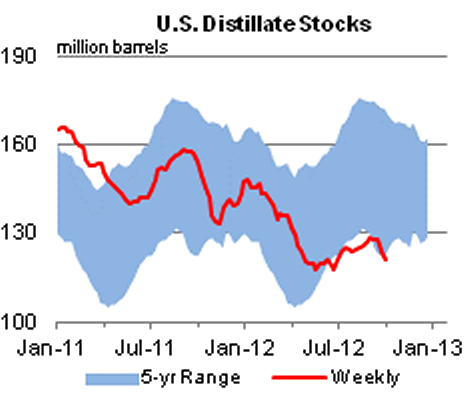
Distillates stocks (jet fuel, heating oil, etc.) are in even worse shape - below the 5-year range.


This imbalance of crude vs. refined products supplies keeps crack spreads wide, making US refineries (such as Tesoro for example - see this story from Reuters) a great deal of money. But it is not good news for the cash-strapped US consumer. In fact in some areas of the country fuel shortages have been downright painful. We've discussed the elevated gasoline prices on the West Coast (see post). Now tight heating oil supplies in the North East could pose serious problems if we return to a more seasonal NE winter weather.


Things could get particularly tough in NY State because of new regulation.
EIA: - Market tightness could be exacerbated by a regulatory change in New York state, which starting this heating season limits the sulfur content of home heating oil to 15 parts per million (ppm), matching the sulfur content limit for ultra-low sulfur diesel fuel (ULSD). This change results in an estimated additional 70,000 barrels per day (bbl/d) of ULSD demand on an annual basis, but in times of peak demand - such as during sustained cold temperatures - could be as high as 170,000 bbl/d.
So how is it that with these extra supplies of crude oil, the US is not building adequate stocks in gasoline and distillate fuels? The answer to a large extent has to do with exports. Distillate stocks are at low levels globally, which increases incentives for US refineries to export fuel to other countries.
EIA: - The tightness in global distillate markets is reflected in both the futures market prices and inventory levels in the United States. While U.S. distillate production is high, the global supply-demand balance for distillate fuels has created a price structure that has not encouraged inventory builds. In recent weeks, prompt prices for distillate fuel have risen compared to prices for fuel delivered in future months. For the week ending October 5, distillate inventories in the U.S. Northeast were 28.3 million barrels, about 21.5 million barrels (43 percent) below their five-year average level. Distillate inventories have historically been used to meet normal winter heating demand but are also an important source of supply when demand surges as a result of unexpected or extreme cold spells. The low distillate inventories could contribute to heating oil price volatility this winter. 

Source: EIA

Once again this dispels the old myth that if the US becomes "energy independent", fuel prices at the consumer level will be lower. Liquid fuels trade in global markets and are therefore driven by global supply/demand fundamentals.


SoberLook.com
Related Posts Plugin for WordPress, Blogger...
Bookmark this post:
Share on StockTwits
Scoop.it