Showing posts with label HYG. Show all posts

Sunday, November 18, 2012

HY markets hit by outflows; correction likely short-leved

As credit markets sold off last week (see discussion), high yield bond funds saw the largest outflows since this summer (during the market squeeze on Spain). HYG, the HY ETF alone saw a $219 mm worth of shares outflow in a single day.

Click to expand (source: JPMorgan)

This was a much needed adjustment to put some risk back into the market that has been frothy for quite some time now (see discussion from August - of course at the time a number of financial journalists professed that HY was still cheap).

Alex Dumortier of the the Motley Fool had a great chart showing the narrowing of HY vs. S&P500 outperformance. There is clearly a limit to how much the two markets can diverge.

Source: Motley Fool

This correction however will likely be short-lived, given the ramp up of the Fed's balance sheet expansion program. It's not as much about the fundamentals as it is about the supply. The reduction of spread product available in the market via MBS purchases and extraordinarily low rates will provide support to credit markets in general and the higher quality HY paper in particular (in spite of record issuance).


SoberLook.com

Tuesday, September 25, 2012

Credit markets reversing post-QE3 euphoria

In a sharp correction during the past couple of days the HY bond market erased most of the post-QE3 announcement gains. As discussed before (see post), it was clear that the HY marked was frothy going into the Fed meeting, and now asset allocators are starting to come to grips with the fact that it's gotten even richer. HY CDX and HY ETFs (HYG, JNK) sold off sharply (HY CDX is down 2% in the past 2 days).


The realization is setting in that the Fed bringing mortgage rates to new lows (national average is now at an all-time low of 3.46%) is going to do little to improve the US economy (see discussion) and corporate profits. And some of the Fed members agree with this assessment.
MarketWatch: - “We are unlikely to see much benefit to growth or employment from further asset purchases,” said Charles Plosser, the president of the Philadelphia Fed Bank, in a speech to financial market trade groups in Philadelphia.
The reversal in the credit markets is also visible in the investment grade space. IG CDX has reversed most of the QE3-driven tightening.

IG CDX spread (Bloomberg)

No matter how much MBS the Fed buys, monetary expansion is unlikely to help Caterpillar for example. And markets are starting to get the point.
NASDAQ: - Caterpillar Inc. (CAT ), the world's largest manufacturer of construction and mining equipment, recently joined the bandwagon of companies who have trimmed their revenue and earnings expectations in the wake of weaker-than-expected growth in the global economy. This news led to a 2.4% fall in Caterpillar share prices to $88.73 in after-hours trading.


SoberLook.com

Saturday, July 21, 2012

Lack of product, cash on the sidelines, and low rates, all driving HY valuations to new highs

What's creating the frothy market that allows companies that normally would turn to VC funding to use HY debt markets instead? The answer turns out to be lack of product, rising cash on the sidelines, and low rates combined with demand for income.

As discussed earlier, based on JPMorgan's analysis there is simply not enough net new issuance to meet the demand. The chart below shows that year-to-date high yield and institutional leveraged loan issuance has been below last year's volume.

Source: LCD

And cash allocated to the HY asset class is accumulating - in search for new product.
Source: Credit Suisse
CS: - After a quiet few months of issuance combined with additional retail demand, we believe the proverbial cash-on-the sidelines is sitting at one-year highs and creates a very positive tailwind in the HY asset class buffering it from a negative macro backdrop.
In another sign of strong demand, shares outstanding of BlackRock's iShares iBoxx $ High Yield Corporate Bond Fund ETF (HYG) resumed their climb, hitting another record. HYG assets are now close to $15bn as retail cash pours in.

HYG shares outstanding

Extraordinarily low interest rates and the need for income are also contributing to this demand.
JPMorgan: - With the recent drop in high-yield bond [yields] (7.28%) and loan yields (6.55%) to fresh 2-month lows and high-grade bond yields also falling further this week to record lows (3.67%), the performance of credit highlights investors’ affinity for income and stability as a highly uncertain global economic landscape continues to develop.
These factors are driving the HY bond valuations to new highs, allowing companies to obtain ridiculously cheap financing. And corporations are jumping in to grab this funding while the going is good.

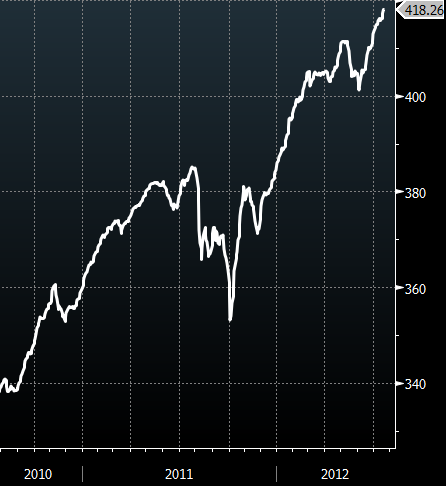
JPMorgan HY Total Return Index


SoberLook.com

Wednesday, May 16, 2012

Europeans also love junk bonds

The historically low rate environment has sent US fixed income investors scrambling for yield, willing to accept a 6-handle coupon on HY new issue bonds. And it's not just the institutional investors. HY ETFs and mutual funds have had quite a run. HYG ETF number of shares outstanding is still at a record high as Wall Street churns more paper to keep up with investor demand. The market looks overbought.

HYG shares outstanding

What's surprising however is that the Europeans are also in love with non-investment grade corporate paper. The latest survey of European fixed income investors asked for their most and least favored investment choice. Here is what they got back:

Most and least favored investment choice (source: Fitch - European Senior Fixed-Income Investor Survey Q212; click to enlarge)

It is no surprise that they all hate developed market sovereign debt. The largest number of "most favored" went to the "speculative grade" asset class. It's not clear this is such a wise choice, given the Eurozone-wide recession. But with German government yields even lower than those in the US, European investors are faced with the same dilemma as their US counterparts. And the chase for yield continues - even in Europe.

SoberLook.com

Saturday, April 21, 2012

Are fixed income ETFs the new "securitization" product?

Larry Fink of BlackRock must be cracking open the Champagne again. The BlackRock junk bond ETF (HYG) has hit another record in shares outstanding. HYG market cap is now approaching $15bn, generating substantial fees for BlackRock. And Fink's banker friends should be quite happy as well. Not only do they make money creating new HYG shares and capturing the premium, but HYG and other HY ETFs are gobbling up new issue HY bonds at record low yields, generating fees for banks. Plus all the brokerage fees, advisory services, and custody. The sausage factory is in full swing.

How banks generate fees on ETFs
Wall Street has found the new "securitization" machine - with or without leverage.
BW: There's no relief in sight for those feeling overwhelmed, as a wave of new fixed-income ETFs reaches investors. Until recently, bond ETF pickings were pretty slim, but fund giants such as BlackRock are busy slicing and dicing fixed-income securities into tightly targeted offerings. Since 2009, the number of bond ETFs has risen from 52 to 191, and more wait in the wings.
As liquidity continues to increase (see M2 chart below - nearing $10 trillion) and rates stay near zero, demand for this product is climbing rapidly. Maybe it is time to ask the question: are we building another bubble with fixed income ETFs?


Fixed income historical ETF performance has certainly been very good in the past two years, but it is clearly a key area to watch for signs of "froth".

Fixed income ETFs total returns over the past two years  (not annualized)

In the mean time retail cash continues to flow in, with $125mm coming into HYG on Friday alone. HYG advertises around a 7% yield to maturity, attracting retail investors chasing yield. But the actual yield will be considerably worse because a number of bonds are expected be called and refinanced at lower yields ("yield to worst" is much lower than yield to maturity). Expected returns are shrinking as they did 7 years ago with structured credit.

HYG shares outstanding (Bloomberg)


SoberLook.com

Friday, April 13, 2012

Year's first outflows from HY bond funds

It was only a matter of time before the extraordinarily strong inflows into high yield bond funds came to an end. This past week saw the first net outflows out of HY this year - about $1.4bn of outflows all in.

HY fund flows

Typically ETFs (such as HYG or JNK) have been the bigger drivers of HY flows recently. But this past week it's the mutual funds that dominated the outflows. Mutual funds are generally considered to be less of a "fast money" investor than ETFs, suggesting that the outflows maybe more enduring.

Source: EPFR

The JPMorgan HY index shows that spreads on HY bonds have widened out by some 35bp from the lows back in March. The days of US leveraged companies issuing BB bonds at 6.3% may be over for a while.

SoberLook.com

Friday, January 27, 2012

The fundamentals behind strong HY fund flows

Following up on the post about HY fund flows, the amount of new cash hitting the system has not only been unusually high, but also consistent on a daily basis.  As the chart below shows, we only saw one day of net outflows.


Source: EPFR

Here is the year-to-date cumulative net inflow ($7.4 bn YTD.)

Source: EPFR

It is clear that zero rates is one reason for these inflows, but what about fundamentals of the HY market? Are they really that attractive? Three items driving fundamentals are worth mentioning:

1. Defaults continue to stay near record lows and spreads seem interesting on a relative basis.

Source: JPMorgan

2. Leverage on in HY corporations in the US remains stable.

Source: JPMorgan

3. US corporations' liquidity, even at leveraged companies, has been rising steadily in the last few months (hat tip Royal Arse)

Source: JPMorgan

But even with these strong fundamentals, the speed of inflows we are seeing is unlikely to be sustained for long. The trend is somewhat troubling because a good portion of these flows is coming from retail investors. Some of the more leveraged names, particularly in the CCC range are still quite vulnerable to global economic shocks. Given the recent rally (the US JPM HY Index is up 2.8% YTD), the overall sector could sell off sharply with a sudden surprise out of Europe.


SoberLook.com

Thursday, January 26, 2012

The chase for yield is on

The US high yield (HY) market is starting to look somewhat frothy. We've had over $7 billion of fund inflows this month with $2.5 billion this week alone. Of the $2.5bn, roughly $1.5bn went into HY mutual funds and $1bn into HY ETFs. That compares to about half a billion into mortgage-backed bond funds and $700mm into muni funds (according to EPFR Global). With the Fed on hold for a while, investors are chasing yield.

For HYG (HY ETF) for example, the growth in the number of shares has been unprecedented, and the ETF again now trades at a 2% premium.

HYG Shares Outstanding (Bloomberg)

One can also see rising risk appetite in the HY primary market as well.  Some new issues that hit the market are quite risky.  For example Realogy, a company that nobody would look at a month ago, comfortably sold new bonds.
LCD News: Realogy's return to market was met with strong demand, with both tranches of secured notes pricing tight to talk, and the paper is volatile this morning in post-break trading. The 9% intermediate-lien notes due 2020, for instance, are pegged at 100/100.25 in the Street, against a break around 101 and trades earlier this morning at 100.375, according to sources. Pricing was at par.

Realogy's 7.625% notes due 2020 also priced at par, and this morning's markets are generally at 100.5/101, sources said. Meanwhile, the previously outstanding 11.5% exchange notes due 2017 are trading at 95.75 this morning, versus 95 yesterday but 90 before the new issue hit the market, trade data show.
The company is highly leveraged and is extremely vulnerable to economic shocks. (For those interested in learning more about Realogy's "distressed" past, read this excellent post).

Spreads are still above last summer's lows and the fundamentals are strong, but we could easily see a pullback in this market. 


SoberLook.com

Saturday, January 7, 2012

Be careful when buying ETFs at premium to NAV

The start of 2012 saw a large spike in shares outstanding of a number of fixed income ETFs, particularly the high yield oriented funds. One of the largest high yield ETFs is the iShares HY fund managed by Blackrock known by its ticker symbol as HYG. Below is a chart showing the recent spike in shares outstanding.

HYG (HY ETF) Shares Outstanding (Bloomberg)

This spike in shares outstanding corresponds to over 6% or almost $700mm increase in market value of the fund. In the high yield bond market, that's a substantial number, particularly given that this is only one of several large HY ETFs (JNK is another large one). Some have interpreted this as an acceleration of capital inflows into fixed income funds. However the reality has more to do with liquidity than fund inflows.

At the end of 2011 HYG started trading at a premium to NAV as demand for yield outweighed the Europe fears. Typically dealers would arbitrage this premium by buying bonds (a basket of bonds that represents the ETF's holdings) in the market and delivering them to the manager in return for additional shares. They would then sell the new shares at a premium, capturing some of the difference between the ETF price and it's NAV. However as liquidity dried up at the end of last year, dealers could not locate the bonds they needed for this transaction. At the start of the new year, liquidity improved and the dealers were able to buy the bonds to create new shares. With all the new shares flooding the market, the price came down while the NAV came up (demand for the basket of bonds increased). As the chart below shows, the premium to NAV declined.  In effect the inflows into this ETF happened last year, while this year that capital is flowing into the bond market.

Market price vs. NAV (premium) for HYG (Bloomberg)

HYG is down 0.6% year-to-date due to this decline in premium, while similar high yield mutual funds that don't have the "premium" issue are up.  For example T.Rowe Price HY Fund (PRHYX) is up 0.8%. What this tells us is that share count is not necessarily an indication of current fund flows into ETFs, particularly when the underlying basket of assets is relatively illiquid. In this aspect ETFs are quite different from mutual funds. More importantly, one should be careful when buying ETFs that trade at a premium, even if the asset class looks attractive.  A mutual fund may be a better alternative.
SoberLook.com
Related Posts Plugin for WordPress, Blogger...
Bookmark this post:
Share on StockTwits
Scoop.it