Showing posts with label India. Show all posts

Monday, January 27, 2014

BRICs under pressure

As the emerging markets contagion spreads, the BRIC nations are coming under increasing pressure in the capital markets. As discussed previously Brazil and Russia are witnessing new multi-year/record lows in their currency valuations. The Indian rupee is still above the all-time low (last summer), but at 63.5 rupees to the dollar, we are not far from that record.


BRL = Brazilian real, RUB = Russia ruble, INR = Indian rupee
(chart shows dollar appreciating against these currencies; source: Investing.com)

China of course has a controlled currency peg to the dollar. But participants in the nation's interbank market remain jittery. Recently a rumor was spread that China's banks were instructed to suspend cash transfers. Forbes ran with the story and later removed it from its website, as the rumor turned out to be false (see story). Nevertheless China's overnight interbank rate rose again, showing just how uneasy the market participants have become.

China's overnight interbank rate

Credit fears surrounding a close call with a wealth management trust called “Credit Equals Gold #1” - which was ultimately bailed out - and others like it have infiltrated the markets (see story). It is expected that these incidents - and the corresponding liquidity jitters - will continue, potentially becoming a major problem for China.


SoberLook.com
From our sponsor:

Wednesday, October 16, 2013

This simple trading strategy points to rationale for currency wars

Looking for a simple way to outperform the market on your international equity index portfolio? Here is a simple algorithm from JPMorgan (warning: do not try this at home). Select two countries with the worst performing currencies (against USD) over the past 4 months and go long equity indices of those two countries. Now select the two best performing currencies and short the indices of those countries (to the extent that's possible). Repeat the exercise once a month. If you back-test this simple strategy, you get the following excess returns.

Source: JPMorgan

Hard to believe, right? Obviously there is friction in shorting equities of certain countries and the "actual returns may vary". Nevertheless this is telling us that currencies drive equity returns for many nations.

The explanation seems to be tied to exports. Exporters' shares and firms that support them, such as developers, raw materials firms, banks, etc.  perform better when a nation's currency is weak. The opposite holds true as well - strong currencies make exports more expensive, creating drag on revenue. This simple strategy therefore points to the rationale for "currency wars". Want a stronger stock market in the next few months, weaken your currency. You may end up with other problems, such as inflation, but the stock market should do well.

Take India for example. After the rupee took a massive beating this summer (see post), inflation has picked up and the economy has slowed.

Source: Econoday

Yet SENSEX, the broadly watched stock market index, is now at a 3-year high.


SoberLook.com
From our sponsor:

Tuesday, September 3, 2013

India's new central banker to face impossible choices

India is about to get a new new central bank governor, Raghuram Rajan, a University of Chicago economist with outstanding academic credentials. He is expected to start this Thursday, smack in the middle of a financial crisis the likes of which have not been seen in India since the early 90s. He will be dealing with a no-win situation in which he is faced with just two key choices:

1. Let the currency continue to fall and face a dramatic rise in inflation and a corporate sector struggling with increasing import prices. That could lead to a rise corporate failures as margins are squeezed. The currency fall would be exacerbated by the fact that several large Indian firms carry some of their liabilities in dollars. Furthermore, the government deficit will rise further as it continues to subsidize ever more expensive fuel imports.

2. Tighten liquidity further and raise short-term rates risking credit contraction and potentially a recession.

Up to now the RBI has tried to run with #2, but so far it hasn't worked. The rupee traded near all-time lows again today.

Source: Investing.com

And now we are seeing this uncertainty and tight liquidity quickly spill over into the "real economy". The GDP growth slipped to nearly a decade low (see chart) and yesterday we saw the manufacturing sector contracting in August for the first time since the Great Recession.

Source: Markit

The RBI of course could also use its foreign reserves to defend the currency. But once the markets sense that the reserves are running low, debt downgrades and market panic will ensue, with the 1991 nightmare scenario (see post) becoming a reality. At this stage the RBI will avoid using its reserves in outright rupee purchases as much as possible. The central bank could also perform some sterilized operations (see post), but these tend to be fairly short-lived.

India's new central banker certainly has his work cut out for him. He is expected to be more transparent with the markets and provide better leadership, hoping to instill some much needed confidence in India's central bank. Unfortunately what India faces is a structural issue, driven by a massive current account imbalance resulting from funding the trade deficit with foreign capital inflows. This capital from foreign investors however has recently turned into outflows. To solve that will take time. The economy will need to be restructured in order to reduce this dependence on imports and some of the nation's controlled domestic markets will need to become more flexible. But time is something the RBI and its new governor do not currently have.


SoberLook.com
From our sponsor:

Friday, August 30, 2013

RBI sells dollars directly to oil importers; kicks the can down the road

India's central bank, the RBI, is trying new measures to stabilize the rupee. One of the key sources of pressure on the currency is the nation's need to import fuel. Oil companies have to buy dollars (sell rupees) in order to purchase crude oil in the international markets (including from Iran) to meet the nation's massive energy needs.

Rather than having these oil firms go into the foreign exchange markets to buy dollars (which have become more expensive by the day) the RBI wants to sell them dollars directly. And it would do so at some rate which is better than what these firms can get in the spot market. The goal is to keep these large importers from flooding the market with rupees.
Reuters: - The Reserve Bank of India will provide dollars directly to state oil companies in its latest attempt to shore up a currency that has slumped to a record low, reflecting the stiff economic challenges facing the country in an uncertain global environment.

The Reserve Bank of India announced late on Wednesday a special window "with immediate effect" to sell dollars through a designated bank to Indian Oil Corp Ltd, Hindustan Petroleum Corp, and Bharat Petroleum Corp "until further notice".

The RBI last opened such a window during the 2008 global financial crisis, although it had been widely expected to re-implement the measures after last month telling oil companies to buy dollars from a single bank.

The steps are the latest in a series of extraordinary measures undertaken by the RBI to combat a currency fall of more than 20 percent this year, by far the biggest decline among the Asian currencies tracked by Reuters.
The announcement of this decision stabilized the rupee - for now.

USD/INR (source: Investing.com)

Many observers view this action as having only a temporary effect. According to Reuters, the RBI will "sterilize" the dollars it provides to India's large energy firms. As it sells dollars to the oil companies, it will simultaneously buy dollars in the forward market to replenish its foreign reserves in the future. The central bank is doing what it can to avoid a repeat of 1991, when foreign reserves dwindled - forcing India to seek help from the IMF (see post).
Reuters: - Officials familiar with RBI thinking told Reuters the dollar sales for state-run oil companies would be offset by positions in forward markets.

That means that although the RBI would need to dip into its currency reserves, it had the prospect of replenishing the lost dollars at a future date by redeeming the forward contracts from oil companies when the rupee stabilises.

The offsetting positions would essentially make these dollar loans, designed to reduce concerns about reserves that at $279 billion, cover only about seven months of imports.

The action further cements the role the central bank is taking to combat the fall in the rupee, as the government has yet to unveil steps that can convince markets it can stabilise the rupee and attract foreign investment.
However when those forwards mature, the RBI will take the dollars back and release the rupees into the market, putting downward pressure on the currency again. Of course the central bank can roll the forwards for a long time, but the more dollars it sells to the oil firms, the more dollars it will need to purchase in the forward market. The RBI is simply kicking the can down the road, creating a growing overhang of rupees that will eventually have to hit the market (as RBI gets the dollars back.)  The hope is that by then the pressure on the currency won't be as great as it is now.


SoberLook.com
From our sponsor:

Tuesday, August 27, 2013

Latest on India: rupee in free fall, stagflation setting in, risks of sovereign downgrade and investor panic rising

This is beginning to sound like a broken record, but India's currency has come under severe pressure - again. India's central bank, the RBI, seems to have completely lost control over the rupee. The currency broke through 67 to the dollar this morning - a level that was difficult to fathom just a few months ago.

Dollar rising vs. the rupee (source: Investing.com)

This is hitting the domestic economy hard. Just when the Indian consumer spending has slowed, prices are about to rise - potentially rapidly. Here is an example.
The Economic Times: - Indian companies such as Whirlpool of India Ltd say they can't plan more than a couple of months out as a fast-falling rupee currency drives up the cost of imports, forcing them to raise prices even as consumer spending crumbles.

The timing is particularly tough for consumer companies that were counting on India's September-to-December holiday season to spur sales. India's consumers, whose spending helped see the country through the global financial crisis in 2008, are closing their wallets, squeezing companies from carmakers to shampoo sellers.

Companies that import finished goods or raw materials are the worst hit as they scramble to hold onto margins while balancing the need to raise prices without deterring buyers.
"We are now planning for a month or three months at best unlike six months or a year earlier," said Shantanu Dasgupta, vice president for corporate affairs and strategy at Whirlpool of India, the local arm of Whirlpool Corp, the world's largest home appliance maker.
One would think that with this type of currency depreciation, India's exports should help with economic growth. Not quite.
BW: - It’s standard macro-economics: When a country’s currency declines, its exporters should soon get a boost as the lower currency makes their goods more competitive. By that rule, India should be enjoying an export boom. Since the start of May, the currency has dropped 23 percent, making it one of the world’s worst performers. Sure enough, exports did go up in July, rising 11.6 percent year-on-year, the best increase in more than 12 months.

Consumers worldwide shouldn’t expect to see a surge in Made-in-India products in the coming months, however. The July increase comes after a period of weakness: India’s exports dropped 1.8 percent in the 2012-13 fiscal year. And while the currency has been steadily weakening for two years, the decline of the rupee hasn’t helped narrow India’s current-account deficit. Instead, the trade gap has just gotten bigger, hitting 9 percent of gross domestic product in the first quarter. “The sustained and large depreciation of the [rupee] since mid-2011 does not appear to have had any near-term impact on the current-account deficit,” Mumbai-based Goldman Sachs economist Tushar Poddar wrote in a report published on Aug. 26. Chances of a short-term rebound driven by a weaker currency are “doubtful,” he added.
And now two risks of serious collateral damage from this devaluation are becoming increasingly real:  (1) a sovereign ratings downgrade and (2) the equity market collapse due to foreign investors' full blown panic.
JPMorgan: - The stagflationary impact of such depreciation is well-known. But, more worryingly, markets have now begun to question whether the currency has entered a zone that could prompt more serious events. Two clear event risks are now appearing on the horizon. First, more currency weakness and its damaging consequences on the fiscal deficit have re-ignited concerns about a sovereign rating downgrade. Second, the risk of a sharp equity outflow has increased. Foreign equity investment is four times that of debt in India, and sustained corporate stress and slowing growth is testing equity investors’ patience. 
At this stage, rising prices, sharply higher interest rates (see post), and a loss of confidence within the business community will bring the economic growth to a standstill, potentially pushing the country into a full blown stagflation.


SoberLook.com
From our sponsor:

Saturday, August 24, 2013

The end of cheap US cash claims another victim: Indonesia

In a fashion similar to what became known as the "Asian Contagion" in the late 90s, the current stress in emerging economies has been spreading. One of the nations to experience financial stress recently has been Indonesia, Southeast Asia’s largest economy. The impact of capital outflows from emerging economies on Indonesia's financial markets has been swift and severe. Here are the key financial indicators:

1. Indonesia's equity markets are down 17% in the past 3 months (note that the market peaked in late May, corresponding to this event) -

The Jakarta Stock Exchange Composite Index 

2. The government bond market (sell-off also started around the same time) -

10yr gov bond yield (source: Investing.com)

3. Currency (the exchange rate went vertical last week) -

Dollar rising against the rupiah (source: Investing.com)

4. Sovereign CDS isn't very liquid but is still showing signs of financial stress.


The question some are asking is whether this is just a contagion-driven panic or are there fundamental flaws in the economy? Just as the case with India (see post), trade imbalance in Indonesia is behind some of this adjustment. In the past, foreign investment covered up the problem, but the party is now over. Investors - not surprisingly - have become uneasy with the chart below:


A massive structural problem like this is an invitation for a punishment from the markets. Indonesia (just as Brazil and others) is trying to plug the trade gap hole.
NYTimes: - Indonesia announced a package of policy measures on Friday to reduce imports and bolster investment in labor-intensive industries as it struggles to revive confidence and consumer spending in its economy, Southeast Asia’s largest.

The intervention by President Susilo Bambang Yudhoyono comes after a punishing week for emerging markets, with currencies from Brazil to India hit hard by fears of higher global borrowing costs and a reduction in cheap cash from the United States.

Indonesia has faced sell-offs in the rupiah, stocks and bonds after an unexpectedly large second-quarter deficit in its current account — a measure of foreign trade and investment — prompted fears that the weak global economy would only further erode exports at a time when a surge in inflation is crimping domestic demand.

The country’s chief economic minister, Hatta Rajasa, said the government would increase the import tax on luxury cars, seek to reduce oil imports and provide tax incentives for investment in agriculture and in metal industries.
With China being one of the large clients for Indonesia's natural resources, fixing the trade balance issue is going to be easier said than done. A few tax adjustments are simply not going to do the trick - at least not in the near-term.  The nation remains vulnerable to further market pressure.


SoberLook.com
From our sponsor:

Monday, August 19, 2013

India, Brazil should thank Bernanke for their currency woes

India and Brazil are struggling to regain control of their currencies as both the rupee and the real touch new lows (all-time record for the rupee). It is remarkable how violent the corrections have been in just the past 3 months:

Green = rupees per dollar; Blue = real per dollar 

For those who don't watch these currencies on a daily basis, these sell-offs seem to happen in spurts - almost at random. But there is a pattern here, particularly in the past few months. Investors are dumping these currencies during periods of higher expectations of the Fed's slowing its securities purchase program. The evidence for the pattern is in the correlation between these exchange rates and the US treasury yields. Since Bernanke's first comments on slowing the securities program, currency weakness consistently corresponds to higher US yields resulting from sharper taper expectations (see post).

Brazil


India


The prospects of higher long-term interest rates resulting from the Fed's taper is forcing investors out of emerging markets - and these two nations are feeling the brunt of this "rotation". To be sure, we have no way of knowing if this would have still occurred if the Fed had not initiated QE3 a year ago. But the severity and the speed of these corrections would suggest that this is one of those unintended consequences of applying and then trying to exit an aggressive monetary stimulus program within highly interconnected capital markets, operating in a global economy. This has not been a part of the FOMC's forecast...


SoberLook.com
From our sponsor:

Friday, August 16, 2013

India's crisis escalates; brings back memories of the 1991 gold airlift

Yesterday India's central bank (the RBI) imposed what amounts to a form of currency controls, while trying to attract foreign deposits.
Bloomberg: - The RBI cut the amount local companies can invest overseas without seeking approval to 100 percent of their net worth, from 400 percent, according to a statement on Aug. 14. Residents can remit $75,000 a year versus the previous limit of $200,000.

The authority said banks accepting deposits after Aug. 24 from Indians living abroad need no longer keep 4 percent of the funds in cash and invest 23 percent in government-approved securities.

India also boosted import duties on bullion on Aug. 13 and banned inward shipments of gold in the form of coins and medallions to reduce the trade deficit. In a briefing in New Delhi on Aug. 14, Mayaram said imported gold must be stored in government-mandated warehouses.
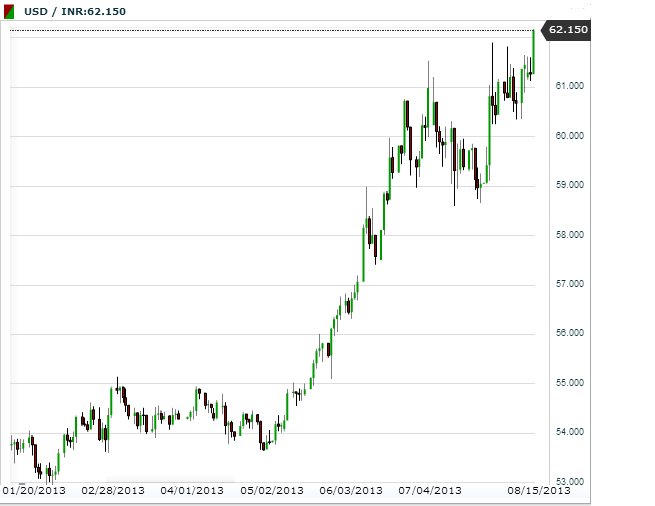
It didn't do any good. Driven by expectations of impending exit from QE3 in the US, the rupee punched through 62 this morning, hitting a new all-time low.

Rupees per $1 (source: Investing.com)

At these levels inflation will soon become a concern. Investors continued dumping short-term government bills, with the 6-month paper going above 11% for the first time.

India 6-month government bills (yield)

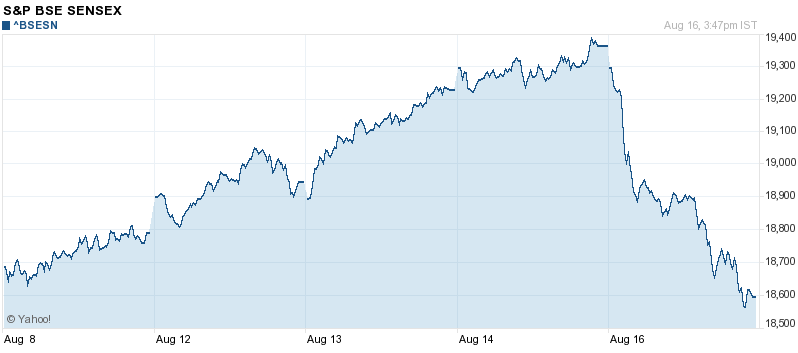
The stock market, which has all but ignored India's currency crisis, tumbled 4% today. The reality of the situation is finally setting in.

India's broadly watched stock index (SENSEX)

The retreat across capital markets was exacerbated by escalating tensions with Pakistan.
The Times of India: - Using heavy calibre guns, Indian Army retaliated strongly after Pakistani troops on Thursday resorted to unprovoked and indiscriminate firing with rocket and mortar shell attacks at LoC posts in Jammu & Kashmir's Poonch sector that injured three Army jawans and a civilian.

This is the 11th ceasefire violation by Pakistan in the past five days, Army officials said.
As capital outflows continue, India is struggling to plug its widening current account gap (6.7% of GDP last year). This has become the worst economic crisis for the nation since 1991, when India's government, faced with depleted foreign reserves, had to resort to asking the IMF for help. At the time, the country had secured a $2.2bn loan, backed by 67 tons of gold reserves. To satisfy the IMF's concerns about access to the collateral, the RBI had to airlift 47 tons of gold to be deposited offshore with the Bank of England and 20 tons of gold with UBS.

While such action is unlikely this time around, if the crisis continues to escalate, Asia's third largest economy will struggle to grow. Even though economists still do not expect a contraction, it is now a real possibility. Some weakening of the rupee may have been desirable for exporters, but losing control of the exchange rate was not what the RBI had in mind.


SoberLook.com
From our sponsor:

Tuesday, August 6, 2013

The rupee near all-time lows again as RBI confuses the market; economic indicators deteriorate further

India's authorities are having a tough time clearly defining what they are willing to do in order to stem the rupee's decline.
Reuters: - Mixed signals from the Reserve Bank of India and the government over how to handle the fall in the rupee has contributed to its decline, investors say.

The RBI has appeared at times to contradict the thrust of its policy to try to stabilise the currency and also seemed at odds with the finance ministry, undermining market confidence in their resolve to tackle the problem, they say.

"The contradictions between the actions and voices from the central bank and finance ministry have aggravated the volatility in the market," said Ganti N. Murthy, head of fixed income at Peerless Fund Management Co Ltd in Mumbai.
...
Traders say Indian authorities have tripped up a number of times, and that has contributed to the rupee's weakness.

The central bank announced a bold strategy to tighten cash conditions in the middle of July, including a rise in short-term borrowing costs and restricting funds available for banks.

But within days it rejected all bids in a treasury bill auction and most bids in a special bond sale organised specifically to mop up cash. That seemed to run against its own efforts to tighten cash conditions and raised doubts about what the central bank wanted to achieve, dealers said.
The currency is under pressure again, trading near record lows (dollar trading higher against the rupee - chart below).

USD/INR (source: Investing.com)

While the RBI still has a number of options with respect to the rupee (none of which look particularly attractive), the larger issue remains with the nation's economic fundamentals.
Reuters: - A record current account deficit and a slump in economic growth in recent years to the lowest pace in a decade have undermined confidence in the currency. A government struggling to push through bold economic reforms ahead of a general election needed by May next year has added to investor jitters.
The trade balance has been deteriorating for quite some time now, ...


... while the "real-time" economic indicators are pointing to not just slow growth, but potentially a contraction. The HSBC composite PMI measure, which combines manufacturing and services, is now in contraction mode for the first time since the Great Recession.

Source: Markit


SoberLook.com
From our sponsor:

Thursday, August 1, 2013

India's short-term yield goes vertical; RBI struggling

Here is a quick update on India's ongoing financial stress. Capital outflows from stocks over the past couple of months reached a post-2008 high, prompting Goldman to downgrade the nation's equity market.
Bloomberg: - Foreigners sold a net $2 billion of domestic debt last month through July 30, extending the record $5.4 billion withdrawal in June. The two-month outflow from stocks reached $2.8 billion, the most since the global financial crisis in November 2008, regulatory and exchange data compiled by Bloomberg show. Goldman Sachs cut its rating on the nation’s shares to underweight in a report dated July 31.
The rupee is trading near record lows as RBI's recent actions are proving to be ineffective. With liquidity conditions remaining tight, the short end of the government curve is under severe pressure. The one-year note yield has gone vertical, approaching 10%. The yield curve remains heavily inverted, with further economic slowdown sure to follow.

Source: Investing.com


SoberLook.com
From our sponsor:

Tuesday, July 23, 2013

RBI's battle with currency weakness inverts the yield curve; will cost India's economy dearly

The Reserve Bank of India decided it has had enough of rupee weakness and capital flight out of the country. The central bank is dealing with the problem by tightening liquidity conditions in the domestic money markets. By making it more expensive to borrow rupees, it reduces investors' ability to short the currency.
Reuters: - The central bank tightened liquidity further and made it even harder for lenders to access funds with measures including lowering the amount banks can borrow or lend under its daily liquidity window.

The latest moves come a week after its initial steps steadied the rupee somewhat, but left the currency still within sight of a record low of 61.21 hit on July 8.
The RBI's move has some similarities to what had recently occurred in China, as the PBoC tightened liquidity conditions there (see post). As a result of these actions, interest rates spiked - particularly on the short end. The chart below shows the dramatic jump in 1-year government bond yield.

Source: Investing.com

The central bank is also intervening directly in the currency markets.
Reuters: - The RBI is intervening more frequently in spot markets, traders said, coming in late in the session or whenever the rupee threatens to break below 59.89, the level at which the currency traded before the RBI's initial measures on July 15.

The central bank's steps, though meant to be temporary, are a clear indication of its renewed focus on financial stability, putting a monetary easing campaign intended to revive growth on hold.
Moreover, many domestic investors, concerned about the currency declines and uneasy about the economy, have been taking the only logical step one takes when currency flows are restricted. They have been buying gold. But domestic purchases of gold generate gold imports into the country, which puts further downward pressure on the rupee. This was another situation of whac-a-mole and the RBI brought down the hammer.
The Economic Times: - The Reserve Bank of India has made gold imports for domestic consumption tougher and forced exporters to bring home their dollar earnings quicker in yet another attempt to shore up the currency that's hurtling toward the Rs 60 mark to the US dollar again.

If any importer of gold fails to export 20% of the gold from the arrived consignment, he would be barred from importing any more gold. This could reduce imports, as only a very small portion of gold is exported now. The central bank's move is also aimed at promoting export of gold and to prevent charges that its measures to improve the fortunes of the rupee are hurting jobs in the gems and jewellery industry that employs more than 3 million people. 
See this story for the full list of measures taken by the RBI to defend the currency. So far the impact on the rupee has not been significant as the currency continues to trade near the lows. Further declines have been halted for now however.

USD/INR

But this battle to keep the rupee under control is going to come at a price. The combination of this spike in rates and tight liquidity conditions will damage domestic credit and dramatically slow growth. This comes at a time when industrial production is already down in June, balance of trade is deep in negative territory, currency is weak, and fuel prices are elevated (see post).

As usual, the best predictor of an impending economic slowdown is an inverted yield curve - and that's precisely the situation in India now.


SoberLook.com
From our sponsor:

Wednesday, July 10, 2013

India's foreign reserves declining

Barclays Capital had a sobering update on India today. Apparently June saw the largest outflows on record from India bonds and equities portfolios.

Source: Barclays

As a result, declines in India's foreign reserves are becoming material.

Source: Barclays

Moreover, India's gold holdings constitute a significant portion (more than other countries) of the nation's reserves. And the recent declines in gold price have not yet been included in the official numbers (not in the chart above).

While the reserves a currently sufficient to defend the currency if the RBI chooses to use them, these recent declines will probably make them hesitate. India has other tools it can deploy, should the officials decide to become more aggressive in defending the currency.
Barclays Capital: - ... government officials are likely to use other policy options to stem INR weakness, including further liberalisation of the financial account (eg,reducing restrictions on debt purchases by foreign investors and relaxing FDI limits) in an effort to support sentiment. Most recently the Securities and Exchange Board of India (SEBI) announced measures to reduce speculative INR trades “in view of the recent turbulent phase of extreme volatility”, which are likely to help stabilise the currency to some degree. In consultation with the RBI, SEBI has instructed relevant exchanges to reduce client position limits and increase margin requirements for currency derivatives.
Therefore for those concerned that the central bank will be forced to sell gold, at this stage there are a number of other alternatives. And given the nation's cultural attitude toward gold, politically that's just not an option. Nevertheless in the near-term the currency remains vulnerable to capital outflows, should confidence deteriorate further.


SoberLook.com
From our sponsor:

Sunday, July 7, 2013

Rupee's weakness may help exports but could do damage elsewhere

Indian rupee's slide to record lows has been extraordinary. It's been driven by weakness across emerging markets and rising rates in the US. As foreign investors exit (accompanied by domestic accumulation of dollars), India's central bank has been reluctant to intervene in order to halt the rupee's slide.

USD/INR (rupees per one dollar)

While this is expected to help companies in service export sectors (IT services, etc.), it will compress margins for other firms. Weaker currency raises input prices for firms that import parts, materials, etc. who are often not in a position to increase their output prices. The divergence between input and output prices in India is already visible.

Source: JPMorgan

Moreover, firms such as Reliance and Bharti Airtel who borrowed in other currencies, are watching their liabilities rise when converted into rupees.

Perhaps the most troubling aspect of this rupee weakness is the chart below which shows Brent crude oil denominated in rupees. For India, oil prices currently stand at recent record highs (except possibly the oil India buys from Iran at a discount). Given that domestic petroleum is generally subsidized by the government, this spike is sure to put significant pressure on India's fiscal balance.


SoberLook.com
From our sponsor:

Friday, May 17, 2013

EM-DM inflation rate divergence hits post-recession high

Emerging economies have always run higher inflation rates than developed markets (DM) due to stronger growth. The spread in inflation rates has generally been steady, running roughly 2-3 percentage points. Recently however the spread has blown out to over 4% - a post-recession high.


Emerging nations selling into developed markets are losing pricing power and will have a tougher time keeping up with domestic labor cost increases (some of which are forced by their governments). EM corporate margins are already under pressure, ultimately weakening growth. India or Mexico are good examples (charts below). While temporary, this divergence could be quite disruptive in the near-term.


Mexico GDP growth (source: GS)

SoberLook.com
From our sponsor:

Friday, December 7, 2012

2012 corruption rankings are out; fight against corruption not making much headway

The 2012 Corruption Index is out. Republic of Botswana and Uruguay seem to have almost the same score as the US. Maybe it shouldn't be a surprise.

Reuters had an interesting point on the topic. Some of the most corrupt nations (such as Libya) are also some of the fastest growing ones (see this post for 20 fastest growth nations from DB).
Reuters: - Uzbekistan, Bangladesh and Vietnam found themselves cheered and chided this week.

The Corruption Perceptions Index, compiled by Berlin-based watchdog Transparency International, measured the perceived levels of public sector corruption in 176 countries and all three found their way into the bottom half of the study.

Uzbekistan shared 170th place with Turkmenistan (a higher ranking denotes higher perceived corruption levels) . Vietnam was ranked 123th, tied with countries like Sierra Leone and Belarus, while Bangladesh was 144th.

Those findings are unlikely to surprise. But consider this. All three countries are said to boast some of the best prospects for business and growth over the next two decades. That’s according to the findings of a separate study released in the same week.

Uzbekistan, Vietnam and Bangladesh made it into the top 20 countries with the best growth prospects for business, outranking the United States, a study by political risk consultancy Maplecroft found.
Source: Transparency International (click to enlarge)

China and India continue to rank poorly on the corruption scale. India in particular is not happy with the score.
Zee News: - India's ranking in the global Corruption Perception Index is "distressing", Vice President Hamid Ansari today said and suggested fourfold approach to treat "deadly social ailment".

"Our ranking in the global Corruption Perception Index is, to say the least, distressing. The disease is not of recent origin but, in an earlier period, carried a social stigma less evident today," Ansari said, delivering Annual Bhimsen Sachar Memorial Lecture on 'Virtue in Public Life' here today.
Unlike India however (who has been trying to fight corruption for some time now), most nations who scored poorly seem to be ignoring this measure altogether. In fact the fight against corruption globally is not progressing well.


Here is the latest overview from Transparency International


SoberLook.com
From our sponsor:

Monday, October 15, 2012

India's stubborn inflation trend puts RBI in a bind - rate likely on hold

India continues to struggle with stubbornly high inflation levels. In spite of slower economic growth, the Wholesale Price Index (WPI) clocked at 7.81% in September, putting the RBI in a real bind. The central bank needs to cut rates as growth has moderated, but it is difficult to do with inflationary pressures unresolved.
The Times of India: - The Wholesale Price Index (WPI) inflation figures are out but those looking for repo rate reductions in the forthcoming October 30 monetary policy announcements by the RBI may be in for some disappointment. According to economists, the WPI figure, though certainly better than the 10%-odd inflation numbers that the economy was totting up till recently, is still not good enough for the RBI to cut rates. In other words, things aren t as bad as before but they are not good enough to merit a growth-inducing repo rate reduction by the RBI.
Part of the issue with India's stubbornly high inflation is that it has been elevated for an unusually prolonged period.
GS: - India has experienced a sustained period of high headline inflation since late 2009. In this period, inflation, as measured by the Wholesale Price Index (WPI), has averaged 9% and has not fallen below 7%. Indeed, the high inflation period can be seen from 2007, with a blip due to the GFC between February and November in 2009. This prolonged period of high inflation has not been witnessed since the early-1990s.
The problem that often accompanies long periods of inflation is the establishment of deeply rooted inflation expectations. Households now fully expect double digit near-term and longer term inflation. The recent rise in food prices is only going to exacerbate these expectations. And as central banks learned from past experiences, inflation expectations create a feedback loop with the actual inflation that is extremely difficult to break. That's why RBI is likely to be on hold for some time.

Source: GS

SoberLook.com

Sunday, September 30, 2012

Deflating the emerging markets bubble

Ryutaro Kono of BNP Paribas recently wrote an excellent piece discussing the bubble that was built in emerging market economies (EMEs) which is in the process of deflating. The thesis is simple: EMEs historical growth is unsustainable and these nations are undergoing a tremendous structural (as opposed to a cyclical) adjustment. The current slowdown (see chart below) is the result of the "stripping away" the post-crisis stimulus.


GDP YoY (source: BNP Paribas)

Monetary easing in the US had a direct impact on monetary policy in emerging markets. It works by weakening the US dollar which puts upward pressure on EMEs' currencies. These nations' central banks try to maintain a peg (implicit or explicit) to the dollar to defend their exports' competitiveness. To do so the central banks must buy dollars and sell ("print") their domestic currency. That ends up boosting foreign reserves and increasing the monetary base, creating an extremely easy domestic monetary policy.

Foreign exchange reserves  (source: BNP Paribas)

Such accommodative policy combined with infrastructure and other government spending generated unsustainable growth that is currently being reversed.
BNP Paribas: - The direct cause of the slowdown that began last spring by three big EMEs— China, Brazil and India — was the stripping away of the effects of the massive fiscal stimulus adopted in 2009. For instance, China’s fiscal stimulus package was massive at RMB 4 trillion (13% of GDP), and this made China the global economy’s growth engine following the Lehman shock. What is more, monetary conditions were also made extremely accommodative. Specifically, the aggressive easing by the Fed (QE1 and QE2) spilled over into the EMEs via their exchange rates. The mechanism involved worked like this: Because the Fed’s aggressive easing resulted in the weakening of the dollar, EMEs had to undertake dollar-buying intervention in the FX market to neutralize upward pressures on the local currency, something that made domestic monetary conditions extremely accommodative. Thus, the robust growth by the EMEs these past three years was inflated by the aggressive monetary/fiscal policies, and so was unsustainable.
Of course EMEs' growth prior to to the financial crisis was not sustainable either because it was driven by the credit bubbles in the US and the EU.
BNP Paribas: - Because the EME boomed both before and after the Lehman shock, the impression has taken root that the EMEs are the global economy’s driver. But the robust EME growth prior to the Lehman shock was also not sustainable. In retrospect, we can see that that brisk EME expansion was made possible by an export boom that was fueled by the bubble-driven economies of Europe and America. That China became the world’s production hub is due not just to its strong competitiveness but also to the voracious demand from the US and Europe. 
This of course does not bode well for global growth in the coming years.
BNP Paribas: - At long last, the process of undoing this bubble seems to have started. Now if my supposition about an EME bubble is correct, the big three EMEs will continue to slow for a while, and even if a cyclical recovery kicks in, returning to the former robust growth rates will be hard. That is why we cannot expect the global economy to pick up the pace for the time being


SoberLook.com

Monday, July 16, 2012

Stagflation risks rising in Asia; could impact global growth

With many North American crops in trouble due to severe drought conditions, analysts will be looking at Asia for signs of food inflation. Food inflation may prevent Asian countries from lowering rates, potentially creating growth problems not just for Asia, but globally. Right now the focus has shifted to India and the rising risks of a poor monsoon season.
The Hindu Business Line: - Weak monsoon poses a challenge in maintaining the high food production, the Agriculture Minister, Mr Sharad Pawar, said here on Monday. The monsoon deficit continues to be at 23 per cent till date, but there is no drought-like situation, yet, he said.

Rueing that India’s agricultural growth is still influenced by monsoon and vagaries of nature, Mr Pawar said meeting the 4 per cent growth was a challenge this year. He said kharif sowing [planting for the autumn harvest] will go on till the first week of August even as farmers anxiously wait for rains.
This is a dangerous development when combined with the US drought. Food accounts for almost a third of the CPI measure in a number of Asian countries.

Even prior to the increased upside risks to food prices, Asian nations had little room to lower rates in response to the global slowdown.

Source: DB

In spite of significant rate hikes since the lows of 2009 (chart above), rates for most Asian countries are roughly where they should be (except for Vietnam) based on the Taylor Rule (chart below). India and Thailand could lower rates another 100bp, but that's about it. In Sri Lanka, Indonesia and the Philippines the rates may already be too low.

Source: DB

As poor harvests propagate through the system and food inflation risks kick in, lowering rates further to stimulate Asian economies could become problematic. In fact these developments could spell stagflation for a number of nations in Asia - an extremely difficult situation for central banks to address.
DB: - Recent increases in wholesale and futures prices for corn and soybeans do not yet constitute enough of a potential threat to price stability to imply a need for rate hikes. But drought in the Western Hemisphere and a so-far disappointing monsoon in India do suggest that the risk of “stagflation” in Asia may be rising.


SoberLook.com

Monday, June 25, 2012

India needs to cut fuel subsidies to avoid fiscal deterioration

India's government took action today to stem the currency declines, as INR reached all-time lows on Friday.
Reuters: India announced steps on Monday to bolster the embattled rupee, including a $5 billion increase in the foreign investment cap in government bonds, but disappointed markets hoping for bolder action to prop up a currency that hit a record low on Friday.
And here is the result:

INR per one dollar

The market pretty much shrugged it off, leaving the INR to USD exchage rate almost where it was before the new policy was announced. Too little, too late.

Beyond India's economic deterioration, one of the things that's spooking investors (and keeping the currency weak) is the government's fiscal situation. With strong GDP growth, government debt levels looked acceptable. But the slowdown will materially increase risks to sovereign bondholders (particularly as RBI becomes a key buyer - remember subordination? ).

Deutsche Bank has proposed a good solution - cut fuel subsidies, especially for diesel, which is the most subsidized fuel.
DB: - It is imperative that a fuel price adjustment is made to prevent serious deterioration of the fiscal outlook, which is under the scrutiny of ratings agencies. Policy actions to raise fuel price, expedite asset sales, pushing through some investor friendly reforms are needed sooner than later. Global oil price decline is a necessary but not sufficient development to turn around India at this juncture.
India's government has been financing growing fuel subsidies, creating market distortions as the usage of diesel vs. other fuels spiked.

Source: DB

Over time as government price increases failed to keep up with the market, the subsidies became ever more expensive, putting the government budget at risk.

Source: DB
DB: - Diesel constitutes almost 55% of the fuel subsidy bill on an average, followed by LPG (25%) and kerosene (20%). Lower global oil prices will help to reduce the subsidy bill, but a weak rupee and rising consumption (in the absence of price hikes), will tend to dilute some of this beneficial impact and keep the pressure on the fiscal intact.
...
In FY11/12, when real GDP growth slowed substantially to 6.5% (from 8.4% in FY10/11), fuel consumption growth in fact rose to 4.9%, up from 2.3% in FY10/11, led mainly by a surge in diesel consumption (7.8% vs. 6.8%).
When price increases are not passed to the consumer, there is no incentive to decrease usage and subsidies can grow out of control (supply/demand fundamentals are out of balance). Here is an example. Remember the bankruptcy of Pacific Gas and Electric Company (PG&E) in California?
Wikipedia: - In 1998, a change in the regulation of California's public utilities, including PG&E, began. The California Public Utility Commission (CPUC) set the rates that PG&E could charge customers and required them to provide as much power as the customers wanted at rates set by the CPUC.
When the wholesale power price spiked (partially driven by manipulation - which would be much harder to pull off without the subsidies), the utility was unable to pass it on to the customer. And the consumer cranked up the power with little regard for the overall implications because power was so cheap. Subsidies forced on PG&E's ended up putting it into bankruptcy. 

Making cheap fuel available to the country at the expense of rising debt levels may look like a popular political solution, but it will not end well. A gradual reduction in these subsidies (as painful as it may be) will be critical to restore confidence. And while crude prices are subdued, this may be the best time to do it.


SoberLook.com

Sunday, June 24, 2012

India's currency spirals out of control

The Rupee hit a lifetime low against the dollar as flow of capital out of the country accelerates. The RBI (central bank) has been selling record amounts of dollars to slow down INR's fall, but so far has been unable to do so.
Reuters: - Traders said the central bank likely sold $250-300 million dollars on Friday to rescue the Indian currency.

INR per one dollar

The authorities are looking for ways to stem the declines.
Bloomberg: Indian Finance Minister Pranab Mukherjee said the government and central bank will announce measures on June 25 to halt a slide in the rupee after the currency sank to a record low two days ago.
Investors now lack the confidence that the RBI will be able to accomplish much, as the central bank tries to battle India's stagflation. "Take your money out first, ask questions later", one investor said.
The Economic Times: - Not much has changed in the last few months, India's high current account deficit, high fiscal deficit, slowing economy; rising inflation are factors that are hurting the local economic growth.
Some speculate that India will launch government guaranteed deposit accounts and loosen foreign investment rules in order to attract capital. The hope is also that at some point property markets may become attractive to foreigners (in dollar terms) and capital will start returning. But so far that has not been the case. The cash settled forward (NDF) market for rupee is indicating expectations for the exchange rate to get worse - with another 2% depreciation over the next 3 months. 


SoberLook.com
Related Posts Plugin for WordPress, Blogger...
Bookmark this post:
Share on StockTwits
Scoop.it