Showing posts with label CLO. Show all posts

Thursday, September 11, 2014

Middle Market CLO Primer

Here is a great middle market collateralized loan obligation (CLO) primer from Wells Fargo.


Enjoy!

MM CLO Primer


_________________________________________________________________________


SoberLook.com
Sign up for our daily newsletter called the Daily Shot. It's a quick graphical summary of topics covered here and on Twitter (see overview). Emails are distributed via Freelists.org and are NEVER sold or otherwise shared with anyone.


From our sponsor:

Monday, May 26, 2014

Spreads on AAA CLO tranches not budging

Top rated investment grade US corporate bonds now trade at or even below pre-recession levels. Depending on the maturity and the type of issuer, new issue paper clears the market at spreads (to treasuries) of 30-80bp for AAA bonds.


Securitized corporate paper for similar maturities on the other hand continues to trade at a significant premium. AAA CLO bonds clear the market at 145-155 basis points spread to LIBOR - unchanged from two years ago. The two (typical) CLO deals below show that while lower rated tranches have tightened significantly (BBB for example tightened about 200 basis points over the same period), AAA spreads for standard tenor deals have not budged (and in fact are higher in some instances).

DM means effective spread
(some tranches  are issued at discount; L="LIBOR"; source: LCD/S&P)

Some attribute this premium to higher risk of structured credit relative to single name bonds. However it is important to note that not a single AAA CLO bond lost principal through the financial crisis. The elevated spread is primarily driven by regulatory pressures and funding markets. The new FDIC rules for example penalize banks for holding these bonds (this is in addition to the Basel rules). Ironically these same rules may encourage banks to move toward riskier CLO tranches with higher yields in order to compensate for the increased FDIC charges.

Normally when there is a market dislocation such as this one, hedge funds find a way to take advantage of it. But LIBOR+150 is not yieldy enough for hedge funds and these bonds are nearly impossible to leverage in order to boost yields. So hedge funds and others in search of yield stick to the lower-rated tranches. Non-US participants, in particular yield-starved Japanese institutional investors, have been the only consistent buyers of AAA CLO paper recently. This makes the primary market vulnerable to disruptions if these investors decide to exit.


SoberLook.com
From our sponsor:

Sunday, April 27, 2014

ECB, BOE want to resurrect shadow banking in Europe

Recently, the ECB and the Bank of England published a joint paper calling for the return of securitization markets in Europe (see below). This goes completely against the grain of the latest Basel accord which has started imposing much higher capital requirements for holding securitized paper. The media called it "bringing back the toxic sludge" (see story). What's going on here?

With the Eurozone banking system on its back (see post), someone else needs to provide corporate and consumer credit. The central banks want to see the securities markets (shadow banking) take on that role. Some are outraged because securitized products are viewed to be one of the key causes of the financial crisis. However this is the case of "throwing out the baby with the bath water". It was a specific asset class, namely US subprime mortgages, that did most of the damage. But the media and many regulators have been applying the term "toxic" to all securitized credit.
ECB/BOE: - Despite the low issuance and the modest take-up by investors, most European structured finance products performed well throughout the financial crisis, with low default rates. According to an analysis by Standard & Poor’s, the cumulative default rate on European structured finance assets from the beginning of the financial downturn, July 2007, until Q3 2013 has been 1.5%. Some asset classes such as consumer finance ABS, SME Collateralised Loan Obligations and RMBS have experienced default rates well below this average and the performance of European structured finance products has also been substantially better than US peers.2 By way of comparison, ABS on US loans experienced default rates of 18.4% over the same period, including subprime loans.
The goal here is to get investor capital to the borrower without materially expanding the balance sheets of EU commercial banks (who are undergoing deleveraging). One of the obstacles to growing this business in Europe (and to some extent in the US) is the so-called Risk Retention Rule which was implemented in 2011. It requires that the structured bond issuer retains some "skin in the game" by buying a part of the origination (usually part of the most junior tranche). It's less of a problem for bank issuers, but creates barriers for independent managers who are not well capitalized. And since the ECB wants non-bank issuers to step up, this rule will cause some difficulties. Given the declines over the past few years in European ABS and other securitized credit product issuance, it will be a while before private securitization can materially supplement bank credit.

Enjoy:
THE IMPAIRED EU SECURITISATION MARKET


SoberLook.com
From our sponsor:

Sunday, February 9, 2014

Why JPMorgan is back in the CLO market

JPMorgan is once again hunting for primary CLO bonds. The bank made enormous profits since 2009 buying the higher rated tranches that provided great spreads above the bank's funding costs. After the "London Whale" fiasco the bank pulled back on its CLO buying, but now JPMorgan appears to be back.
Asset-Backed Alert: - J.P. Morgan is again showing interest in the senior pieces of newly issued collateralized loan obligations. The bank, which had been among the world’s largest buyer of those securities, retreated from the market early last year. But in the past two weeks, it has resumed discussions with managers that have deals in the works.
Why is this renewed interest in CLO paper? Here are some possible explanations:

1. New CLO bonds are still coming to market with attractive pricing. According to LCD, a recent CLO deal from ING (see press release from Fitch) priced the AAA (the largest tranche) at LIBOR + 150bp. A regular AAA corporate bond would typically price at (equivalent of)  L+20 to L+40bp. While there is clearly more risk with structured paper, the discount is attractive on a relative basis. CLOs also look attractive relative to other structured credit bonds (see post).

2. There is speculation that when it comes to CLOs, the US regulators may provide some Volcker Rule relief (see discussion - Item # 6). Below is the video from the latest congressional hearing on Voclker Rule implementation below.
Asset-Backed Alert: - ... some industry players believe J.P. Morgan now is part of a contingent that expects the Commodity Futures Trading Commission, Comptroller of the Currency, FDIC, Federal Reserve and SEC to ease Volker Rule restrictions for CLOs in the coming weeks.
3. JPMorgan is in effect hedged on its CLO holdings. If the new regulatory framework ends up being damaging to the CLO market by restricting banks' participation, the CLO bond issuance would decline materially.
BW: - Morgan Stanley cut its collateralized loan obligation [2014] forecast by as much as 27 percent to $55 billion as issuance slowed last month because of questions about the Volcker Rule’s impact on the funds that finance buyouts.
This reduction in supply would over time result in strong secondary demand for the highest-rated tranches. And banks will be given ample time to reduce their holdings. Either way, JPMorgan comes out ahead on this.

Hearing:  “The Impact of the Volcker Rule on Job Creators, Part II” 

SoberLook.com
From our sponsor:

Wednesday, January 15, 2014

TruPS CDOs now exempt from the Volcker Rule

Yesterday, after some intense industry pressure, US regulators (OCC, FDIC, SEC, etc.) collectively announced that the bulk of the so-called TruPS CDO securities issued prior to May 19, 2010 will be exempt from the Volcker Rule. Let's take a quick look at the issues around this decision.

1. What are TruPS?

Trust Preferred Securities, issued mostly by banks, are longer-term fixed maturity securities that pay a fixed quarterly coupon. They are junior to any bonds but senior to common equity (similar to preferred stock). Securities issued by banks prior to May 19, 2010 qualify for tier-1 capital and were a good way for many smaller banks to raise capital.

2. What are TruPS CDOs?

TruPS issued by multiple banks were pooled for diversification and funded by issuing "tranched" CDO debt. The coupon payments from the TruPS pool are used to repay this debt, with the higher rated tranches having a priority claim on these payments over the lower rated CDO debt.

3. How does the media explain this exemption from the Volcker Rule?

Here is an example from the WSJ.
WSJ: - Banks had been seeking changes to a provision of the Volcker rule that would have forced firms to sell such debt investments by July 2015 to avoid violating the regulation.

The so-called Trups CDO provision had sparked heated opposition from community bankers, who said the rule would unfairly harm hundreds of small banks that bought the investments by forcing them to take immediate write-downs on their holdings.
4. Do community banks really invest in TruPS CDO?

While some smaller banks do have CDO holdings, it's not that common, and the explanation from the WSJ is simply wrong.

5. So how was the banking industry able to pressure the regulators into this exemption?

Community banks were allowed to raise tier-1 capital by issuing TruPS. But small banks could not access the broader capital markets to sell this paper. It would be the equivalent of a local community bank attempting a rated bond issuance or an IPO. That just doesn't work. So CDO managers would privately transact with small banks and pool their TruPS in a portfolio that could be financed in aggregate (as oppose to each bank having to find investors for its trust preferred securities).

The American Bankers Association and other industry groups argued that if you allow small banks to raise capital using TruPS that could only be efficiently financed via CDOs, you can't prohibit other banks from buying/holding these securities. This "inconsistency argument" worked and banking entities in the US are now allowed to invest in (pre-May 19, 2010) CDOs primarily consisting of TruPS collateral.

6. What's next?

The next on the chopping block are CLOs, where the industry is arguing that if corporate loans are good enough for banks, some of the debt issued against portfolios of corporate loans should be allowed as well. No comment from the regulators so far.
Reuters: - The Loan Syndications and Trading Association (LSTA) urged US regulators on Wednesday to modify the Volcker Rule concerning collateralized loan obligations (CLOs) to prevent upheaval in the industry and potentially big losses for US banks.

Elliot Ganz, the LSTA's executive vice president, told the House Financial Services Committee that the definition of "ownership interest" in the final Volcker Rule will have significant unintended consequences for the CLO market, including material losses for US banks and restrictions on the availability of credit for US businesses.

Five US bank regulatory agencies on Tuesday approved a tweak to the rule that would allow banks to keep interests in certain funds backed by trust-preferred securities, but they did not address CLOs.


SoberLook.com
From our sponsor:

Tuesday, September 24, 2013

What do CLO managers and retail investors have in common?

The answer is, they both love senior leveraged loans...

The amount of US leveraged senior secured debt outstanding has risen sharply this year. According to LCD this market is now some $630bn in size.

Source: LCD
(the fluctuations include new loans/refinancings as well as partial or full prepayments)

Yet that doesn't seem to be enough. While the M&A activity has picked up this year (Heinz, Dell - see story), the volumes are not nearly sufficient to feed retail investors and CLO managers.
Reuters: - Retail money keeps flooding into loan funds, marking 66 straight weeks of heavy inflows, according to Lipper data. Loan funds pulled in $1.3 billion in the week ended September 18, during which the Fed surprised the markets with its plan to keep on buying $85 billion of bonds weekly to keep rates low and boost economic growth.

Loan fund inflows accelerated over the summer on expectations that the U.S. central bank was about to reduce those bond purchases this month, keeping interest rates rising. Issuance of collateralized loan obligations (CLO), another key source of demand for leveraged loans, at $57 billion so far this year already topped last year's issuance.
This demand continues to keep loan valuations elevated. In spite of the recent selloff across fixed income markets, the leveraged loan index has been pushed to new highs.

Source: LCD

At a recent CLO conference nobody seemed to be too concerned about this. Participants just complained about not getting enough new allocations from the banks running loan syndication. But there are some troubling signs in this market. While leverage on new deals remains well below the 2007 levels, it is starting to creep up as buyers are willing to accept higher risk.

Source: Forbes

Other loan "features" are beginning to look more like 2007 as well.
Reuters: - Conference attendees did note more risky leveraged loan features including payment-in-kind (PIK) toggles, dividend limitations and looser terms cropping up as more investors hunger for relatively higher-yielding assets.
But CLO managers insist that the credit environment remains benign and none of this is a problem.
John Popp (manages CLOs for Credit Suisse): - "At the end of the day, we're most concerned about being paid back, and our outlook from a fundamental credit perspective remains quite benign at present."
All is well -  until someone isn't "being paid back" ...

SoberLook.com
From our sponsor:

Sunday, July 21, 2013

CLO leverage rises to 13x

A new trend has developed in the CLO market. Some of the top managers are now able to place the single-B tranches with investors, thus cutting the size of the equity (unrated) tranche. Since the financial crisis, the lowest rated tranche has been the BB.

Oak Hill CLO (June-2013; source: LCD)
Invesco CLO (July-2013; "L"="LIBOR"; source: LCD)

That extra layer of single-B takes the leverage (total CLO size over the size of the equity tranche) from 9-10x to 13x. Just as a reference below are a couple of transactions from 2012.

Source: JPMorgan

The only way to juice up the projected returns on CLO equity in this low yield environment is to crank up leverage. The leveraged loan market remains quite strong, driven by demand for floating rate paper, low default rates, and lack of M&A activity to bring new supply to the market. As a result, CLO spreads have declined considerably, from L+150 on the AAA tranche in 2012 to L+115 now. The new single-B tranches now price at the spread that the BB tranches used to price in 2012, as investors reach for yield. With this new demand, the 13x leverage becomes possible.


SoberLook.com
From our sponsor:

Thursday, May 16, 2013

Why new CLO volume is declining?

CLO issuance in the US got off to a strong start this year. According to LCD, issuance averaged $1.9 billion per week in January and February. The volume however has declined sharply since then.


There are three key reasons for the decline.

1. Regulatory capital requirements for banks to hold AAA tranches is increasing (see this write-up for all the gory details). CLO managers tried to get their deals done prior to this change, pumping extra volume into the first couple months of the year.

 2. There simply aren't enough corporate loans to build a diversified collateral pool quickly enough. We don't see enough LBO deals to generate sufficient amount of new loans - the much anticipated Dell transaction for example didn't take place. And most companies who wanted to refinance, already did.

On the demand side, CLOs now face competition for loans from hedge funds, BDCs, and closed-end loan funds (see discussion). With few new loans for sale, a manager could end up with too much cash in the collateral portfolio. And you can't pay interest on liabilities with interest "earned" on cash.

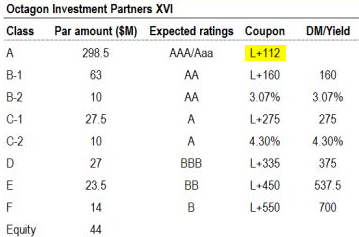
 3. Finally, the interest earned on the collateral - even if you can get it - is too low. As the table below shows, the latest CLO deal still pays LIBOR+112bp on its AAA tranche.

Source: LCD
It's a bit lower than the 120bp spread on some earlier deals (see discussion) but is still pricey relative to the declining spreads on the collateral (chart below). The income received on the collateral less the expense paid on the liabilities (all the tranches) does not leave enough net "juice" for the equity to generate worth while returns. And as long as that dynamic is in place, it's going to be increasingly difficult to print new CLO deals.


SoberLook.com
From our sponsor:

Monday, February 4, 2013

AAA CLO paper looks attractive on a relative basis

In the post-financial-crisis environment, securitization markets are limited to a handful of products that continue to trade. Basically the active markets are made up of GSEs' sponsored MBS (agency MBS is by far the largest structured credit market, with the Fed as the largest buyer), ABS pools (these include autos, credit cards, and student loans), and CLOs. All are quite critical for the US economy, as bank credit is replaced by these forms of "shadow banking".

In the "AAA" universe, CLOs (securitized corporate loans) continue to be the most attractive on a relative basis. The spreads for credit card and auto ABS for example are now a fraction of the CLO spreads.


SL="student loans", CC="credit cards" (source: JPMorgan)

With little room for further compression in the ABS space, the CLO market becomes interesting for investors. It's the only "AAA" paying around LIBOR+120bp, as the market prices in the risk of the rating agencies getting it wrong once again. Clearly the market that used to include bank-sponsored commercial paper vehicles has shrunk, reducing the number of "natural" buyers of this paper. Regulatory changes make it less palatable for banks to hold it. Hedge funds also have a tough time with AAA paper because the yield is too low for their target returns, while obtaining leverage for such bonds is quite difficult (hedge funds tend to focus on lower rated CLO tranches). That leaves insurance firms who have been a bit gun-shy due to their CDO fiasco in 08. Many are also less comfortable with longer maturities of CLO bonds vs. 3-year or shorter ABS. But with demand for floating rate product picking up (see discussion), the CLO market should do quite well in 2013, as yield-hungry investors turn to this market for an extra 100bp of spread.


For those interested in learning more about CLOs, here is a good, although somewhat dated paper from Babson (one of the largest CLO managers).


SoberLook.com
From our sponsor:

Wednesday, December 5, 2012

CLO characteristics over time

In response to an earlier post, a number of readers have asked to see the latest CLO structure and collateral characteristics. It is also helpful to see how these stats changed over time. Here is an excellent summary from LCD:

Source: LCD


SoberLook.com
From our sponsor:

Tuesday, December 4, 2012

US CLO market booming

CLO issuance in the US hit a new post-2007 record in November. Driven by demand for yield and low default rates among US corporates, investor base for CLO paper has been growing. Institutions are realizing that this asset class actually performed relatively well during the financial crisis with no material losses to AAA tranches. The volume of CLO deals is still significantly below the 2006-2007 period and the AAA tranches in current deals have 40% subordination rather than some 25% in the boom years. But the market is much healthier. There are no monoline insurers, "negative basis", or "CP conduits" involved.
LCD: - For the first 11 months of 2012, the volume of new, regular-way arbitrage deals stands at $45.8 billion. Add to that what managers expect will be another $5-6 billion of December business, and 2012 volume will likely climb to about $51-52 billion, versus $12.5 billion in 2011. That’s a giant leap for a market that produced just $15 billion of new vehicles during the extremely lean years of 2008-2010.
Source: LCD
CLO AAA tranches price in the LIBOR+130-140 range, while many A/BBB corporate bonds yield somewhere is in the same neighborhood as well. Let's see, AAA senior secured diversified pool of corporate loans or BBB single name unsecured bond - both yielding roughly the same. It's no wonder there is significant demand for senior CLO tranches.

But who is buying the lower rated tranches? Given the performance of the US corporate sector over the cycle, new buyers (various forms of credit funds) are coming in.
LCD: - In today’s yield-starved environment, the low-to-mid-teens equity [the lowest (unrated) tranche of CLOs] returns suggested by CLO models play well, particularly in light of (1) how resilient vintage deals were across the cycle and (2) the fact that distributions are consistent and predictable. Participants note that business-development corporations have been major buyers of CLO equity.

Prospect Capital Corp. (PSEC), for instance, lists $215 million of CLO residual interest, at cost, on June 30, 2012 in its latest 10-K filing, up from none a year earlier. What’s more, several new CLO equity funds cropped up or expanded this year. Examples include Stone Point and Pearl Diver. In addition, sources say, Crystal Fund of London is raising a new CLO fund called BK Opportunities Fund that will invest in junior debt and equity tranches of U.S. CLOs. And GSO in June raised $125 million for its Carador Income Fund, a vehicle listed on the London Stock Exchange that invests in CLO liabilities and equity. Finally, Priority Senior Secured Income Management – an adviser jointly owned by Prospect Capital Management and a subsidiary of Behringer Harvard – filed a shelf registration at the SEC for the Priority Senior Secured Income Fund. If raised, the fund will invest proceeds in CLO equity and junior obligations.
As banks become cautious running certain corporate exposure due to new regulations, this old form of "shadow banking" is stepping up once again.


SoberLook.com
From our sponsor:

Sunday, November 4, 2012

A good paper on shadow banking, finally

Finally here is an easy to follow, comprehensive, well researched, and unbiased paper from FRBNY (Tobias Adrian and Adam Ashcraft) on the so-called shadow banking (many thanks once again to Kostas Kalevras for pointing it out). A few comments:

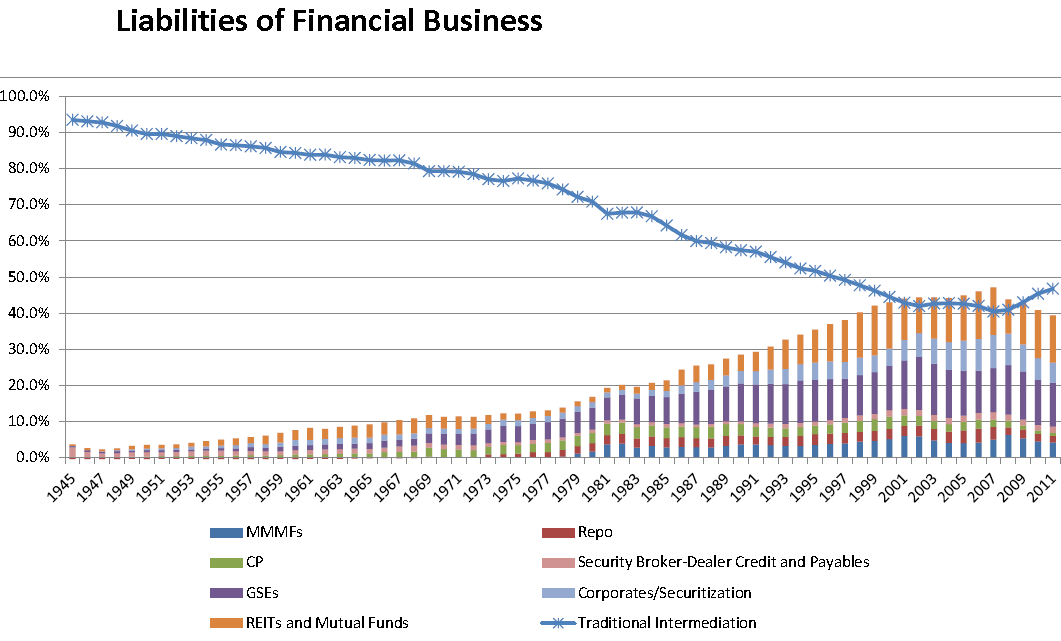
I. This chart from the paper shows the breakdown of the "traditional" vs. the "shadow" banking market sizes. It is important to point out the precise definition of traditional banking sources of funds.
Traditional Intermediation [sources of funding] refers to net interbank liabilities [banks borrowing from each other] plus checkable and savings deposits of depository institutions plus reserves of life insurance companies and pensions plus [unsecuritized] corporate debt.

Source: FRBNY (click to expand)

Note that a big chunk of shadow banking is comprised of the GSE (Fannie Mae, Freddie Mac), something the mainstream media often misses. Also this does not include government sponsored student loans, which many would classify as shadow banking (and could become a serious issue at some point).

II. The authors may have overemphasized the complexity of the securitization process with the 7 steps (chart below). Yes, in the few years leading up to the financial crisis, with CDO squared, etc., one could potentially count this many steps. But those days are over. Modern securitization usually involves only the first three steps. For example, in CLOs one has the following:

  1. Banks lend to corporations and syndicate those loans.
  2. The CLO manager uses a "warehouse line" to purchase some large portion of the loans needed for the CLO.
  3. A permanent entity is set up, which issues the liabilities (tranches) and buys the loans out of the warehouse. It than uses excess cash from issuing the tranches to buy more loans in the market.

ABS deals (autos, cards, etc.) also have three steps and are even simpler. The use of ABCP has declined dramatically and with it went some of the more complex securitization (see discussion).

Source: FRBNY (click to expand)

III. The authors also put too much emphasis on regulation. Investors need to do their own homework rather than relying on rating agencies as they often did prior to 2008 (rating agencies had some serious conflicts of interest - also discussed in the paper). If a sophisticated investor buys a complex bond without understanding the risks, it has to be his/her problem. The government should stay out of it because in trying to protect such investors the authorities will create moral hazards. Plus the fact that something is regulated doesn't make it a safe investment by any stretch. There are plenty of "regulated" stocks and ETFs out there that could do serious damage to one's portfolio. Regulation of shadow banking should be limited to how it impacts regulated banks (such as not allowing Citibank or Wachovia to run a massive off-balance-sheet portfolio via CP conduits with a relatively small regulatory capital allocation - regulatory capital arbitrage).  Assigning appropriate levels of capitalization to liquidity backstops and credit guarantees is where the focus should be.

The other type of regulation that would be helpful is in products that are marketed and sold to retail investors/borrowers. For some reason mortgage brokers do not have to have the same level of regulatory scrutiny and licensing requirements as securities brokers. Yet for many households a mortgage is a much more risky transaction than their securities purchases (see discussion) - as we have discovered during the financial crisis.

IV. What many people (particularly the mass media) don't fully appreciate is that much of the securitization activities - which if done properly can be extremely helpful to the US consumers and to the economic growth as a whole - were started by the US government.
FRBNY: - In many ways, the modern shadow banking system originated in the government sector. Securitization was first conducted by government-sponsored enterprises (GSE), which are comprised of the FHLB system (1932), Fannie Mae (1938), and Freddie Mac (1970). The GSEs have dramatically impacted the way in which banks are funded and the way in which they conduct credit transformation: The FHLBs were the first providers of term warehousing of loans, and Fannie Mae and Freddie Mac pioneered the originate-to-distribute model of securitized credit intermediation.

Like banks, the GSEs fund their loan and securities portfolios with a maturity mismatch. Unlike banks, however, the GSEs are funded not through deposits, but through capital markets, where they issue short- and long-term agency debt securities. These agency debt securities are bought by money market investors and real money investors such as fixed-income mutual funds. The funding functions performed by the GSEs on behalf of banks and the way in which GSEs are funded are the models for wholesale funding markets. The GSEs use several securitization techniques. They use term loan warehousing services provided by the FHLBs. They also use credit risk transfer and transformation through credit insurance provided by Fannie Mae and Freddie Mac. Securitization functions are provided by Fannie Mae and Freddie Mac. Maturity transformation is conducted on the GSEs’ balance sheets through retained portfolios. These securitization techniques first used by the GSEs were adopted and imitated by banks and nonbanks to generate the nongovernmental shadow banking system. The adaptation of these techniques gave rise to the securitization-based, originate-to-distribute credit intermediation process.


Enjoy!

Shadow Banking - Dan Freed, you'll appreciate this one.


SoberLook.com

Tuesday, August 14, 2012

As firms chip away at the maturity wall, CLOs are having trouble finding short-term paper

Since 2009 leveraged companies in the US have been pushing out the wall of maturities created by frenzied LBO activity prior to the financial crisis. These days they are continuing to chip away at the 2014 maturity.
LCD: - So far this month, issuers have completed or announced opportunistic transactions that address $9.8 billion of loans maturing in 2014... These include bond-for-loan takeouts, amend-to-extend exercises, and loans to refinance shorter-dated loans. Some executions have been large, with Community Health Systems, ServiceMaster, and First Data poised to clear away more than $1 billion apiece of their 2014 maturities.
Source: LCD
According to LCD, this is creating a shortage in short-term corporate loans. CLOs that are still reinvesting collateral (replacing loans that have partially or fully repaid) have restrictions on the weighted average life (WAL) of the collateral. The goal of these restrictions is to make sure there is no significant mismatches between the maturity of the CLO and the maturity of the loans in the collateral pool. Because of these restrictions, CLOs that will be maturing in the next few years (and are still reinvesting) are only allowed to buy shorter maturity loans. But as the companies push out maturities of their liabilities, the amount of short-dated loans in the market declines. That trend is creating a shortage, tightening spreads for nearby leveraged loan maturities.
LCD: - With the pool of shorter-dated loans shrinking, there is a strong bid for shorted-dated paper from CLOs as they work to maintain compliance with weighted-average-life tests, traders note.

SoberLook.com

Sunday, August 12, 2012

The CLO market - then and now

After a conversation with Ed Grebeck (Tempus Advisors), I thought it may be helpful to do a quick overview of the evolution of Collateralized Loan Obligations (CLOs) from the "bubble" years to the current environment. The CLO market is the only securitization survivor of the financial crisis that has retained the full capital structure - from "AAA" down to equity (unrated tranche) and has fairly long maturities. The AAA tranches of the pre-crisis years were severely mispriced - paying as low as LIBOR + 23bp in 2007 for example - but came out of the crisis mostly unscathed (except in a couple of fraud cases).

Unlike their brethren in the CDO space that securitized sub-prime resi loans, the CLO collateral - portfolios of non-investment-grade corporate loans - experienced fairly modest default rates. The US corporate sector did reasonably well through the recession and was able to tap the HY bond market to refinance its debt or extend maturities (even for many weak credits). Some companies of course struggled and were too leveraged (like Clear Channel), sometimes undergoing debt restructuring (Tribune, Dynegy, etc.). Some firms, such as TXU - one of the largest LBO transactions to date - are yet to be restructured.

But even more importantly it was the diversification assumptions for the corporate sector that generally worked. Different industries were not impacted equally by the downturn. In the subprime mortgage space on the other hand, diversification was based on geography, a highly flawed approach. The rating agencies applied similar diversification assumptions/logic to California and Florida properties that they would to telecom and energy corporate sectors. The lesson was that corporate diversification, which has been employed by banks for centuries, works reasonably well but can not be translated into residential property markets based on geography.

In spite of its relative success, the CLO market has changed markedly since the pre-crisis era. With no ability to use bank-backed commercial paper (ABCP) to fund the AAA tranches and no monoline (such as Ambac) guarantees, the AAA needed real investors. That means volumes, pricing, and leverage all needed to adjust. Volumes are of course a fraction of the bubble years these days, but are beginning to pick up.

Source: JPMorgan

Leverage has also changed dramatically. The pre-crisis leverage kept increasing through 2007 as the equity tranche became "thinner". 2007 leverage got as high as 15:1 (15x), averaging 12x (assets to equity).

Source: LSTA

That leverage dropped to 7.5x in 2010 as the rating agencies swung to the other extreme, taking the ultra-conservative approach.

Source: LSTA

Leverage has increased somewhat since 2010. One of the deals that printed this month, managed by Symphony Asset Management and structured/distributed by Morgan Stanley, is leveraged just under 10x (417.75M total deal size over 43M equity tranche size = 9.7x).

Source: S&P

Note that the X tranche (78bp) represents Morgan Stanley's fees as well as closing expenses (mostly legal and "warehousing" costs) which the bank financed for Symphony via the "super-senior" tranche. Pricing for the AAA tranche is now around LIBOR+150, making it a bit more interesting for institutional investors like insurance firms. Here are a couple of other recent CLO deal structures - both with leverage under 10x.

Source: JPMorgan

Other changes include permissible collateral. In 2007 CLOs permitted the inclusion of 5-10% of unsecured HY bonds and 5-7.5% of tranches of other CLOs. Up to 10% of second lien (as opposed to standard first lien) loans could also be included. Current CLOs generally do not allow any of this. Maybe a couple percent could be in bonds, but they would all have to be senior secured.

Legal maturities went from 12-14 years in 2007 to about 10 years these days. Perhaps the biggest change has to do with the "reinvestment period" - the period during which the manager is permitted to replace loans that prepay (partially or fully). It went from 6-7 years in 2007 to 2 years these days. Investors want the manager to build a portfolio and after a couple of years let the deal begin amortizing. That makes the AAA durations considerably shorter, reducing mark-to-market volatility.

CLO managers continue to be plagued by difficult markets. Low volumes of new institutional loans make it harder to ramp collateral quickly (a sufficient amount of collateral has to be invested in order to close the deal). At the same time banks do not finance loan "warehousing" for too long in fear of getting stuck with the collateral if the market shuts down and the deal does not close - which happened in 2008. Equity returns are considerably lower (because of lower leverage) than they used to be, ranging from 10% to 15% (vs. in the 20s during the pre-crisis era). New regulations pertaining to bank capital and risk retention rules will put a damper on how much the banks will be able to structure and distribute. And of course Europe could quickly bring this market to a grinding halt. Nevertheless as demand for fixed income stays strong (these days investors are chasing anything with a coupon), CLO managers are cautiously optimistic.


SoberLook.com

Monday, May 21, 2012

CLO market poised for growth

Interest rates at unprecedented lows are forcing investors to reexamine their hate for structured credit. Slowly but surely the CLO market is coming back in spite of the recent obstacles.

Source: JPMorgan

Based on this JPMorgan forecast, we are on target to get to 2004 CLO volume. It is highly unlikely the pace of growth will mimic anything that followed 2004, but relative to recent years, this is real progress.

One factor that is helping this market is the diversification of buyers in the secondary market, as the next chart shows. "Real money" means insurance and pension funds who are key to finding a home for "AAA" tranches - the largest part of the capital structure. An active secondary market is key to growth in this business. Hedge funds in particular are jumping into the game.

Secondary CLO activity (source: JPMorgan)

In the long run this will help drive insitituonal leveraged loan volumes in the primary markets as new CLOs look for fresh collateral.

Source: JPMorgan (click to enlarge)


SoberLook.com

Thursday, February 23, 2012

Why CLO managers continue to struggle

By all accounts the CLO business should be going well. Some $3.3 billion of new CLO deals have been done this year already as compared to $4.4 billion for the whole of Q4 of 2011. Seems like a significant amount but this volume is actually quite light relative to historical levels (see chart).


In fact CLO managers are finding it tough to do business these days. Here are some reasons why they continue to struggle:

1. In order to execute a CLO deal, a manager needs to have a portfolio of loans ready to go. Most stock traders would say, so what, just buy it in the market. But corporate loan liquidity is quite poor, and to accumulate (“ramp”) say $200mm of loans in order to launch a new deal could take months (weeks if you are lucky). This process is made particularly difficult because loan “issuance” (origination of new corporate loans by banks) has been rather slow (see chart). There is practically no LBO activity and the merger activity has slowed down. These are the typical transactions that require corporate loans - the rest is mostly refinancing of existing debt. There simply isn’t enough of new supply hitting the market, making it tough for CLO managers to build portfolios.


New syndicated corporate loan volume  (source: LCD)

2. Prior to the issuance of the CLO tranches, managers need banks to provide a “warehouse” – a facility to finance the “seed” portfolio. The problem is that such facilities these days require 10-15% first loss commitment from the manager. Smaller managers may be required to post that amount as cash in order to obtain the warehouse facility. And that commitment is nearly impossible for some managers. That’s why most CLO issuers in recent years have been the bigger firms (such as private equity).


3. The “equity” tranche for new CLOs has prospective returns of 10-14%. This is due to the fact that senior tranches now require significant subordination by the rating agencies – who are being overly conservative to compensate for their "sins" of the past. Higher subordination makes the equity tranche larger and the returns lower. At these modest returns and given the negative connotation associated with any structured credit, equity tranches are hard to place (particularly with pensions and other institutional investors).

4. It may also become difficult to place the AAA tranches soon. The buyers of these tranches tend to be banks and the new regulations may make holding this paper uneconomical.

Because of these uncertainties, analysts are divided as to the expected size of total CLO issuance this year. Forecasts range from $12 to $25bn for the whole year. Back in 2007 that would have been a bad quarter.
SoberLook.com

Wednesday, February 8, 2012

New CLO deals - structure and pricing

The CLO market kicked off the year to a decent start with about 6 deals that priced so far. The typical structure this year has been similar to this Ares deal (below). Transactions are around $400mm, more than double the deal sizes of the pre-08 period. Pricing has been at LIBOR+150bp for the AAA tranche - as much as 4 to 5 times the pre-crisis levels (pricing got to L+300 or even wider in 2009). Without the monolines to skew the pricing on AAA paper, the bonds are priced for a "natural" investor (as opposed to a combination of a monoline and a CP conduit).

The most important development has been the level of subordination for the AAA. With the rating agencies not wishing to repeat their disastrous CDO mistakes, these new CLO deals have about 37% underneath the AAA tranche. At a 50% recovery on defaulted senior secured corporate loans, over 70% of the portfolio credits would have to default in order to impair the AAA tranche.

Ares CLO (source: LCD)
Another feature of the new CLO deals has been the placement of some of the junior tranches at a discount. In this deal for example the newly minted BBB tranche is placed at 88c on the dollar or L+825 on a yield basis. This allows the manager to match these discounted liabilities to the loan assets, some of which also trade at a discount.

Middle market loan portfolios (loans to mid-sized companies) such as the Golub deal, require some 42% subordination for the AAA and the pricing is LIBOR+200 (50bp higher) because these deals are considered riskier. Middle market deals are particularly important because banks don't always step up to fund middle market corporations that have leverage. CLOs make credit available to some of these firms.

Golub Middle Market CLO  (source: LCD)  

So far we've had $1.92bn of paper price year to date - a tiny amount compared to 2006, but progress nevertheless.
SoberLook.com

Monday, January 9, 2012

3 observations about the AAA CLO market

Here is followup to a recent post on the proposed draconian capital rules for banks holding AAA CLO paper.  Any regulation, whether it's pharmaceuticals or financial products, should be based on data and other empirical evidence rather than political motivations and career advancements.  Over-regulating something just because a regulator does not fully understand the market can result in unintended consequences with adverse impact on the economy.

Let's consider the data available for AAA CLO tranches to see how it reconciles with the proposal to increase capital requirements by a multiple. Here are 3 key empirical observations about this market.

1.  Current CLO deals typically have a 35% subordination for the AAA tranches.  The collateral represents a diversified pool of senior secured corporate loans with 90% or higher in first lien.  In order to impair a AAA tranche, 70% of corporate loans have to default, assuming a 50% recovery rate (which is generally much higher for first lien senior secured loans). Even during times of severe credit crunch, loan default rates did not exceed 10% in a year. 

Institutional loans default rate (CS)

2. As conservative as the rating agencies have become in downgrading everything within their sights, their analysis continues to show that the bulk of AAA tranches actually remain "AAA".  Some may argue that they have seen this movie before, but given the guns pointed at the rating agencies, they have all the incentives in the world to downgrade CLOs.  They have aggressively done so for the more junior tranches but not the AAA.

Downgrades of CLO tranches by Moody's (CS)

3. If these assets were more risky than investors initially believed, a year like 2011 would have proven it out and the risk would manifest itself in price volatility (as it was with other assets). Again, that was definitely the case for the more junior tranches, but the AAA paper held up well.


So before the Basel rules are adjusted as proposed, bank regulators need to look at this data.  Rather than overcompensating for the RMBS secularization fiasco in 08, regulators need to start from scratch when developing capital rules for this market.
SoberLook.com

Monday, December 26, 2011

CLOs and the new bank capital rules

In the heyday of credit structuring the rating agencies had been far more successful in rating the securitizations of corporate debt than of mortgage debt. Collateralized Loan Obligations (CLO) tranches rated AAA had not lost principal during the 08-09 crisis (except for a couple of fraud cases), although often traded as low as 60-70 cents on the dollar because of uncertainties around corporate default rates. During the crisis banks like JPMorgan had bought significant amounts of the AAA tranches at large discounts and made enormous returns as the market began to realize that corporate defaults among leveraged companies will continue to stay subdued.

As a bit of background, between 2004 and 2007 CLO issuance had spiked tremendously as asset backed commercial paper (ABCP) issuance allowed banks to keep tranches in CP conduits and off their balance sheets using what used to be called "regulatory capital arbitrage".  This allowed for ever larger leveraged buyout (LBO) transactions including firms like TXU and First Data.

CLO Issuance in $billion per year (source: LSTA)

As ABCP demand collapsed in late 2007 (driven primarily by concerns about subprime mortgages), CLO issuance collapsed as well.

ABCP outstanding (source: the Fed)
This year some CLO deals got done (about $13 bn) and the hope was that the business, in spite of being a fraction of pre-crisis levels, would continue to grow. But given the history of structured credit, the recent news that capital requirements will be increasing on AAA CLO paper held by banks is not a surprise.
FT: Under existing Basel rules, large banks using “internal-ratings based” models are required to set aside just 0.56 per cent of the market value of triple A rated CLO securities as capital against losses. That would increase to a minimum of 1.6 per cent under the proposed US system, and then jump to 8 per cent if cumulative losses on a CLO exceed 4 per cent.
Many new CLO deals have 25-30% subordination, making it nearly impossible to "pierce" the AAA, particularly given that most loans are senior secured corporate obligations.  However over a few years most CLOs will accumulate losses of 4% or more - this is typical for a pool on non-investment grade loans.  So the capital charge for holding the AAA tranche will suddenly become equivalent to holding some corporate loans directly. Yet these losses on the CLO will flow to the lower tranches, not the AAA.  This new capital requirement will certainly make it capital inefficient to hold AAA paper on banks' balance sheets, particularly as it gets closer to maturity.

With CLO issuance in 2012 expected to be only slightly up from this year, the new regulation may significantly cut into this business.  Banks tend to be the largest holders of the most senior tranches, making it almost impossible to structure a new CLO without a commitment from a large financial institution.  In turn this will reduce demand for institutional loans (corporate loans of leveraged companies) that form the collateral pool for CLOs.  When combining this regulation with new rules impacting the corporate bond market, funding costs for corporations, particularly the "middle market" (mid-sized) firms in the US will increase.  This is yet another example of "unintended consequences" that some of the new regulation may introduce into the US economy. 
SoberLook.com

Wednesday, November 25, 2009

The CLO market may be making a comeback

Amazingly, the primary CLO market, which has been shut down since late 2007, may be making a comeback in 2010. The volumes will be a fraction of the peak, the capital structure will be simple, and the equity structures will be thicker, but the deals will get done. Unlike other securitization markets such as ABS and CMBS, it seems that the vast majority of the original AAA tranches will get their principal back in spite of record levels of corporate loan defaults. The AAA subordination of 25-30% has been sufficient to cushion the senior tranches from principal losses. In addition, deals that have had a relatively large portion of their collateral default or get downgraded have been forced to start using income to down the AAA principal, amortizing/deleveraging the transactions early. These facts may bring institutional investors back into the market.

The secondary CLO market spreads have come in dramatically as the chart from Citi/Reuters shows.


In order for the primary CLO market to work, the spread between the leveraged loan yields and the AAA tranche rate has to reach a level that will make the "excess return" attractive. As an analogy, consider what happens if you were to buy a rental property. If the monthly payments on the loan you take out is higher than the rent you collect on the property, you would never buy the property. In fact the differential between the rent collected and the interest expense on the loan has to be attractive enough to make you want to put down a downpayment on the property. In this analogy the CLO equity tranche is the "downpayment", the AAA tranche is the mortgage on the property (with lower rated tranches being "second mortgages"), and the collateral portfolio of corporate loans paying interest representing the property paying rent.

To make the equity returns work, one needs a relatively low financing spread ("mortgage rate") and a sufficiently narrow equity tranche (the "downpayment"). The chart below illustrates the expected return levels (roughly) as a function of the financing spread (blended spread of all the tranches above the equity).


The three lines represent the different equity tranche thickness ("downpayment"). As the AAA tranches continue to tighten in the secondary market, at some point the return on equity starts to make sense for some investors and the new transactions would get done. This may be the first securitization market that comes back (even as a shadow of what it used to be) without government (TALF) assistance.


SoberLook.com
Related Posts Plugin for WordPress, Blogger...
Bookmark this post:
Share on StockTwits
Scoop.it