Showing posts with label Ukraine. Show all posts

Sunday, February 8, 2015

Ukraine's impending debt restructuring

Diplomatic efforts are once again under way to establish a more lasting ceasefire in eastern Ukraine via the "Minsk peace talks redux" (see story). While Angela Merkel's diplomatic efforts should be applauded, chances for success remain poor. The Russian government simply has no incentives to stabilize the situation. Applying pressure on Western-backed Ukraine is part of Russia's foreign policy with significant popular support. Putin is not as interested in the Russian insurgents in Ukraine gaining autonomy as he is in embarrassing the West.

The military threat and the resulting humanitarian crisis in the east however are only a part of the threats Ukraine is now facing. The nation's economy is in deep trouble and the fiscal situation is becoming increasingly untenable.

The nation is running out of foreign exchange reserves after defending the currency in the face of significant capital flight over the past couple of years. Exports have collapsed, with Russia being the key export market.


Desperate to stabilize the currency without wasting much more of the dwindling reserves, the central bank hiked interest rates to 19.5% last week. Domestic credit markets are now shut.


To relieve the pressure from capital outflows, the Ukrainian currency (hryvnia) was allowed to plummet some 36% against the euro last week - an unprecedented move. There is very little the central bank can do now.

Chart shows EUR appreciating against UAH

Such currency weakness will sharply exacerbate Ukraine's inflation, which is already running close to 30%.
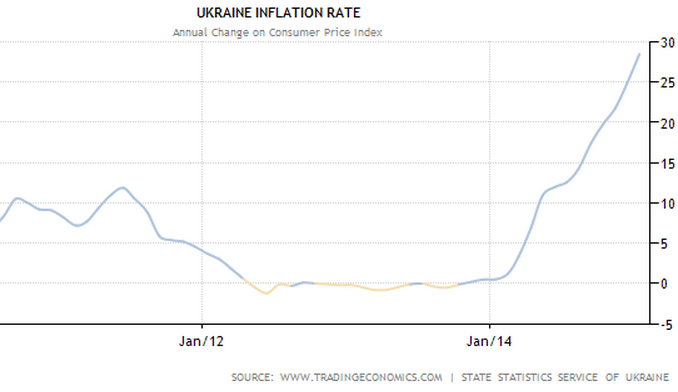


And growth is now deep in negative territory. The GDP, the industrial production, and retail trade are all experiencing a double-digit contraction.

Source: Barclays Research

Default or debt restructuring in 2015 is now inevitable. Some of the recent proposals have focused on simply extending the nation's bond maturities. Foreign currency denominated bonds (Ukraine's eurobonds) are of particular concern (chart below). But Ukraine has other FX denominated debt outstanding - including USD-based bonds issued domestically as well as debt to the IMF.


Most of the dollar-denominated bonds already trade around 50 cents on the dollar.

Source: Barclays Research

Whether maturity extensions or a principal haircut, unless Ukraine sees fresh bailout funds soon, a credit event is now just a matter of months - possibly weeks. The current economic and fiscal trends are unsustainable and the near-term dollar-denominated debt maturities are simply untenable.
_________________________________________________________________________

Sign up for our daily newsletter called the Daily Shot. It's a quick graphical summary of topics covered here and on Twitter (see overview). Emails are NEVER sold or otherwise shared with anyone.
_________________________________________________________________________

From our sponsor, Fitch Solutions: Sign-up for Inside Credit - a weekly wrap-up of noteworthy Fitch content delivered every Friday.

SoberLook.com

Wednesday, November 12, 2014

The question of "propaganda"

A comment in last night's Daily Shot on the situation in Ukraine and Russia has resulted in a flurry of responses from the readers. Given how charged the situation is - both on the ground as well as globally - it's helpful to have a discussion on the topic. To start with, here is the original statement - which was clearly one-sided:
The Ukrainian currency (hryvnia) is in free-fall- almost 20 to the euro now – with violence flaring up as ceasefire collapses. According to the Moscow propaganda machine, the oppressed Russians in eastern Ukraine are fighting the evil Western “fascists”. It’s working well for Putin in maintaining popularity.

Source: Investing.com

Below are two of the numerous "letters to the editor" in full:

1.
Dear Author,

I’m personally so disappointed of your one-sided perception of the world. I have a plea for you - please be more politically correct when you are saying this: “According to the Moscow propaganda machine, the oppressed Russians in eastern Ukraine are fighting the evil Western “fascists””. Please, take 5 min of your time and look at the photos and video in the Internet - there are plenty facts of fascists on the streets in Ukraine. Don’t be so naive and look what West did in Ukraine starting this “colour revolution” (bombing civil people and Ukraine officials refuse to talk with half of the country, as they do not adhere to Western views). Is it democracy? When Ukrainian fascists burned 50 people in building in Odessa, people who want to say that they disagree with what is happening now - is it not fascism? I don’t talk even about Donbass, where thousands of civilians were killed by ultranazi group Right Sector and Ukrainian Army.

And who gave the power to US to start this revolution and then to interfere to this situation? It’s over 10 000 miles from US borders? Why NATO is expanding year to year trying to make artificial evil from Russia & China? Think about it...

And please, when you say something look at the situation from both sides, don’t be biased by CNN, BBC, Bloomberg, etc. - they are showing only one part of the real situation!

Best regards,
Your Reader

2.
Hello,

Thank you for your most excellent charts.

I am prompted to reply to your comment about the "Russian propaganda machine". This type of phraseology is becoming nnoticeablymore frequent. By comparison to the lack of subtlety of Russian propaganda, Western propaganda is perhaps more sophisticated (in the true sense of the word), and all the more insidious and dangerous because of it.

A knowledge of history and of geography allows one to see at least some grains of truth in the Russian statements. The perception (and the implication) that the propaganda is all one-sided is itself a product of Western propaganda. Can you not see the irony?

Regards,
Glenn


Readers are invited to comment on this issue - either in the comment section or on the survey below.


_________________________________________________________________________


SoberLook.com
Sign up for our daily newsletter called the Daily Shot. It's a quick graphical summary of topics covered here and on Twitter (see overview). Emails are distributed via Freelists.org and are NEVER sold or otherwise shared with anyone.


Sunday, September 21, 2014

Ukraine on the brink

While we see a great deal of media coverage of Ukraine-related geopolitical risks, there hasn't been sufficient discussion about the dire economic and fiscal conditions the nation is facing. Writing about men in masks fighting in eastern Ukraine sells far more advertising than covering the nation's economic activity. However it's the economy, not the Russian army that has brought Ukraine close to the brink. And just to be clear, some of Kiev's economic and fiscal problems were visible long before the spat with Russia (see post from 2012).

Ukraine is now in recession. Deep economic ties with Russia have resulted in painful adjustments in recent months. The nation's exports are down some 19% from last year in dollar terms and expected to fall further. A great example of Ukraine's export challenges is the Antonov aircraft company known for its Soviet era large transport planes as well as other types of aircraft.


As the military cooperation with Russia ended, Antonov was in trouble. It had to take a $150 million hit recently by not delivering the medium-range An-148 planes to the Russian Air Force. The Russians will find a replacement for this aircraft, but in the highly competitive global aircraft market, it's far less likely that Antonov will find another client.

Here are some key indicators of Ukraine's worsening situation:

1. The nation's GDP is down almost 5% from a year ago and growth is expected to worsen.


2. Ukraine's retail sales are falling at the rate we haven't seen since the financial crisis.


3. And industrial production is collapsing.


4. The most immediate concern however is the nation's currency, which has been trading near record lows in spite of currency controls. In fact Friday's fall in hryvnia was unprecedented (over 11%), as Kiev fails to stem capital outflows.

Intraday exchange rate (source: Bloomberg)

Those who have spend any time in Ukraine during the winter know how harsh the weather can get. And at these valuations, hryvnia isn't going to buy much heating fuel from abroad. Furthermore, it's not clear if the government will have the wherewithal to provide sufficient assistance to the population.

5. Inflation rate is running above 14% and will spike sharply from here in the next few months if the currency weakness persists. Real wages are collapsing.

6. Finally, Ukraine's fiscal situation is unraveling. In its attempts to defend the currency, Kiev has been using up its foreign exchange reserves. It is only the access to some IMF funding that has allowed Ukraine's government to maintain some semblance of order in its FX markets.


Moreover, public debt levels continue to rise as the government attempts to keep the Ukrainian banking system afloat.
Fitch Ratings: - Government debt (including guarantees such as NBU liabilities to the IMF) to GDP has quadrupled since 2008, reflecting exchange rate depreciation, fiscal deficits, low growth and below-the-line costs such as recapitalisation of banks and Naftogaz. There is high dollarisation and foreign-currency exposure, making government solvency, banks' balance sheets and the overall economy vulnerable to sharp depreciation.
A number of economists now believe that given worsening economic crisis, the country's public debt problem is simply unsustainable and default is becoming increasingly likely.
Goldman: - We continue to see downside risks to activity and to our forecast for a contraction of output of 8% this year and for growth of 1% next year. As we recently argued, this severe economic weakness is likely to cause public debt to rise to 70% this year and 77% next year, above the IMF’s “high-risk threshold” for debt sustainability. These downside risks to our forecasts further call into question the sustainability of Ukraine’s debt trajectory.

_________________________________________________________________________


SoberLook.com
Sign up for our daily newsletter called the Daily Shot. It's a quick graphical summary of topics covered here and on Twitter (see overview). Emails are distributed via Freelists.org and are NEVER sold or otherwise shared with anyone.


From our sponsor:

Friday, August 15, 2014

Geopolitical risks hit US consumer

Today's University of Michigan consumer sentiment report demonstrated how the current geopolitical uncertainty is impacting US consumers. The "Current Conditions" subindex is now at the highest level since the recession (beating forecasts), while the "Expectations" subindex declined sharply (worse than forecast). US consumers are feeling better about their current situation but have become increasingly jittery about the future.

Apologies for the different time scales - it's the only data that was available (Investing.com)

While the current events in Eastern Europe and the Middle East are likely to have a smaller impact on the US than the EU, Americans have certainly become more cautious. It remains to be seen how much of this decline in sentiment will translate into weaker consumer spending. In the post-recession economic climate it doesn't take much for US households to pull back spending.


Update: See more info and better chart here. Also see similar effect in the ECRI weekly leading index here.
_________________________________________________________________________


SoberLook.com
Sign up for our daily newsletter called the Daily Shot. It's a quick graphical summary of topics covered here and on Twitter (see overview). Emails are distributed via Freelists.org and are NEVER sold or otherwise shared with anyone.


From our sponsor:

Thursday, February 27, 2014

Ukraine's currency in free fall

Ukraine's financial situation continued to unravel today as the currency gave up another 10% - and seems to be in free fall.

Source: Investing.com

With fresh promises of aid from the West, including possibly the IMF, the near-term financial situation could potentially be stabilized. The political realities however look grim. It is not clear if the revolutionaries in Kiev will support the Parliament and the interim government.  It is also not entirely clear if the nation as a whole supports the revolution. The probability of more violence - possibly on a broad scale - remains high.

History is not on Ukraine's side. The Ukrainian people have been under some form of control of one or several of their neighbors for centuries. Other than during the years following the collapse of the Soviet Union and a short period at the beginning of the 20th century, the nation has almost no history of independence. It may take more than an ouster of an unpopular leader to create an independent state with a democratic government. 

Even after the collapse of the USSR, the Ukrainians have had a tough time moving away from the Russian sphere of influence - in large part due to their reliance on Russian energy resources. The Russians in turn are unlikely to just let Ukraine go. That's why the latest developments in Crimea (see story) are especially troubling.

The Russian ruble, which has already been under pressure as a result of the central bank policy (see post), has traded to new lows in part due to potential escalation of tensions in the region. The situation remains quite fluid and more volatility is to be expected.

Source: Investing.com (chart shows the euro appreciating against the ruble)


SoberLook.com
From our sponsor:

Thursday, February 13, 2014

Ukraine on the brink

Ukraine's sovereign CDS spread is approaching the high reached right before the Russian bailout was announced. The currency is nearing the pre-bail-out lows.

Source: DB

The market is all but discounting the nation's ability to obtain the next batch of bailout funds - wherever it comes from - before defaulting.
Euronews: - Financial experts have warned Ukraine is on the brink of default with some saying currency reserves are enough for only two months. Russia has provided the first three billion dollar tranche of a loan. With the political stand off the rest has been frozen.
There are no easy answers here, as the nation faces a daunting challenge of obtaining cash to run its government for the next few months. Many view the country as a victim of tensions between the West - who prefers to see a certain type of government there - and Russia, who is not too interested in Ukrainian sovereignty. Some analysts warn that Russia could escalate its pressure on the former Soviet republic.
WSJ (Stephen Blank): - Behind its coercive diplomacy in Ukraine is the threat of force, either incited by Russia or carried out by it. Recent reports of pro-government militant groups forming in eastern Ukraine, calls in the Crimean legislature for Russia to "rescue" them from Ukraine's anti-government uprising, and repeated discussions in the Russian media about partitioning Ukraine, all point to a pattern of escalating pressure from Moscow—a pattern that paves the way for the use of force.
In the mean time, the tensions on the streets are rising, as both sides - the protesters and the authorities - harden their stance (see story). Time is running out for Ukraine.


SoberLook.com
From our sponsor:

Saturday, March 17, 2012

The Ukrainians learning from Greece about "debt restructuring"

The Greek PSI restructuring is giving some indebted nations an idea. Debt restructuring is very doable. Debt holders? That's OK, they will be back. Plus who needs them anyway when you have the IMF, which is easier to push around. One nation that is thinking about taking this route is Ukraine.
Bloomberg: Ukraine invoked Greece’s record debt restructuring in a bid to stave off repaying $3 billion to the International Monetary Fund as Standard and Poor’s warned of funding risks and cut the country’s rating outlook to negative.

First Deputy Economy Minister Vadym Kopylov cited last week’s “huge” deal between Greece and holders of its bonds, saying Ukraine may seek a 10-year delay in repaying the IMF under a $16.4 billion rescue program granted in 2008. The lender said it hasn’t been asked to reschedule payments.
Recently the Ukrainian government decided to increase spending on social programs by at least 1.2% of GDP above what was targeted in the budget as part of the original IMF financing. This is how politicians get reelected (not much different than in the US).

A couple of weeks ago Prime Minister Azarov also said that Ukraine should receive new IMF financing - just because... The new funds would be used to pay interest on the 2008 loan. Of course the IMF didn't go for that proposal.

Now the Ukrainians are having a tough time negotiating natural gas purchases from Russia and may end up buying gas elsewhere. They are looking to get sizable discounts because the nation is running out of funds. Given that the Russians control most natural gas supplies in Europe, it's not exactly clear where Ukraine would be buying it from. And as before, the Russians could simply turn the spigot off. If that were to happen, the Ukrainians would have other things to worry about than the $3bn IMF payment they need to make this year.

Ukrainian CDS widened last week to 757bp. This is far above the Markit iTraxx SovX CEEMEA index of sovereign CDS, which comprises of 15 emerging markets names in the Central  and Eastern Europe, Middle East and African countries (a good benchmark for emerging markets CDS). The chart below is the spread between Ukrainian CDS spreads and the SovX CEEMEA index.

Ukrainian CDS - SovX CEEMEA (Bloomberg)

Bloomberg: Negotiations to restructure Ukraine IMF debt “are on,” Kopylov told reporters yesterday in the capital, Kiev. “Why not? If we have Greece and such huge debts.”

Max Alier, who heads the IMF’s office in Ukraine, said yesterday that the fund has no “mechanisms to restructure or reschedule payments” and hasn’t received “any requests” from the government to do so.
No mechanism to restructure IMF debt? That's too bad, because that's exactly what the Ukrainians may be intending to do. After all they've learned from the best in the debt restructuring business.

SoberLook.com
Related Posts Plugin for WordPress, Blogger...
Bookmark this post:
Share on StockTwits
Scoop.it
