Showing posts with label ECB Deposit Facility. Show all posts

Sunday, November 9, 2014

Everything you wanted to know about the ECB's latest monetary policy (but were afraid to ask)

Once again, a great deal of confusion surrounds the European Central Bank's current policy objectives as well as the nearterm action expectations. Let's try to tackle the subject in a Q&A format.

Q:  Since the policy change announcement back in June, what has the ECB accomplished?
A:  In addition to lowering short-term rates, the ECB has launched the TLTRO program (4-year cheap loans to banks) and began its third covered bond buying program (these bonds are issued by banks and secured with loans).

Q:  What has been the impact of the ECB's interest rate reductions?
A:  The overnight benchmark rate has been set to near zero and the excess reserve rate has been moved to negative 20bp to incentivize banks to deploy capital. This has resulted in negative overnight interbank rate - banks pay each other to park their cash (which is still cheaper than parking cash with the ECB).

Overnight interbank rate in the euro area (source: emmi)

Furthermore, the euro's decline that resulted from negative rates and a possibility of further easing is expected to provide support for the export-dependent euro area nations.


Q:  Has the rate action resulted in more lending in the euro area?
A:  The immediate reaction of the area's banks to the negative deposit rate was to buy massive amounts of sovereign debt, including periphery bonds. This has resulted in unprecedented declines in government bond yields across the yield curve.


There is evidence however that credit conditions in the euro area are beginning to ease. Growth in broad money supply measures for example has improved markedly.

M3 YoY (source: ECB)

However, it remains unclear whether monetary policy had much to do with this development. Instead the banking system deleveraging cycle, which started a few years ago, is gradually ebbing. Moreover, the conclusion of the ECB's stress tests should help banks deploy more of their balance sheets in the private sector without the uncertainty surrounding the stress testing process hanging over them.

Q:  How much in TLTRO loans has been taken up by the banking system thus far?
A:  About €90bn - see story. This is well below some of the more conservative projections.

Q:  How much ABS (asset backed securities, such as credit card and auto loan receivables) and covered bonds has been purchased since the announcement of the program?
A:  The ECB has acquired a small amount of covered bonds but no ABS thus far - see schedule.

Q:  What has been the impact on the Eurosystem's (ECB's) balance sheet?
A:  The impact has actually been a net decline, as banks continue to repay their MRO and the original LTRO loans.

Eurosystem total balance sheet (source: ECB)

Q:  Why hasn't the ECB been able to buy more covered bonds and ABS in order to have a visible impact?
A:  According to Credit Suisse, the total amount of qualifying ABS and covered bonds the ECB could purchase is around €140bn. The volume is insufficient for the ECB to accumulate substantial amounts of paper without massively overpaying and disrupting this market. And even if the ECB did purchase that whole amount, it would take too long and have only a limited impact on the balance sheet expansion (note: this is roughly the amount of paper the Fed would buy in 2 months during QE3).

Q: There has been some talk of the ECB buying corporate bonds as well. Couldn't that help grow the balance sheet?
A:  Corporate bond purchases are a possibility, given the ECB can no longer afford to wait for the banking system to act as the area's policy transmission mechanism. According to Credit Suisse however, only about €100bn of corporate bonds would qualify/ be available for such a program. While it sounds like a large amount and would certainly cut borrowing costs for companies, the amount is insufficient to restore the Eurosystem's balance sheet to the 2012 levels.

Q:  How much then does the ECB need to expand its balance sheet in order to be credible?
A:  As discussed back in September, the ECB should probably grow the balance sheet by about €1 trillion. And the only way to achieve that is to augment existing programs with a more traditional QE effort that includes buying government bonds. Up to now there has been resistance from some Governing Council members (particularly) Germany, but supposedly Mario Draghi has been able to build consensus for such expansion - see story. That is why we had a rather sharp market reaction to the latest ECB press conference (see chart). Yet Draghi continues to downplay the €1 trillion balance sheet "target".
Credit Suisse: - ... ABS and covered bonds add up to €140bn-odd of potential purchases. Adding a (putative) €100bn of corporates is wildly insufficient to achieve the "target" [€1 trillion]. This target therefore has to be downgraded, in our view, to "something I believe I might have mentioned" while the much more thorny issue of "proper" (government) QE is addressed.
Q:  Why do many of the Governing Council members all of a sudden are convinced that such a drastic action (€1 trillion expansion) may be needed?
A: The persistently weak inflation readings have convinced them that Japan-style deflation risks in the Eurozone are quite real.

Source: ECB

Q:  When (if at all) will the ECB begin to purchase government bonds?
A:  The ECB is likely to wait on any traditional QE for some time, even though it has started to prepare for it (some ECB employees have been asked to dust off the old Securities Markets Program - SMP). The goal is to see if another round of TLTRO will meet with more demand and if inflation stabilizes on its own.

Q:  Will all this monetary activity by the ECB stem the declines in inflation?
A:  The technique used thus far has been to talk down the euro by hinting that a "bazooka" monetary event is on its way. That approach has worked. Whether the weaker euro will ultimately end up generating a higher sustainable inflation rate remains uncertain.

_________________________________________________________________________


SoberLook.com
Sign up for our daily newsletter called the Daily Shot. It's a quick graphical summary of topics covered here and on Twitter (see overview). Emails are distributed via Freelists.org and are NEVER sold or otherwise shared with anyone.


Thursday, June 5, 2014

A look at today's ECB action - without the hype

In cutting through some of the media noise on today's action form the ECB, here are a few points worth discussing.

1. The negative rate on deposits would have been far more effective a couple of years ago when the Eurozone banks' excess reserves were a multiple of what they are now.


2. The end of sterilization of the SMP portfolio, bonds that the ECB had purchased a few years back (see discussion from Feb), will provide a boost to excess reserves. The current SMP balance is about €165bn - which is material relative to current excess reserve levels. Additional excess reserves will make the negative rate policy more effective.

3. The negative rate on deposits is sending banks into short-term periphery paper, as yields compress further.

Spain's 1y government bond yield (source: Investing.com)

It's important to note that excess reserves are a bit like a hot potato - you can pass them from bank to bank, but at the end of the day someone always gets stuck with them. That means some euro area banks will be making payments to the ECB of 0.1% on deposits. The Germans were quite upset about this - they feel that as far as their country is concerned the action will do more harm than good (see story).

4. The cut in ECB's main financing rate is basically symbolic. The problem with this near-zero rate is that if the ECB could set a separate rate for Germany vs. the rest of the member states, these rates would have been dramatically different. The so-called Taylor Rule, which models the "appropriate" interest rate, produces the following result.

Source: CIBC
This high discrepancy maintains tight conditions in "EZ ex-Germany", while risking asset bubbles in Germany due to a highly accommodate policy there. Here is an example.

Germany; Residential property prices, New and existing dwellings; Residential property in good & poor condition; Whole country (source: ECB)

5. The targeted approach to providing liquidity, the so-called TLTRO (€400bn), is a good idea.
Bloomberg: - Financial institutions will be allowed to borrow money from the ECB equivalent to as much as 7 percent of their outstanding loans to non-financial corporations and households, excluding mortgages.

The maturity will be up to four years, priced at the ECB’s benchmark rate when the loans are taken out plus 0.1 percentage point. Banks that don’t pass the money on will be obliged to repay it after two years. The so-called targeted longer-term refinancing operations, or TLTROs, will be carried out in September and December.

From March 2015 to June 2016, on a quarterly basis, banks will be able to borrow as much as three times the amount of their net lending to euro-area companies, above a threshold set by the ECB.
This creates incentives for banks to grow their "real economy" loan books. One of the problems with the Fed's QE program has been the weakening of loan growth (see post). Large firms and mortgage holders, who were able to refinance, certainly benefited from QE, but some of the biggest beneficiaries were asset management firms. That's why a targeted approach could prove to have more "bang for the buck"...

6. The ABS buying program is still in the works. There isn't sufficient amount of paper out there to have a large impact (see post), but we'll see what the central bank cooks up. They certainly have been quite creative.

7. Markets cheered, but the impact varied by asset class. The currency markets for example had a great deal of this ECB action already priced in  - and then some. The euro fell sharply on the announcements and then rebounded to finish up on the day.

Source: Investing.com

SoberLook.com
IMPORTANT: We require that any re-published posts preserve ALL embedded links to previous Sober Look and Twitter posts. Sober Look represents an ongoing discussion which relies on continuity as well as references to key external materials.

From our sponsor:

Wednesday, June 26, 2013

Massive decline in euro area's excess reserves is not an indication of improved lending

The decline in euro area banks' excess reserves has been quite spectacular. Excess reserve levels are back to 2011 levels.

Source: ECB
Some are attributing this to banks "no longer hoarding cash" and therefore lending. That's nonsense. This decline in excess reserves was a direct result of banks reducing their borrowing from the Eurosystem. The combination of the MRO, the LTRO, and the MLF loans from the ECB has been falling.

Source: ECB

Why are banks paying off their loans? Some have found alternative sources of funding in the private markets (repo or secured bonds for example), but a great number of Eurozone banks are simply deleveraging. As they reduce their assets, they don't need to borrow as much. Sadly, this deleveraging has resulted in extraordinarily weak loan growth, both to households,

YoY growth in loans to Eurozone households (source: ECB)
... and to corporations.

YoY growth in loans to Eurozone non-financial companies (source: ECB)

While there are some signs of economic improvements in certain parts of the Eurozone, the deleveraging of the banking system and nonexistent loan growth does not bode well for a near-term recovery.


SoberLook.com
From our sponsor:

Sunday, December 30, 2012

Negative rates on deposits would force Eurozone core banks to repay their LTRO funding

There is concern among some Eurozone banks that the ECB may push the deposit rates on excess reserves into negative territory next year. In fact the 12-month EUR OIS rate (the so-called EONIA swap rate), which is the market expectation of where the overnight rates will be next year, briefly dipped below zero recently.

Source: euribor-ebf

If that were to happen, banks would in effect be penalized for holding excess reserves at the ECB. Such action would force those who are able (more likely the core banks) to pay down their borrowings from the ECB (otherwise they are paying 1% for the LTRO funding and then paying again for depositing the cash at the ECB).
JPMorgan: - There has been renewed speculation that the ECB will set a negative rate on its deposit facility. Indeed, the EONIA curve, which tracks the deposit facility, dipped into negative territory for the first time last week. Negative interest rates on deposits are like safe deposit charges – the idea is that they should incentivize banks to lend out money rather than suffer an erosion of capital.
...
Core banks are more susceptible to negative deposit rates. The first response by core banks would be to repay back most of the extra funds they borrowed via the 3y LTROs, which they can do from January 30th. We previously argued that core banks could repay €100bn of 3y LTRO funds as yield compression makes carry trades less attractive. But an ECB deposit rate cut to -25bp could induce them to pay back perhaps all of the €140bn they borrowed on net via the 3y LTROs.
In preparation for this potential event, banks have been paying down the shorter term LTRO balances (not all LTRO is 3 years). In fact the ECB is showing a gradual but consistent decline in LTRO funding provided to the euro area banks.

LTRO funding by the Eurosystem to MFIs

According to JPMorgan, the effect of a negative deposit rate on excess balances would help the Eurozone periphery by pushing capital out of the core.
JPMorgan: - ... an ECB rate cut to -25bp could accelerate that process [of paying down LTRO]. In trying to avoid negative carry, the resulting search for yield and increase in the velocity of reserves, i.e. passing on the “hot potato”, within the euro area banking system is likely to improve capital flows back to peripheral banks and reduce TARGET2 imbalances, especially now that the ECB has back-stopped the system with OMT. From this perspective, negative deposit rates could be a useful policy tool to induce financial re-integration in the Euro zone and ultimately allow the periphery to reduce its reliance on the ECB.
Of course one of the reasons the Fed hasn't followed this path is a potential disruption to the money markets. Even the recent drop to zero rate on deposits by the ECB has caused havoc for euro denominated money market funds (see discussion). A negative rate would force money market firms to simply kick the existing depositors out, forcing them into periphery government paper or periphery banks - which of course is the idea behind negative rates.

SoberLook.com
From our sponsor:

Saturday, July 14, 2012

A massive drop in the ECB Deposit Facility balance is due to zero rate

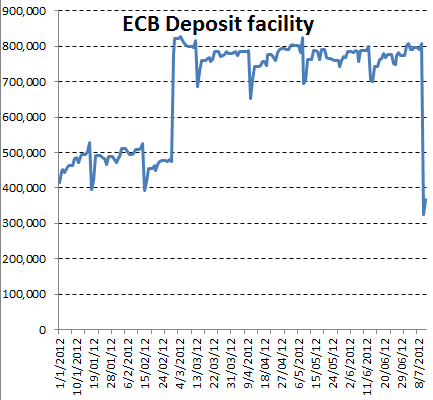
As discussed in the earlier post, the zero rate in the ECB Deposit Facility means there is no need for banks to move excess reserves back and forth between the reserve account and the Deposit Facility just to capture some of that 25bp the ECB used to pay on deposits. Banks are now comfortable just leaving more funds in the reserve account ("current account") for operational ease. That's why we've had such a drastic drop in the ECB Deposit Facility in the last few days.


SoberLook.com

Friday, July 13, 2012

Decline in Spanish banks' contribution to the ECB Deposit Facility

The flight of capital out of Spain can be seen in the deposits held by Spanish banks at the ECB Deposit Facility. Right after the 3-year LTRO program, Spain's banks had significant excess reserves. Those reserves rapidly declined as capital left the country.


Given that the overall Deposit Facility has been fairly static, excess reserves for other banks in the Eurosystem have gone up. Going forward these banks (in the Eurozone "core") will be turning away periphery depositors (or charging them for holding cash) because the ECB facility no longer pays interest. Moving deposits out of Spain has become more difficult.


See this link for the latest Banks of Spain balance sheet figures (h/t Kostas Kalevras).
SoberLook.com

Saturday, July 7, 2012

Draghi's zero deposit rate policy put an end to euro money market funds

There has been some confusion as to why the biggest US mutual fund operators are closing euro denominated money market funds to additional investments. The decline in euro cash fund products is not a new trend (see this post for some background) since such products have been unprofitable for quite some time. The managers have been subsidizing these funds in order to service their clients in hopes of recouping losses from more profitable programs. But Draghi's recent and somewhat surprising move to set the deposit rate to zero had finally put an end to these offerings.

Here is how these funds were kept operational. As money funds shifted away from commercial paper and into secured lending (due to heightened credit risk aversion), they were only able to scrape 12-20bp annualized returns throughout much of this year. Not enough to cover expenses, but it was something. Of course most investors in the funds were receiving zero returns for the privilege of holding euros with say a JPMorgan money fund.

The funds would lend (for 1-3 months) to Eurozone banks who had some excess collateral sitting around. These banks would post collateral, eliminating credit risk for the money funds. In turn banks would deposit this cash with the ECB and make a spread (about 13bp in the example below). Easy money if you have a few Bunds sitting around.


But once the deposit rate at the ECB was set to zero, the party was over. Banks could no longer make money this way and term repo rates collapsed to zero (see chart below). In fact some banks just stopped doing this altogether (putting a damper on the overall term repo market - see Kostas Kalevras updated post on the topic).

1m eurepo rate

Without the ability to invest via term repo, money market funds (as well as other cash holders) moved funds into the only thing they felt was safe in the euro world: German government paper. That pushed German notes with maturities of two years and under deep into negative yield territory. Such conditions simply make it impossible to operate a euro denominated money market fund, causing these firms to pull such products off the market (see the video below for more background).


SoberLook.com

Thursday, July 5, 2012

ECB rate cut impact will be marginal at best

The markets were not impressed by today's policy announcement from the ECB. Sovereign spreads are wider, the euro is lower by 1.1%, and European stocks are down 1.2% on the day. Here is what the ECB's Governing Council had decided:

ECB:
1. The interest rate on the main refinancing operations [MRO] of the Eurosystem will be decreased by 25 basis points to 0.75%, starting from the operation to be settled on 11 July 2012.

2. The interest rate on the marginal lending facility will be decreased by 25 basis points to 1.50%, with effect from 11 July 2012.

3. The interest rate on the deposit facility will be decreased by 25 basis points to 0.00%, with effect from 11 July 2012.
What does this mean for financial institutions and the ECB's attampt to ease credit conditions across the Eurozone?

1. About €180bn is currently borrowed under the MRO, and the rate cut should provide some relief for periphery banks who are the primary users of the facility. But the cut translates into savings of about €37.5 million euros a month - for all the banks using the facility combined. This is clearly helpful but is going to make little difference in these banks' behavior (in terms of credit) because they are looking for liquidity relief, not a tiny reduction in their borrowing costs.

2. Only €0.7bn is borrowed under the marginal lending facility. That's less than €150 thousand a month in savings - not even worth discussing.

3. Setting the deposit rate to zero (something the Fed had also considered) will have an impact on German and other stronger Eurozone institutions who have a great deal of excess liquidity. Thus far these banks have been moving funds between the reserve accounts and the deposit facility. That's because they need to maintain a minimum average balance in the reserve account (which pays zero interest on excess reserves). Once they achieve that average for the month (by holding an excess amount over a few days) they would move the funds back into the deposit facility which paid them 25bp.

ECB Deposit Facility (€MM)

Now with the reserve account and the Deposit Facility both paying zero on excess reserves, they will simply leave the money in the reserve account. Other than this change, banks' behavior is not driven by what they receive on excess reserves and whether the reserves sit in the Deposit Facility or the reserve account. It is highly unlikely therefore that the difference between 25bp and zero on deposits at the ECB will somehow encourage these stronger banks to extend more credit.

The markets were hoping for more action from the ECB on the heels of the recent summit. The hope was that if the politicians make a move in the "right direction", the ECB will reward them with more "non-standard monetary policy measures". But Draghi thought otherwise and of course the markets reacted accordingly.


For further discussion on the ECB rate cut see this post by Kostas Kalevras.

SoberLook.com

Sunday, March 18, 2012

SMP deposits excess bidding

Guest post by Kostas Kalevras (@kkalev, Blog)

The latest SMP term deposits data show increased bidding for the 7-day deposit facility, while the marginal rate has dropped to 0.26%, essentially equal to ECB’s deposit facility. The excess bid increased by more than 100 billion € after the second LTRO:

Date
Bid Amount
Alloted
Excess Bid
22 Feb
372.2
219.5
152.7
29 Feb
331.9
219.5
112.4
7 Mar
452.1
219.5
232.6
14 Mar
437.4
218
219.4

It seems that at least 1/3 of new net liquidity created through the second LTRO of 29 February does not have any immediate productive investment opportunity and is bid at the SMP 7-day deposit facility, signaling that the corresponding amount can be parted for at least a week from its holder bank.

Excess bidding drives the rate paid by ECB to the rate of the overnight deposit standing facility. Since the 7-day deposit is equivalent to a weekly risk-free repo transaction, the SMP rate sets a floor for short term repos (for risk-free assets). That corresponds to monetary easing for banks with access to excess liquidity and risk-free assets, mainly the banking systems with positive Target2 balances (Germany, Netherlands, Luxemburg and Finland), in a period where inflation risk is still elevated due to energy prices, while the periphery still faces high effective lending rates, low access to interbank lending, high unemployment and a deep recession.

Nomura (which first pointed out the high excess bidding at SMP deposit auctions) suggested  (hat tip Izabella Kaminska) that the ECB create a tradable 7-day Debt Certificate security in order to facilitate trading and repo lending. In my view such a policy would not be very successful since the banks acquiring the DC would be the ones with excess liquidity and not the ones with a liquidity deficit. What would probably be very helpful is a program like the Fed’s ‘Term Securities Lending Facility’ which would accept periphery collateral (for instance government debt) in exchange for high quality securities held outright by the ECB. One problem is that ECB’s monetary is quite different from the Fed’s, with low outright purchases of paper and a focus to short/medium-term lending. As a result, ECB’s high quality securities portfolio might be quite thin.

In general, SMP bidding makes the absence of a risk-free Eurobond quite clear, with banks seeking low yield/risk/term returns at an ECB created ‘repo market’, instead of lending their Euro-periphery counterparts, since the latter do not actually have access to high quality collateral and face sovereign and balance sheet risks.
SoberLook.com

Monday, February 6, 2012

LTRO redux

In anticipation of the second LTRO program from the ECB, Barclays Capital has revised its expectation of the Eurozone's "Surplus Liquidity" measure. Surplus Liquidity represents bank Excess Reserves (in the reserve account) plus the amount in the Deposit Facility; basically the amount available for lending/investing to the banking sector. Expressed another way, Surplus Liquidity is roughly equal to the total amount of euros in the euro-system less bank reserve requirements less government deposits directly at national central banks less physical notes in circulation.

Since LTRO-II is expected to introduce incremental semi-permanent liquidity into the system, the amount of Surplus Liquidity will go up accordingly. As much as the ECB does not want this program to be viewed as a form of QE, it actually is. The difference between this process and the Fed's program is that LTRO is locked up for three years (although banks can repay it after one year), while the Fed can start taking liquidity out at any time (the ECB can reduce balance sheet as well by selling other assets.) LTRO is also meant to support banks directly, while Fed's QE is a general expansion of base money.

Euro-system Liquidity Surplus (source: Barcap - 1/24/12)

Euro-system Liquidity Surplus (source: Barcap - 2/6/12)

The new 3-year LTRO will be allocated on Feb 29th. Barclays expects the take-up to be €250bn-350bn (closer to the upper end of the range). The actual size may depend on the types of collateral that will be eligible. Some third of the LTRO-II will be used to refinance existing short-term ECB loans. Another third will be used to cover maturing bank bonds, particularly the unsecured paper that has no natural buyers.

There are several implications of this program for the Eurozone:

1. We should see a spike in the ECB Deposit Facility comparable to the increase in the Liquidity Surplus (chart above).

2. This will further reduce private repo financing in the banking system, driving down M3, the broad money stock indicator, particularly in the periphery countries.

3. LTRO-II will create additional encumbrance of bank assets pledged as collateral to the ECB, making any unsecured bank paper even less likely to recover anything in default.

4. The ECB will be less willing to lower rates further until it sees the full impact of this program. The central bank wants to leave some tools in its "monetary toolbox", should the situation in the Eurozone suddenly take a turn for the worse.


For further information on the LTRO program, please see this description/manual called THE LONGER TERM REFINANCING OPERATIONS OF THE ECB.
SoberLook.com

Monday, January 23, 2012

Tired of hearing about the ECB Deposit Facility? Here is some good news.

A chart from Barclays Capital just may limit media coverage of the ECB Deposit Facility. The badly needed chart (below) shows Barcap's projections for what's called the "liquidity surplus" in the euro-system.

Euro-system Liquidity Surplus (source: Barcap)

The "liquidity surplus" represents the Deposit Facility balances plus banks' excess reserves. Excess reserves are the banks' current accounts (reserve accounts) at the ECB less the required reserves.  That amount fluctuates as banks "front load" their accounts to make sure the period average exceeds the required reserve amount.

Source: ECB

The excess reserves could be either positive or negative depending on where one is in the cycle. Therefore according to Barcap's chart, the Deposit Facility should be quite stable going forward except for the excess reserve cyclicality. Since the liquidity surplus is driven by the amount borrowed from the ECB (not banks hoarding cash), Barcap's forecast must assume that the net lending to banks by the ECB has stabilized.  With the 3-year LTRO significantly extending the average maturity, banks are not expected to repay their loans for a while. This will keep the net Deposit Facility balances reasonably stable, declining slightly over time.

And that is good news for those who don't want to hear about this facility any more. Since the facility is not expected to change for a while, it should result in the mainstream media staying away from covering the topic. It's just not going to be sensational enough going forward.
SoberLook.com

Tuesday, January 17, 2012

The Deposit Facility is an indicator of net borrowings from the ECB

There have been a great deal of focus recently on the ECB Deposit Facility as it reached another record today.
London Evening Standard: The huge amount - busting the previous record set last week - comes despite the ECB flooding the banking system with €489 billion in cheap loans to more than 500 banks last month. Analysts warned that banks were stuffing the cash into the ECB because they are too afraid to lend it to other potentially struggling banks while some are hoarding the cash to pay off their own debts maturing this year. 
ECB Deposit Facility balances (EUR-mm, source: ECB)
Does it indicate "cash hoarding" by the Eurozone banking system because banks are afraid of lending or is there something else going on?

First of all the euro area is a “closed system”. That means every new euro created by the ECB stays within the system. When the ECB lends to a bank it “creates” new euros temporarily until the loan is repaid. The ECB credits these borrowed euros to the bank’s reserve account. The bank has a choice to either keep the funds at the reserve account or move them out to the Deposit Facility which tends to pay a better rate than excess reserves. Banks generally keep the minimum amount necessary in the reserve account. They just want to make sure that the daily balances average out to a number that is above the minimum reserve requirement over a specific time period. This makes the reserve amount “cyclical”.

Required reserves vs. actual balances (EUR-mm, source: ECB)

But what happens if a bank chooses not to deposit the borrowed money in the Deposit Facility? For example it decides to purchase an asset. If it purchases an asset from another bank, now that other bank has the extra money in its reserve account and has to make the same decision - whether to keep the funds in the reserve account or move them to the Deposit Facility. As Credit Suisse pointed out, it works a bit like musical chairs – with the last bank holding the cash in its reserves ultimately having to move it into the Deposit Facility.

Here is where it gets interesting. If a bank lends what it borrowed from the ECB to a corporation (or an individual or a government), that borrower deposits the money with her own bank (also in the eurozone), where it ends up in the reserve account. If the borrower buys a truck with her loan, the truck seller still has to deposit the money at a bank (unless the buyer uses physical cash, which is a tiny amount of the overall euros in the system).  No matter where it travels, that newly “created” euro ends up in some Eurozone bank’s reserve account. And unless that bank at the end of the musical chairs game needs that euro for its reserve requirement, it moves it into the Deposit Facility. Which means that even if the eurozone banks were lending massive amounts to each other, to governments, corporations, individuals, etc., the same amount of money would still end up at the Deposit Facility (assuming reserve requirements didn't increase).

So the balances in the Deposit Facility depend on two factors: how many new euros the ECB put into the banking system and what are the banks’ reserve requirements at the time. That means that the Deposit Facility balances have less to do with how much lending eurozone banks are doing and more to do with the net borrowings from the ECB. The more banks borrow from the central bank, the larger are the initial total reserve balances in the system and the more gets moved into the Deposit Facility. The chart below shows the combination of bank reserves and the deposit facility with the cyclical movements between the two accounts clearly visible (as reserves decrease, the Deposit Facility balances increase and vice versa). 

Reserve balances and the Deposit Facility balances (EUR-mm, source: ECB.)  Note: in this chart the Deposit Facility amount is sitting "on top" of the reserves amount - these are not two separate charts.

Therefore when the Deposit Facility balances increase, the banks are not really “hoarding cash” – they simply have no choice but to use the ECB's facility. The way to interpret this record deposit amount is that the banking system as a whole is borrowing record amounts from the ECB on a net basis.
SoberLook.com

Wednesday, January 11, 2012

EU corporates move cash from bank deposits to repo

A number of large European corporations have sizable cash positions, a similar trend to what's been happening in the US. In the past these corporations would simply deposit that cash in their local eurozone banks. But these days the companies are much more cautious with their cash. Some corporations have bank subsidiaries (for example Nestle owns Nestle Bank), a practice generally illegal in the US, but common in Europe. They use their "internal" banks to deposit funds with the central bank to avoid credit risk, contributing to this rapid rise in the ECB Deposit Facility balances.

EUR Billion (source: ECB)
Corporations that do not have a bank subsidiary do not want to leave unsecured deposits at the banks, so they revert to lending to banks on a secured basis via repo.
Reuters: ... a group of well-known, cash-rich companies with solid cash flows has stepped in the repo market, which provides a form of lending so far almost exclusively in use between banks, and between banks and central banks.
To obtain additional protections on these loans, the collateral is often held by third parties in a so-called triparty repo.
Reuters: Based on his daily practice, Euroclear's Reiss estimated that up to 25 percent of the triparty market was on behalf of companies, a massive and sudden rise from the 2 to 5 percent where it had traditionally been.
To accommodate their corporate clients, banks need collateral to post on these repo transactions. And that is putting additional strain on collateral availability and helping to drive down repo rates in the eurozone.

3- month Eurepo rate (Bloomberg)

Hat tip Blankfiend

SoberLook.com

Tuesday, January 3, 2012

Eurozone citizens not benefitting from ECB's easing

The latest report from Capital Economics shows that the ECB’s easy monetary policy is not translating into improved credit conditions. The monetary base spiked after the ECB offered out the 3-year loans to the banking system.

Eurozone monetary base or "M0" (source: Capital Economics)
So far however this new liquidity is not being converted into any lending growth across the eurozone.  This can be seen in the weakness of M3, the broad money stock indicator.  But there are other signs of a difficult credit environment.  Similar to what happened in the US, loan growth to eurozone citizens has been dropping.  In particular growth in credit card lending has fallen off significantly.

Loans to individuals/households (source: Capital Economics)
Another sign of tightening credit conditions is seen in the survey of bank credit officers in the eurozone banking system. It shows more stringent credit standards - recent and projected.

Lending survey of credit conditions (source: Capital Economics)

And just as was the case in the US, banks are hoarding cash and depositing it with the central banks, as can be seen in the updated chart of the ECB Deposit Facility.

ECB Deposit Facility (source: ECB)

Given that liquidity provided by the ECB is temporary (overnight to 3 years - unlike true QE), it may be holding the banking system back from taking risk.  Sovereign debt is effectively "crowding out" private credit because banks still view it as a safer bet than industrial or consumer debt. And as long as they can make money on short term Italian government paper, why lend to an Italian household? 


SoberLook.com
Related Posts Plugin for WordPress, Blogger...
Bookmark this post:
Share on StockTwits
Scoop.it