US consumer credit report surprised to the upside today, beating forecasts by nearly $2bn.
Source: Investing.com
One positive aspect of this report is that for the first time in months we are seeing a jump in credit growth outside of the government sponsored student loans.
The key to this report however is that the bulk of that growth increase was driven by auto finance. Revolving credit, which mostly represents credit cards, has remained subdued for quite some time now.
In fact auto finance balances in the US have increased by 4% from a year ago. Who is funding all this growth?
Banks have certainly been active, with Wells Fargo for example growing its auto loan book by 15% over the past year. And then we have the securitization markets, where asset-backed securities (ABS) are used to finance pools of auto loans and leases. ABS spreads have tightened since the taper-driven fixed income selloff last summer as demand for this paper remains strong.
According to Deutsche Bank, we've had some $39bn issued in the first quarter alone.
Source: DB
And it's not just about auto loans - securitization has been heating up in auto leases as well. Tracy Alloway has a great article in the FT (here) on auto lease securitization (which involves taking exposure to residual value of cars that come off lease.) 2014 could be a record year for such issuance. All of this activity has helped to improve consumer credit growth this year.
As an aside, these are precisely the types of markets the ECB would love to jump-start in the euro area (see post). With the banking system still undergoing deleveraging, the central bank is looking for a way to get the "shadow" banking involved in order to boost consumer (and corporate) credit growth.
Recently, the ECB and the Bank of England published a joint paper calling for the return of securitization markets in Europe (see below). This goes completely against the grain of the latest Basel accord which has started imposing much higher capital requirements for holding securitized paper. The media called it "bringing back the toxic sludge" (see story). What's going on here?
With the Eurozone banking system on its back (see post), someone else needs to provide corporate and consumer credit. The central banks want to see the securities markets (shadow banking) take on that role. Some are outraged because securitized products are viewed to be one of the key causes of the financial crisis. However this is the case of "throwing out the baby with the bath water". It was a specific asset class, namely US subprime mortgages, that did most of the damage. But the media and many regulators have been applying the term "toxic" to all securitized credit.
ECB/BOE: - Despite the low issuance and the modest take-up by investors, most European structured finance products performed well throughout the financial crisis, with low default rates. According to an analysis by Standard & Poor’s, the cumulative default rate on European structured finance assets from the beginning of the financial downturn, July 2007, until Q3 2013 has been 1.5%. Some asset classes such as consumer finance ABS, SME Collateralised Loan Obligations and RMBS have experienced default rates well below this average and the performance of European structured finance products has also been substantially better than US peers.2 By way of comparison, ABS on US loans experienced default rates of 18.4% over the same period, including subprime loans.
The goal here is to get investor capital to the borrower without materially expanding the balance sheets of EU commercial banks (who are undergoing deleveraging). One of the obstacles to growing this business in Europe (and to some extent in the US) is the so-called Risk Retention Rule which was implemented in 2011. It requires that the structured bond issuer retains some "skin in the game" by buying a part of the origination (usually part of the most junior tranche). It's less of a problem for bank issuers, but creates barriers for independent managers who are not well capitalized. And since the ECB wants non-bank issuers to step up, this rule will cause some difficulties. Given the declines over the past few years in European ABS and other securitized credit product issuance, it will be a while before private securitization can materially supplement bank credit.
The Fed's banking survey seems to indicate that senior bankers on the whole see slower demand for auto loans in the US - see chart. The real issue here however is less with auto borrowers' demand and more about increasing competition. Even the largest lender in the space, the TARP-funded Ally Financial (formerly GMAC) is facing competitive headwinds as it loses its cozy relationship with Chrysler (while its GM contract is about to expire). And more banks are jumping into auto financing recently - particularly now that the mortgage refi gravy train has ended.
WSJ: - An exclusive contract with Chrysler to provide so-called subvented, or promotional rate loans, to car buyers ended last April after the auto maker struck a new financing partnership with lender Santander Consumer USA Holdings Inc.
A similar agreement with GM was set to expire at the end of 2013, but Ally President William Muir said during the call Thursday that the companies have extended their existing agreement and are working on completing a new agreement.
Competition in the auto-lending business has intensified during the last two years as more banks have increased their focus on the business amid a rise in loan demand.
Competition is especially heating up in the sub-prime auto lending - with companies such as Santander expanding into the business.
Reuters: - Santander Consumer offers loans through 14,000 car dealers across the United States and has about $25.6 billion of loans outstanding. A majority of the company's loans are subprime, which have higher yields but also higher default rates.
The demand for yield combined with ample liquidity has created a bid from shadow banking in the form of sub-prime auto ABS (asset-backed securities). The sub-prime ABS outstanding has increased significantly since the end of the recession.
Source: SIFMA
Of course all this competition means lower rates, riskier loans, and higher delinquencies.
Automotive News: - Subprime financing -- and delinquencies -- are likely to grow in 2014, says Melinda Zabritski, senior director of automotive credit for Experian Automotive.
Vehicle loan terms, which hit an average of 65 months for new cars during the first 10 months of 2013, also will continue to stretch out.
With more aggressive lenders in the market, many bankers are indeed experiencing less demand - particularly if they want to maintain their margins. The question is - at what point does this market become overheated?
After less that two years of modest but positive growth, real estate loans in the US banking system have recently gone into the red again. Lower demand and banks' unease with real estate keep this sector from growing.
Source: FRB
On the other hand, banks are making a big push into auto loans. Auto loan portfolios are up 6.4% from a year ago as car sales remain brisk. Note that non-bank (shadow) lenders including ABS buyers (see post) are also a major part of this market (just check Carfinco's shares on the Toronto Stock Exchange for example).
Source: FRB
Crain's Cleveland Business: - Columbus-based Huntington Bank enjoyed a record quarter in originations in indirect auto lending, the industry's term for when borrowers secure financing from a lender through a dealership. The bank's originations totaled $1.2 billion in the third quarter of 2013, up 10% from the year-ago period and nearly 19% from the third quarter of 2011.
...
Auto loan growth also has accelerated in 2013 at Firefighters Community Credit Union in Cleveland. Its auto loan balance in this year's third quarter was 13.6% higher than the year-ago quarter. That's a greatly improved performance over the 3.3% increase Firefighters recorded in the third quarter of 2012 over the like quarter in 2011, and the 7.5% decrease it saw in the third quarter of 2011 versus the third quarter of 2010.
Given the relatively low default rates in auto loans, banks' credit departments have loosened lending requirements. And as the average age of light vehicles in the US continues to rise (above 11 years), auto sales pick up (with US baby boomers now dominating sales - see story).
Detroit Free Press: - A boom in auto loans continues to support a resurgence in U.S. car buying that has hit its highest sales pace since 2007.
The total amount of outstanding auto loans topped $782.9 billion as of Sept. 30, up $103 billion from the same period last year, according to Experian Automotive’s quarterly report.
...
[Experian] said the availability of credit, combined with consumers’ strong track record of repaying loans, is helping banks justify greater access to loans and helping to boost U.S. automotive sales.
Through October, consumers have purchased 13 million new cars and trucks in the U.S., up 8.4 percent from the same period last year. The auto industry remains on track to sell about 15.5 million new cars and trucks this year - the most since 2007
But of course as the auto loan boom replaces the real estate boom of 7 years ago, signs of excessive lending and risk taking by banks are beginning to appear. Just as real estate lending was "safe" back then, auto lending is "safe" now.
Detroit Free Press: - Banks have become increasingly willing to provide loans to sub-prime customers and are allowing consumers to finance over a longer period, with some loans extending as long as eight years.
Indeed, longer dated auto loans are becoming increasingly common.
Montgomery Advertiser: - More new-car buyers are stretching out their loan payments for as many as seven years, and some experts worry that’s another financial time bomb.
While Not so long ago, remember the days when ads touted 48-month loans. Today the biggest growth is coming in loans lasting up to 84 months — That’s longer than most people are expected to want to keep their new car.
The longest-term new-car loans — 73 to 84 months — have jumped 25.1 percent in the past year and now make up 19.5 percent of total new-car lending, according to Experian Automotive. All other loan-length categories, in fact, have become less popular as buyers shift to longer terms to get lower payments.
The next-shorter category — 61 to 72 months, considered a very long loan only a few years ago — now is 41.7 percent of new-car loans, Experian says. That’s down 3.2 percent from a year ago, but it’s still by far the biggest single loan-length category.
One of the problems with risk management departments at banks is that they often "fight the last war". As a new asset class becomes in vogue - sometimes because of historically low default rates, banks pile into it and profits flow. With competition heating up, lending standards suffer, and risks of another systemic credit problem rise.
After a rough patch this summer (driven by "taper" fears), consumer asset backed securities (ABS) business is heating up again. The bulk of that business is represented by auto and credit card loans. The pick up in demand is visible in the ABS index credit default swap contract called ABX.
Source: Markit
As a result of this liquidity, this year's car purchaser will generally have no problem obtaining credit. This even applies to some so-called sub-prime auto borrowers with low credit scores.
Furthermore, some of the longer term auto financing (5 years and longer) is on the rise.
Fitch Ratings: - Auto loans with original terms of 60+ months (longer-term loans) increased in 2012-2013 auto loan ABS transactions versus 2009-2011 pools. Though Fitch Ratings believes the growth of these types of loans could be negative, as they have potential for increased loss severity, we currently view these loans as underwritten to account for this additive risk and do not expect transaction asset performance to be significantly affected.
Overall, there has been a 20% increase in longer-term loans in auto ABS transactions in 2013 since 2010. The use of extended-term loans in nonprime ABS transactions increased with loan pools containing approximately 80% longer-term loans in transactions issued in 2013, up from 67% in 2010. Similarly, in the prime sector these loans comprised 43% of pools securitized in 2013 from 36% in 2010.
In spite of popular belief that ABS securitization business is limited to major "Wall Street" banks, the large regional players love this business even more. In this regulatory environment banks' ability to build a book of auto loans and then blow out a large portion of it via securitization is particularly appealing.
Fitch Ratings: - ... Fitch sees the revival of auto ABS issuance partly as an effort by these banks to gain some regulatory relief on capital and liquidity requirements.
Aside from Huntington Bancshares, few large U.S. regional banks have been frequent issuers of auto ABS paper recently. However, Fifth Third, M&T Bank and other lenders have launched new deals. Many of these transactions have been upsized from initially proposed levels.
...
Banks are likely viewing the openness of the market as an opportunity to swap out less liquid loans for securitizations that stay on the balance sheet but receive more favourable treatment under Basel III with respect to capital and liquidity.
In some cases, the deals have included a large share of banks' total auto-loan books. For example, collateral in M&T's recent $1.4 billion ABS transaction represented over 60% of its total auto loans. Fifth Third's recent $1.3 billion ABS transaction was collateralized by a pool of loans exceeding 10% of the bank's total auto-loan balance as of June 30.
Why do investors love this asset class? There are two key reasons:
1. Consumer ABS loans' tenor tends to be relatively short. Even a 5-year auto loan is far easier to get comfortable with than a 30-year mortgage.
2. Delinquency rates on ABS have been benign. Prime auto loan delinquencies for example are near historical lows.
Just to put this in perspective, the following chart compares delinquency rates for consumer non-real estate loans (blue) with mortgage loans (red).
This spectacular divergence that started with the housing recession in 2007 persists through today and continues to make ABS assets attractive on a relative basis.
Can unsecured consumer lending be disintermediated? At least one fairly successful company thinks it can - as long as you get large groups of people willing to borrow and investors willing to lend. The company is called Lending Club. The firm allows for pooling of personal loans, with borrowers rated from from A to G based on the credit profile. In this low rate environment returns generated by this lending look attractive and are available to investors who don't own a credit card provider.
Source: Lending Club
Lending Club charges both the investors and the borrowers some fees - with the riskier borrowers paying higher charges. Investors can come into this program through their IRA account to get tax free interest income.
Sounds risky? It all depends on how diversified the portfolio is. About $20k buys some 800 "notes". An investor can build a portfolio by selecting pieces of loans from rated borrowers as they come online. The system also tells investors a very indicative "use of proceeds" as well as what portion of each desired loan has been raised so far. Each investor effectively becomes "the bank", electing how much to lend to whom (although for regulatory purposes it seems that loans are funneled through "WebBank, a Utah-chartered Industrial Bank").
Source: Lending Club
What's good about this program is that unlike credit cards who generally charge a high rate to all borrowers, the credit scoring provides cheaper capital to the strongest borrowers. These are credit markets at work - applied at the retail level.
According to the company almost $1.5bn has been funded this way. It's a drop in the bucket compared to trillions in consumer finance, but is certainly a good proof of concept.
Is this a sign of where consumer lending is headed? Should the credit card industry be concerned that technology-based free market will one day disintermediate them?
Finally here is an easy to follow, comprehensive, well researched, and unbiased paper from FRBNY (Tobias Adrian and
Adam Ashcraft) on the so-called shadow banking (many thanks once again to Kostas Kalevras for pointing it out). A few comments:
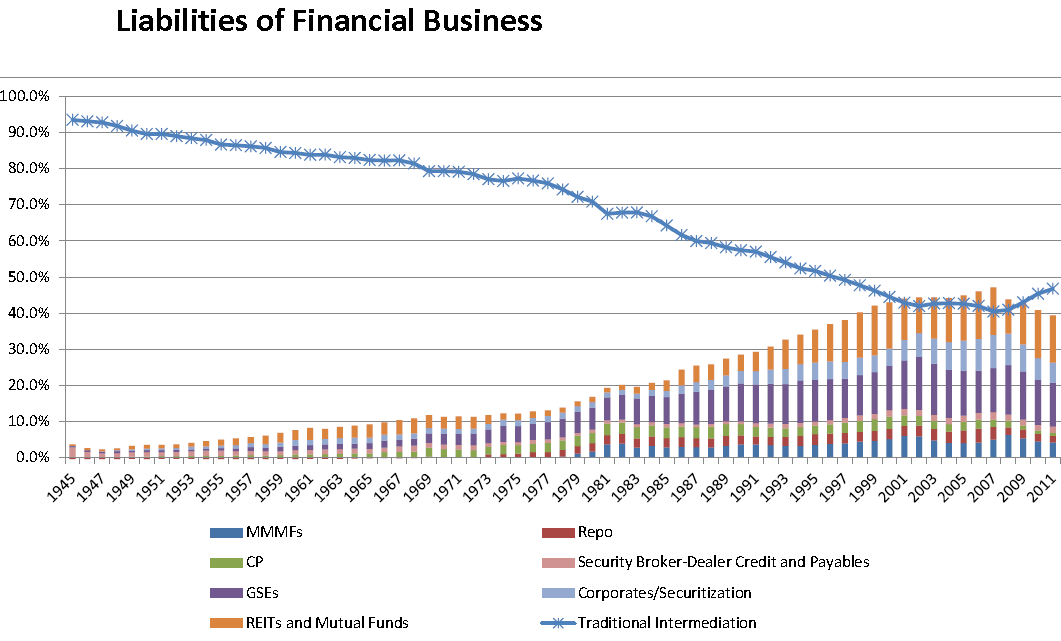
I. This chart from the paper shows the breakdown of the "traditional" vs. the "shadow" banking market sizes. It is important to point out the precise definition of traditional banking sources of funds.
Traditional Intermediation [sources of funding] refers to net interbank liabilities [banks borrowing from each other] plus
checkable and savings deposits of depository institutions plus reserves of life insurance companies and pensions plus [unsecuritized] corporate debt.
Source: FRBNY (click to expand)
Note that a big chunk of shadow banking is comprised of the GSE (Fannie Mae, Freddie Mac), something the mainstream media often misses. Also this does not include government sponsored student loans, which many would classify as shadow banking (and could become a serious issue at some point).
II. The authors may have overemphasized the complexity of the securitization process with the 7 steps (chart below). Yes, in the few years leading up to the financial crisis, with CDO squared, etc., one could potentially count this many steps. But those days are over. Modern securitization usually involves only the first three steps. For example, in CLOs one has the following:
Banks lend to corporations and syndicate those loans.
The CLO manager uses a "warehouse line" to purchase some large portion of the loans needed for the CLO.
A permanent entity is set up, which issues the liabilities (tranches) and buys the loans out of the warehouse. It than uses excess cash from issuing the tranches to buy more loans in the market.
ABS deals (autos, cards, etc.) also have three steps and are even simpler. The use of ABCP has declined dramatically and with it went some of the more complex securitization (see discussion).
Source: FRBNY (click to expand)
III. The authors also put too much emphasis on regulation. Investors need to do their own homework rather than relying on rating agencies as they often did prior to 2008 (rating agencies had some serious conflicts of interest - also discussed in the paper). If a sophisticated investor buys a complex bond without understanding the risks, it has to be his/her problem. The government should stay out of it because in trying to protect such investors the authorities will create moral hazards. Plus the fact that something is regulated doesn't make it a safe investment by any stretch. There are plenty of "regulated" stocks and ETFs out there that could do serious damage to one's portfolio. Regulation of shadow banking should be limited to how it impacts regulated banks (such as not allowing Citibank or Wachovia to run a massive off-balance-sheet portfolio via CP conduits with a relatively small regulatory capital allocation - regulatory capital arbitrage). Assigning appropriate levels of capitalization to liquidity backstops and credit guarantees is where the focus should be.
The other type of regulation that would be helpful is in products that are marketed and sold to retail investors/borrowers. For some reason mortgage brokers do not have to have the same level of regulatory scrutiny and licensing requirements as securities brokers. Yet for many households a mortgage is a much more risky transaction than their securities purchases (see discussion) - as we have discovered during the financial crisis.
IV. What many people (particularly the mass media) don't fully appreciate is that much of the securitization activities - which if done properly can be extremely helpful to the US consumers and to the economic growth as a whole - were started by the US government.
FRBNY: - In many ways, the modern shadow banking system originated in the government sector. Securitization
was first conducted by government-sponsored enterprises (GSE), which are comprised of the FHLB
system (1932), Fannie Mae (1938), and Freddie Mac (1970). The GSEs have dramatically impacted the
way in which banks are funded and the way in which they conduct credit transformation: The FHLBs
were the first providers of term warehousing of loans, and Fannie Mae and Freddie Mac pioneered the
originate-to-distribute model of securitized credit intermediation.
Like banks, the GSEs fund their loan and securities portfolios with a maturity mismatch. Unlike
banks, however, the GSEs are funded not through deposits, but through capital markets, where they
issue short- and long-term agency debt securities. These agency debt securities are bought by money
market investors and real money investors such as fixed-income mutual funds. The funding functions
performed by the GSEs on behalf of banks and the way in which GSEs are funded are the models for
wholesale funding markets. The GSEs use several securitization techniques. They use term loan
warehousing services provided by the FHLBs. They also use credit risk transfer and transformation
through credit insurance provided by Fannie Mae and Freddie Mac. Securitization functions are
provided by Fannie Mae and Freddie Mac. Maturity transformation is conducted on the GSEs’ balance
sheets through retained portfolios. These securitization techniques first used by the GSEs were adopted
and imitated by banks and nonbanks to generate the nongovernmental shadow banking system. The
adaptation of these techniques gave rise to the securitization-based, originate-to-distribute credit
intermediation process.
Here is what chasing yield looks like in the current environment. The horizontal axis indicates the size of each US fixed income market (in $trillion). The vertical axis shows the yield adjusted for historical losses due to defaults (more on that later). The Agency MBS adjustment takes out the prepayment option (OAS).
The Fed is achieving its goal - investors are shifting to the left.
The ABS market in the Eurozone has shrunk dramatically. There is no paper to be found and investors are trying to figure out what's going on.
Bloomberg: - Frank Erik Meijer, who buys asset- backed securities [ABS] for Aegon Asset Management Holding BV, wanted 1 billion euros ($1.2 billion) of bonds tied to car loans. Two weeks later, his brokers had raised 2 percent of that amount.
“There are, simply, no sellers,” Meijer, who’s been investing in Europe’s securitization market for seven years, said in an interview from The Hague, Netherlands.
Sales of bonds backed by mortgages, auto loans and credit- card payments have plunged about 80 percent in the five years since the financial crisis started, which is bad news for politicians counting on consumer spending to rescue the continent from recession. It’s also a problem for investors such as Meijer, who favor the top-rated bonds as a safe, higher- yielding alternative to German debt and other haven assets.
Asset-backed bond sales fell to 41.9 billion euros for the year through Aug. 6, from 50.5 billion euros in the same period of 2011 and compared with a record 509 billion euros in 2006, JPMorgan Chase & Co. data show. The drought is forcing investors to accept the lowest yields in five years on some securities.
So where is all the euro denominated ABS paper? Two trends in the Eurozone are responsible for this collapse in ABS activity.
1. Clearly the economic slowdown has reduced demand for consumer loans. With fewer loans to build collateral pools, secularization has slowed.
The ECB (bank survey): - Net demand for consumer credit continued to decline strongly in the second quarter of
2012, at -27% according to euro area banks, compared with -26% in the previous survey
round. According to euro area banks, the protracted decline was mainly driven by less
household spending on durable goods (-28%, unchanged from the first quarter of 2012)
and a decrease in consumer confidence (-26%, compared with -28% in the first quarter of
2012).
2. Eurozone banks can't or don't want to sell ABS bonds. The majority of banks in the Eurozone periphery nations (and some in France) have securitized all the consumer loans on their balance sheets they could - particularly where they could get an investment grade rating. But instead of selling these bonds, they posted them with the Eurosystem (the ECB) as collateral in order to obtain financing. This practice became widespread as the ECB expanded collateral eligibility rules and the dependence on the ECB funding increased.
The ECB: - In addition to the ABSs that are already eligible for use as collateral in Eurosystem operations, the Eurosystem will consider the following ABSs as eligible:
1. Auto loan, leasing and consumer finance ABSs and ABSs backed by commercial mortgages (CMBSs) which have a second-best rating of at least “single A” [1] in the Eurosystem’s harmonised credit scale, at issuance and at all times subsequently. These ABSs will be subject to a valuation haircut of 16%.
2. Residential mortgage-backed securities (RMBSs), securities backed by loans to small and medium-sized enterprises (SMEs), auto loan, leasing and consumer finance ABSs and CMBSs which have a second-best rating of at least “triple B” [2] in the Eurosystem’s harmonised credit scale, at issuance and at all times subsequently. RMBSs, securities backed by loans to SMEs, and auto loan, leasing and consumer finance ABSs would be subject to a valuation haircut of 26%, while CMBSs would be subject to a valuation haircut of 32%.
These bonds are "trapped" at the National Central Banks and will likely not see the light of day (dependence on the ECB funding is not going away any time soon).
But even banks in the Eurozone core nations do not want to sell their consumer loans. With rates in those nations at or even below zero and demand for loans from consumers weakening, these banks need to hold on to consumer loans they have to provide them with much needed interest income.
Asset backed securities (ABS) continue to hit the market in volume, with both high quality as well as subprime paper in high demand.
Top quality:
Bloomberg: - Nissan Motor Co. sold $1.4 billion of bonds tied to auto loans at the lowest rate ever as the Federal Reserve’s efforts to spur economic growth reduce borrowing costs.
The company issued the top-rated securities with an average life of 1.49 years to yield 0.481 percent, the lowest financing rate for an auto company in the asset-backed market on record, according to data from Citigroup Inc. (C), the lead manager of the transaction. Though spreads on the debt were narrower in 2006, the higher lending benchmarks boosted the cost, the data show.
Subprime:
Bloomnerg: - Sales of bonds tied to payments on subprime car loans are accelerating at the fastest pace in five years as investors seek high yields amid speculation the Federal Reserve will keep interest rates at record lows until mid-2015.
Led by Santander Consumer USA, issuance of $10 billion this year in asset-backed debt linked to vehicle loans to borrowers with spotty credit records compares with $8.2 billion in the same period of 2011, according to Barclays Plc. Top-ranked securities backed by the loans yield between 15 and 25 basis points more than benchmark swap rates, versus 5 to 8 basis points for similar debt of prime borrowers, Deutsche Bank AG data show.
The demand is also seen in the asset backed CDS rally - the "AAA" tranche of asset backed CDS index called ABX (chart below) is up 18% since May.
Analysts are tracking this index and the ABS market in general quite closely because the development/recovery of ABS is critical to US economic growth (these markets freezing was the whole reason behind TALF).
China's residential property values are continuing to decline. The chart below from ISI Research shows that the rate of decline is now similar to the lows in early 2009. And data from ISI tends to be more accurate than the official numbers coming out of China's housing ministry.
Reuters: - An unnamed spokesman from the housing ministry was quoted as saying that "all localities must firmly implement various property tightening measures as required by the central government."
In spite of this being an "unnamed spokesman", such policy directives are fairly common. And this particular directive is not at all surprising. Beijing is sending a stern message to local authorities to keep the measures place.
However as the nation undergoes an economic slowdown, which may end up being more severe than the authorities had anticipated, the tightening measures in the housing market may be relaxed (particularly at the local level).
Reuters: - ... the weakening economy, likely to grow at its slowest pace in more than three years this quarter, is fuelling expectations that Beijing will probably have to relax property curbs if external headwinds worsen.
Reinforcing such expectations are local governments' steps to make it easier for first-time home buyers, by relaxing policies marginally so as not to irritate Beijing while stimulating local housing transactions.
The local governments have profited tremendously from the housing boom and will do whatever they can to prop up sales and prices. There is some anecdotal evidence that home sales have indeed been brisk. But given the high levels of unsold inventories, any material increases in prices from this point are unlikely.
Reuters: - ...high inventories will cap any quick rebound in home prices in the near term, [China Securities Journal] cited Home Link analyst Chen Xue as saying.
Vanke, China's largest developer by sales, said earlier this month it would take about 11 months to sell down unsold stocks in key cities such as Beijing, Shanghai and Shenzhen.
"I'm not worried about a home price rebound as long as the government keeps its tightening stance," Hui Jianqiang, head of research at the China Real Estate Association, told Reuters after the data.
Here is a nice chart from Barclays that shows how much the various nations' banking systems rely on ECB funding. The data is as of the end of May except for three countries.
Source: Barclays Capital
The bulk of this is via LTRO (3-year) loans. Spain's banks however also tapped MRO (short-term) loans in May because the 3-year LTRO is not currently available and banks had to shift funding from private sources (deposits) to the central bank. Given that all of these loans are collateralized, some have asked where do banks get this seemingly unlimited amounts of collateral. The answer is that once banks run out of assets that are "ECB eligible", they create new collateral with the help of their governments (as discussed here and here).
A number of readers have asked about the declines from the peak of mortgage backed securities (MBS) holdings on Fed's balance sheet. Here is a quick overview.
MBS on Fed's balance sheet
Right after the financial crisis, the Fed initiated the first round of balance sheet expansion (QE1) which involved MBS. The Fed at the time was buying massive amounts of these securities, effectively consuming the bulk of agency new issue and then some. The balances went above 1.1 trillion before the program ended.
QE2 did not involve MBS and neither did the Operation Twist. Unlike treasuries however, MBS tend to prepay when mortgage holders refinance. It means that the principal of these bonds naturally declines, particularly as rates drop and refinancing gains momentum. That was the reason for the decline in balances after the peak in 2010.
Late last year, the Fed decided to start replacing the portion of MBS that pays down or matures. It was the fall of 2011 and things looked shaky in Europe. The Fed wanted to send a signal that it is ready to take action, and stabilizing the MBS holdings was one of them. That's when the balances stopped declining.
The central bank may end up revisiting MBS purchases as part of the next easing program (as discussed here), although outright purchases are still unlikely.
With all the negative economic and market news out there it's worth pointing out a positive development that's been taking place recently. It is the expansion of bank credit in the US, which surprisingly has held up reasonably well. Certainly the rate of expansion is nothing like it was during the 04-07 period, but nevertheless it is trending up.
Source: Board of Governors of the Federal Reserve System ($MM)
This growth in credit is driven by improved lending (as opposed to securities purchases). The lending trend is something the Fed pays a rather close attention to. When lending continued to decline in the second half of 2010, the Fed initiated QE2. Lending in the US had bottomed in early 2011 and has been on the rise since then.
Source: Board of Governors of the Federal Reserve System
The decline in 2010 was led by slowing consumer lending (which had made Bernanke & Co. very uneasy). Consumer credit had since stabilized (arresting the decline in the overall lending - above) but for now is not showing any sustainable growth trend..
Source: Board of Governors of the Federal Reserve System
In fact growth in lending has been driven by corporate loans, which began to increase sine the late 2010 and have been on a steady upward trajectory since.
Source: Board of Governors of the Federal Reserve System
These trends in credit conditions should give the FOMC a pause if the Committee chooses to consider QE3. In spite of the mess in Europe, the overall liquidity conditions in the US look considerably better than they did in 2010 when the Fed felt that balance sheet expansion was warranted. That does not preclude the Fed however from extending Operation Twist or implementing sterilized purchases.
For those who love risk, take a look at DirexionShares. It exemplifies the proliferation of leveraged ETFs - particularly the ones that give you three times the return (3 x ETFs). Take for example the one with the ticker symbol GASX - that's right, the same name as the famous medicine. It's an ETF that is 3x short natural gas equities.
GASX Fund Objective: - "The Direxion Daily Natural Gas Related Bear 3x ETF seeks daily investment results, before fees and expenses, of 300% of the inverse (or opposite) of the performance of the ISE Revere Natural Gas Index. There is no guarantee the fund will meet its stated investment objective."
From its inception (about two years ago) GASX is down 38.5%. The negative 3x the natural gas index (which is what the ETF is supposed to be tracking) is up 17% for the same period. If you bet against natural gas companies 2 years ago, you would have been right, but this ETF would have lost you close to 40%. Ouch.
What makes this even more interesting is that its twin, GASL, the 3x long natural gas index ETF is is also down for that same period - a whopping 48%.
What gives? This is what's known as leveraged ETF slippage (illustrated here). Over time you lose either way. And the higher the volatility the more you lose. The chart below shows GASX daily annualized vol - over a period of 250 business days - approaching 100%. Using shorter periods, the volatility measures are even higher. That's why slippage is such a big problem.
GASX - Rolling 250 business days vol
Now if you want to find alternative ways of losing money, try some of the other Direxion ETFs. Indian equities, long-term treasuries, semiconductors - whatever your heart desires - all 3 times. Who said that derivatives and leverage was just for the big guys?
It is in fact remarkable that this is a retail product. But no worries, there is proper disclosure.
Fact sheet disclosure: - Investing in the funds may be more volatile than investing in broadly diversified funds. The use of leverage by a fund increases the risk to the fund. The Funds are not suitable for all investors and should be utilized only by sophisticated investors who understand leverage risk, consequences of seeking daily leveraged investment results and intend to actively monitor and manage their investment. The Funds are not designed to track the underlying index over a longer period of time.
And clearly most retail investors will read this and say: "but of course, the volatility is extremely high - so I should expect some tremendous slippage risk."
Expectations were high last week that India's central bank would cut rates. After all, the slowdown in growth has become quite visible.
Reuters (last week): - ... supporting bond prices are expectations the RBI will cut interest rates by 25 basis points this month after recently weak January-March economic growth data. Some analysts expect an additional cut in the cash reserve ratio, or the money banks must park with the central bank.
Instead we got no change in rates today with the following statement:
RBI - ... notwithstanding the moderation in core inflation, the
persistence of overall inflation [CPI is above 10%] both at the wholesale and retail levels, in the face of significant
growth slowdown, points to serious supply bottlenecks and sticky inflation.
Inflation indeed remains sticky. With the rupee at 56 to the dollar (near all-time low), risks of food inflation are still substantial, while labor costs continue to grow (wage inflation has been a real issue).
It seems however that some of these inflationary pressures and currency weakness may be caused by RBI's own policies of balance sheet expansion.
Reuters: - The OMOs [open market operations] from the Reserve Bank of India would resume bond purchases after a two-week absence, helping offset the impact of expected outflows as corporates start paying taxes ahead of the June 15 deadline.
The RBI is injecting funds to facilitate tax payments? If so, that would be a one shot transaction that later gets "mopped" up. But the RBI has not been selling the bulk of its securities back into the market. In fact the recent aggressive rate of net purchases has been nothing short of a full blown quantitative easing (QE).
Credit Suisse: - In FY13, the RBI has bought Rs687 bn of bonds until 12 June. This
annualises to an unprecedented Rs3.4 tn of bond-buying, and at 3.4%
of the GDP, it is a level of monetary stimulus that is rare even
in these times globally. To put things in perspective, the Fed’s bond
buying in 2011 was 3.9% of US GDP.
The central bank seems to be targeting to lower long-term rates (the 10-year is at 8.2%) - similar to what the Fed has been doing but without selling the equivalent amount of short-term securities.
Credit Suisse: - What is worrying for us is that the un-announced purchases continue
to be meaningful. Only Rs480 bn of the Rs687 bn has been through
pre-announced Open Market Operations (OMOs), and the rest
through un-announced unsterilised interventions. The latter can be
seen as an attempt at yield management by the central bank.
The chart below shows the cumulative securities purchases by the central bank since 2008.
Purchases - Sales - Redemptions (cumulative since 1/1/2008)
This policy of QE could certainly explain the currency weakness and inflationary pressures the nation has been facing. So far this approach has resulted in a stagflationary environment that will be increasingly difficult for the RBI to overcome.
As analysts look deeper under the hood of Spain's public finances, they are finding an an increasingly unstable engine. It's not just the growth in the debt to GDP ratio
that worries people but also the "contingent" liabilities and other debt not yet included in this ratio. In many cases the central government will be stepping in to bail out regional governments, some of which are in trouble (sometimes unable to pay vendors such as garbage collectors, etc.). FROB (Fund For Orderly Bank Restructuring) that gets consolidated into government's balance sheet has contingent liabilities to the banking system. And the government continues to guarantee bank-issued unsecured bonds that banks use as collateral at the ECB to borrow funds. That allows them to buy more Spanish government paper to support Spain's bond auctions. The chart below shows how government guarantees have grown in the past few years - both on an absolute basis as well as the percentage of the GDP.
Italy to Spain 10-year spread has hit a record (as did the Spanish yields, spreads, and CDS levels this morning). In fact some in the market are now putting on Italy to Spain spread trades (long Italy short Spain).
Italy 10y yield minus Spain 10y yield.
With the Greek elections out of the way, Spain will now be the primary focus.
Financial advisers continue to profess that US treasuries should be a large part of a balanced portfolio. With the 10-year treasury yielding around 1.6%, the advice is hardly based on return expectations. It is also not due to expectations of mark to market gains. The up-side case in being long the 10-year treasury would be if the rate were to drop to the level of Japan's - just over half (a fairly unlikely outcome). The mark to market gain would be 7.5%. The downside case on the other hand would be if the 10-year yield rose to what it was just a year ago (or higher) - say around 3%. The mark to market loss would be around 11.5%. So the instrument effectively has an asymmetric payout profile and terrible current yield. What gives?
What many advisers point out is that long-term treasuries can significantly reduce portfolio volatility - acting as a hedge. And investors are willing to live with the poor returns and asymmetric payout profile (paying insurance premium) in return for stabilizing their portfolios.
The analysis below looks at portfolio volatility by mixing equities with
1. Long-term treasuries
2. Medium-term treasuries
3. Cash
The horizontal axis is the percentage of the portfolio invested in SP500, while the vertical axis is the daily volatility over the past two years. 100% of the portfolio invested in SP500 produces a volatility of 1.22%. As we start adding other assets the volatility declines.
What this tells us is that long-term treasuries have provided the largest reduction in portfolio volatility while allowing the investor to maintain a fairly high exposure to equities. With 45% in equities and 55% in long-term treasuries (optimal portfolio mix), the volatility drops to 0.45%. The same mix with medium term treasuries produces volatility of 0.50%, and cash at this same ratio results in 0.55%.
This explains why market participants are willing to hold treasuries in spite of an asymmetric longer term payout and extremely low current income. Long-term treasuries provide effective short-term insulation (better than cash) against volatility - a property that has been extremely valuable to investors.
It is unclear however whether treasuries will continue having the same volatility-reducing properties over the long-term. We've certainly had periods in the past when this relationship did not hold (1994-96 for example).
When a non-Eurozone central bank holds euros, it tends to deposit those euros with the ECB. So when the Fed executed its liquidity swap, it received euros as collateral and deposited them in its account at the ECB. That deposit by the Fed created a "non-Eurozone resident" liability at the ECB.
But the Fed's liquidity swap is now a fraction of what it was at its peak. The ECB returned the dollars and the Fed returned the euros.
Fed Liquidity Swap
That means the ECB's liability to non-Eurozone residents should have declined. And it has, until recently. But now we have a new spike in non-resident liability at the ECB. So who outside the Eurozone is depositing a massive amount of euros? The Swiss National Bank (SNB) of course. As as the SNB defends the Swiss Franc from strengthening (trying to keep the peg at 1.2), it buys a great deal of euros and of course promptly deposits them at the ECB, increasing the non-resident liability .
Therefore this second spike is created by flight of capital our of the Eurozone (the ECB provides this data on a weekly basis allowing one to monitor the trend closely - ht Kostas Kalevras). Note, these euros are still held within the Eurozone (the amount of euros is always fixed unless the ECB chooses to change it), but they no longer belong to Eurozone residents. These Eurozone residents have swapped their euros for Swiss Francs.
With all the talk about mark to market accounting, nobody seems to care that US pensions do not use these accounting principles when determining the present value of their liabilities. Pensions mark to market their bond portfolio based on current rates and spread levels (i.e. current yield/spread curve). However liabilities are discounted using a 2-year average of the investment grade corporate curve (see attached document for the latest rates). That means that pension liabilities are currently undervalued relative to pension assets because rates have come down so sharply in the past two years.
One would think however that in the next two years this problem should correct itself as low rates get reflected in the average. As the 2-year average starts including these low rates and liabilities become worth more on a present value basis, an increasing number of pensions will become underfunded and corporations will be required to inject more capital. And that in fact has already been taking place.
Treasury and Risk:
- Corporate contributions to defined-benefit pension plans have been
rising, reflecting the damage done to plan assets by the financial
crisis and recession and the boost to plan liabilities that results from
record low interest rates. A study published last fall by the Society
of Actuaries showed that in the decade that ended in 2009, companies’
cash contributions to their plans averaged about $66 billion a year. The
study estimates that minimum required contributions will average $90
billion a year in the decade that started in 2010 and hit a peak of
about $140 billion in 2016.
But no worries - the corporate pension lobby was able to get to the US politicians before the really low rates got into the average. And the politicians snuck in a little provision into (of all places) the Transportation Spending bill that was recently passed by the US Senate changing the rolling 2-year averaging into a 25 (twenty five) - year average. Rates of course were significantly higher in the past 25 years than they are now and will likely be in the next few years.
MERCATUS CENTER AT GEORGE MASON UNIVERSITY: - The provision in the Senate-passed version of the Transportation bill currently under consideration in the House would allow corporations to use a 25-year average rate as opposed to the current 2-year average, increasing the current discount rate from the 4 percent range to roughly 6 percent. Since liabilities are sensitive to discount rate assumptions, the plan's liability will change roughly 15 percent for every one percentage point change in the discount rate. For example, Boeing reports that a mere quarter of a point increase in the discount rate could cut its pension liability by $1.7 billion. Apply a small discount rate hike across all private plans and it's easy to see why corporations are lobbying Congress for a discount rate boost.
All of a sudden pensions will no longer look underfunded.
Accounting magic!
JPMorgan: - This artificially low sensitivity [the two-year smoothing] of US pension liabilities to market rates is set to decline even further under new rules being proposed by Congress as part of the Transportation Spending bill passed by the Senate in March (S. 1813) and now being considered by the House.
Buried on page 1472 of the bill are new rules on “Pension Funding Stabilization” that effectively put a corridor on the discount rate used to value pension liabilities. The upper bound of this corridor is equal to a rolling 25-year average of the IRS published corporate bond yield scaled up by a factor (110% for 2012, 115% for 2013, trending up to 130% for 2016 and beyond); the lower bound equals a rolling 25-year
average of the IRS published corporate bond yield scaled down by a factor (90% for 2012, 85% for 2013 and trending down to 70% for 2016
and beyond). The 25-year average greatly increases the smoothing effect, further reducing the reported sensitivity of pension fund liabilities
to changes in market interest rates.
...
While the House has thus far failed to bring the Transportation bill to the floor for a vote, our best guess is that Congress approves a bill that
includes these pension funding rules in the next month. Congress considers the Transportation bill “must-pass” legislation; part of the
funding for it in the Senate bill comes from increasing employer premiums to the Pension Benefits Guaranty Corporation and there has been limited pushback on this in the House. This makes it likely pensions will be a component of any Transportation bill that is passed. With the current funding authorization expiring at the end of this month, therefore, we view it likely that a bill is passed that includes new rules on
Why do we care? Again, the taxpayer is very much at risk here. As discussed before, the US pension bailout fund PBGC is already stretched and may require more taxpayer money. Now it would be taking over pensions that will be even more underfunded, with asset values way below the present value of the liabilities. And more of taxpayers' money will be used to fund the benefit payments.