Showing posts with label investment grade spread. Show all posts

Wednesday, December 25, 2013

US credit risk appetite hits euphoria

Per earlier post (see discussion and chart), corporate spreads in the US are grinding lower - with new post-recession lows for both IG and HY spreads. The Merrill HY Index spread is now below 400bp and the investment grade equivalent is below 130bp. For those who track fixed income ETFs, the following chart comparing treasuries with corporate bonds (LQD vs. IEF and HYG vs. IEI) illustrates the extend of spread compression.


In fact US corporate credit is outperforming other forms of credit assets such as commercial real estate (see post). A good way to see that outperformance vs. global risk assets is in the components of the Credit Suisse Risk Appetite Index. For the first time since Bernanke began hinting about taper, US Credit Risk Appetite is at the level of "euphoria".

Source: Credit Suisse

But some argue that these credit spread levels are justified given where the US stock market is currently valued. The scatter plot below shows the S&P500 index vs the HY index spread over the past 10 years. The last time spreads were at these levels (2007), equities were priced much lower (S&P500 was around 1550). Of course corporate revenue has grown substantially since then making this comparison less relevant. Nevertheless some are suggesting that it's the stock market which is overvalued relative to credit.


Whatever the case, as monetary conditions in the US begin to tighten and interest rates rise, credit spread compression has to slow or reverse. The current trend is simply not sustainable.


SoberLook.com
From our sponsor:

Thursday, November 21, 2013

Corporate credit markets back to frothy levels

This summer's growing fears of the Fed's impending policy change hit a number of fixed income sectors quite hard. While corporate credit was the best performer on a relative basis, it too was hit by some sell-off and a decline in liquidity. In September however an event in the bond markets brought investors back. Verizon's massive bond sale went so well, the whole investment grade universe perked up.
FT: - Verizon sold $49bn worth of bonds in a combination of fixed and floating-rate debt spread across six maturities that ranged from three to 30 years. The bonds jumped in secondary markets, rewarding investors who bought the securities at discount prices. The gains generated up to $2bn in profit for investors on the bonds in 24 hours, analysts estimated.

Verizon’s successful sale helped end the summer sell-off and paved the way for an upswing in the market for US corporate bonds. The Fed’s decision later in September to keep its bond-buying programme in place added a new enticement to corporate borrowers as well as investors in fixed income assets.

“There were talks earlier this year about a ‘great rotation’ out of fixed-income and into other asset classes,” says Alex Gennis, a credit strategist at Barclays. “Indications point to a very strong and healthy appetite for paper in the corporate bond market. The ‘great rotation’ has yet to happen.”
As the equity markets resumed their rally, corporate spreads - including high yield - began to tighten again. All of a sudden we find ourselves back in the frothy corporate credit environment that existed before the Fed struck a more hawkish tone in May (see discussion).

Source: FRED
SFGate: - The extra yield company bonds offer over Treasuries approached the narrowest level in six years as Federal Reserve Chairman Ben S. Bernanke said interest rates will stay low and investors sought ways to boost income.
Even within the middle-market credit space, pricing is looking quite rich. BDCs (public investment firms that focus on middle market debt - see discussion) have seen a nearly 60% total return over the past two years. In order to keep paying the same dividend they have been historically, BDCs are increasingly reaching for yield, flooding credit markets with more capital.

11/21/2011 = 100

Perhaps some of the more publicized signs of corporate credit markets overheating have been the loosened underwriting standards in the syndicated loan market. The so-called "cov-lite" loans often limit the lenders' ability to take corrective action with the borrower when the company takes a turn for the worse. And the number of such deals has reached new highs.

Source: Barclays Capital

Just as in the past, eventually someone will be suing the banks for selling these products. We will hear institutional investors testifying in court on how they were mislead by unscrupulous bankers about the "hidden" risks. And some shareholders will be complaining about the amount of leverage the lenders put on the company. Everyone will all of a sudden develop amnesia about how these assets ended up in their portfolios in the first place. And those with capital and the ability to work out distressed situations will make a fortune.
 
For now however investors don't seem to care - as long as it's rated corporate credit it's got to be good. It's not 2006 quite yet, but we are certainly moving in that direction.
 
 
SoberLook.com
From our sponsor:

Friday, November 2, 2012

Investment grade spread touching multi-year support level as CAT issues 5y notes at T+60

New issue investment grade corporate bond market continues to run hot. With the Fed expected to take out a chunk of spread product out of the market, investors are chasing quality paper and willing to accept historically low rates.
LCD: - Caterpillar Financial Services floated guidance in the T [treasury yield] +40 area for new three-year notes and in the T+60 area for new five-year notes, including ranges of five basis points on either side of the midpoints, sources said. The SEC-registered issues come off the medium-term note program.
In June Caterpillar's five-year notes priced at T+80 - which at the time was "among the 20 lowest rates ever inked". Now the same bond will price 20bp tighter. Note that at the current treasury yield investors are taking Caterpillar risk for 5 years to receive about 1.35% per year in total coupon. This is below some 5-year FDIC-guaranteed CDs (Barclays will pay 1.7% on a 5yr CD). CAT is a strong company, but most individual investors would generally prefer FDIC risk, particularly at a higher rate. The point is that 1.35% is just ridiculous.

Investment grade spreads are now back at the multi-year support. Much below that and we are entering the "bubble period" (pre-recession) levels. If the Fed has its way, we are going there.


SoberLook.com

Sunday, September 30, 2012

Investment grade corporate bonds are priced to perfection

Investment grade (IG) corporate bonds continue to attract investment dollars. The latest fund flows show about half a billion inflows into IG ETFs (like LQD) and $1.8 billion into IG mutual funds.

IG fund flows (source:GS)

While junk bonds were impacted by the recent downward adjustment, investment grade bonds did not respond the same way. Even though investment grade spreads widened, the corresponding decline in treasury yields provided an offset. That kept the overall yield (treasury yield + bond spread) stable - it's a bit of a "self-hedging" product.

Year to date LQD (investment grade ETF) has outperformed HYG (high yield ETF) by about 2% as the two diverged recently.

HYG vs LQD total return (Bloomberg)

With the Fed taking investment grade MBS paper out of the market, the bid for strong credits has risen. But IG corporate bonds are now "priced to perfection".


Companies have flooded the market with new supply during the third quarter.
LCD: - ... the third quarter is on track for at least $215 billion of new supply placed to ravenous demand, more than 43% above issuance volume over the same period last year, according to LCD data that excludes sovereign, supranational, split-rated, and preferred-stock issues.
All this makes corporate bonds increasingly vulnerable to risks in the Eurozone, particularly if spreads widen more than treasury yields decline.
LCD: - After corporate credit spreads trended steadily tighter through a robust slate of new-issue supply over the third quarter, flat progressions for spreads over the last several sessions may be at risk as the high-grade market drifts into the fourth quarter against the backdrop of unrest in Europe, trade data show.

Even as cash bond levels held steady in recent sessions, derivative indications flashed warning signals for spreads. Along with a material rise in the VIX index, the CDX IG 19 index continued 2.5 bps higher this morning in an approach to 105 bps, marking a fifth-straight push higher for the index as U.S. markets opened. [see discussion]

SoberLook.com

Sunday, July 15, 2012

Demand for investment grade corporate paper accelerates

Investors' love affair with investment grade corporate bonds is heating up. LQD (iShares iBoxx Investment Grade Corporate Bond Fund), the largest investment grade ETF, has returned nearly 12% year over year (about 6% better than the S&P500 over the same period).

LQD total return

The share count (a measure of fund inflows into ETFs) for LQD is once again hitting new records, as the ETF continues to trade at premium to NAV (currently some 50bp). The AUM for this ETF is now almost $23 billion, making BlackRock very happy. This is about $35 MM in fees a year just for this one index ETF - no investment decisions required (just follow the iBoxx IG index).

LQD shares outstanding

And it's not only the corporate bond ETFs that are growing rapidly. Flows into investment grade mutual funds are on fire.

Source: JPMorgan

Seeing this demand, companies out there are tapping historically low financing rates.
Bloomberg: - Companies worldwide are selling bonds at the second-fastest pace on record with investors seeing the debt as an alternative to traditional havens such as government securities that are now paying negative yields.

Anheuser-Busch InBev NV, the world’s biggest brewer, and Mexico City-based America Movil SAB de CV lead sales this week of at least $74.2 billion, bringing this year’s total to $2.08 trillion, according to data compiled by Bloomberg. That’s second only to the $2.37 trillion issued at this point in 2009.

Investors are seeking corporate bonds with investment-grade yields that average a record-low 3.13 percent, or 2.13 percentage points more than government securities, and balance sheets that hold near record amounts of cash, according to Bank of America Merrill Lynch index data. At the same time, stocks and commodities are losing money as Europe’s debt turmoil spreads and the global economy falters.

“For an increasing number of investors, corporate bonds are serving as de facto substitutes for Treasury securities, but with higher yields,” Edward Marrinan, macro credit strategist at Royal Bank of Scotland Plc in Stamford, Connecticut, said in a telephone interview.
Investment grade bonds are becoming the "new treasuries". That is until some investment grade company runs into trouble.


Note: These low corporate yields are what's driving pensions to become severely underfunded (pensions use high grade corporate yields to discount liabilities), triggering the "big smoothing" lobby effort.


SoberLook.com

Wednesday, June 27, 2012

Frenzied buying of investment grade corporate bonds

Investors seem to have a bottomless appetite for investment grade (IG) corporate paper. Issuers are coming to market to borrow money at ridiculously low rates. Even for the longer maturities the spreads are 1-2% above the corresponding treasury yield. Here are some examples:
  • Tyco: 10-year notes at Treasuries + 190bp
  • Markel: 10-year notes at Treasuries + 225bp (this firm is BBB)
  • John Deere: 10-year notes at Treasuries + 122bp
  • Caterpillar: 10-year notes at Treasuries +110bp
People are lending to CAT at 2.7% for 10 years! Who is buying this paper? Institutional investors of course, but also mutual funds, and ETFs. The ETF situation is particularly scary because it is driving some of these low yields and should be viewed as short-term money.

Below is a chart of shares outstanding for LQD, the iShares IBOXX investment grade corporate bond ETF. This thing is now $22.3 billion in assets (growing rapidly as new money pours in), and Larry Fink is opening the Champagne - again. LQD paid out 1.7% in dividends YTD (3.4% annualized) and investors can't get enough of it. People are betting that rates/spreads will go down even further and they will get capital appreciation on top of the crummy interest income. This looks like another crowded trade that is not going to end well.


LQD shares outstanding


SoberLook.com

Friday, May 4, 2012

The strange reality of the current rate and spread environment


LCDNews: - U.S. Bancorp launched a $1.25 billion offering of SEC-registered, five-year medium-term notes at T [treasury] +87.5, or the narrow end of initial guidance in the T+90 area, sources said.
U.S. Bancorp is a strong, Aa3/AA- rated bank. It makes sense that it should be able to issue debt at T+87.5. But let's step back for a second. By buying this note, you are taking bank risk for 5 years to get paid 1.69% in total per year (no collateral, no FDIC protection, etc.) About a 35 basis point increase in either rate or spread will wipe out one year's worth of interest. Another flare up in Europe or slightly stronger inflation expectations and the bond is under water. Doesn't look like a great risk/reward situation. But this is the strange reality of the current rate and spread environment. What's amazing is that the older U.S. Bancorp, the one maturing in 4 years, is trading at T+64, or yield of 1.46% (yes, per year).


SoberLook.com

Wednesday, January 18, 2012

IG CDX swaption vol finally caught up with VIX

The Investment Grade (IG) CDX  has tightened in below 110bp today for the first time since last summer (for more information on credit indices see primer). Some of this move was driven by financials, as Goldman 5-yr CDS tightened 25bp to 270.  IG CDX is now about 40bp tighter than the highs reached a couple of times last fall.

IG CDX spread (Bloomberg)

The market now views the index locked in a range, and that is starting to be reflected in the swaptions market.  Swaptions on IG CDX allow one to purchase a call option at say 125bp strike, protecting the holder from IG CDX widening above that level.  This is quite similar to equity index puts, except it is often used to hedge credit portfolios rather than equities.

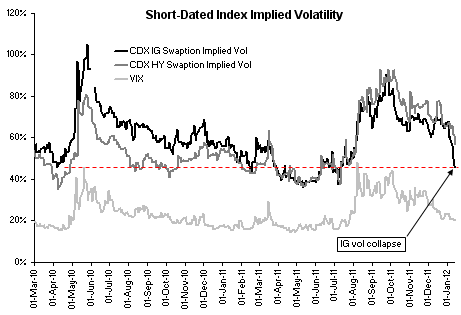
The short-term implied volatility of IG CDX swaptions is often traded against VIX on a relative value basis.  While VIX crashed in during the last couple of months, IG CDX implied volatility did not follow for some time.  Recently however, after a sharp correction, the short-term IG CDX vol touched 50%, a level not seen since August.


VIX vs IG CDX vol (and HY CDX vol). Source: Credit Suisse
The IG CDX vol seemed to be expensive relative to VIX recently, and in the last few days the market took out this perceived mispricing.  At 50% the implied volatility is now pricing in a roughly 100 - 150bp range for the index spread.  Once the index vol drops materially below 50%, it could be a signal that the market is again underpricing risk, and IG CDX swaptions may become an attractive hedge.

SoberLook.com

Monday, September 14, 2009

US dollar a safe-haven currency? You bet.

In the previous post we mentioned that the US dollar (strangely enough) is actually a safe-haven currency. Some Sober Look readers were quite astonished by this statement. How can the dollar be one of the currencies investors flock to during periods of increasing risk aversion? Doesn't seem likely after what the US has been through and with all the new dollars entering the system from the Fed's quantitative easing? But here are some reasons this may not be so crazy after all:

1. As we discussed earlier, the low US borrowing rates make the dollar a perfect carry trade currency to short. That means any increase in volatility will push investors into unwinding the carry trade by buying back the dollars they've been short. When risk aversion recedes, investors put the carry trade back on by shorting the dollar.

2. Switzerland is no longer considered a safe haven due to it's exposure to the banking sector (significantly larger as a fraction of the GDP than that of the US) and increased transparency with regard to depositor accounts (reducing the amount of deposits at Swiss banks.) Therefore the Swiss Franc is no longer as attractive of a place to park investors' cash.

3. The US has a deep short-term government bond market, making it easy to park dollars and maintain tremendous liquidity if need be.

4. Currencies that have exposure to commodities are considered a leveraged bet on the global economic recovery. These include the Australian and the Canadian dollars and are expected to benefit from strong commodity prices. The same applies to many emerging market nations, who will benefit from any recovery much faster than the developed nations. Any threat to the speed of the recovery sends investors running back to USD and Yen.

5. The Yen, the other safe-haven currency, is a bit more of a problem (relatively) these days because Japan's deep recession and government debt levels far beyond other OECD countries makes investors uneasy. It's still one of the top choices, but has given ground to the dollar as the boring place to park cash.

6. Gold is another such currency, but it lacks the liquidity of the dollar, which is so critical in this environment.

The data actually supports the "dollar safe-haven" hypothesis. As a safe-haven currency, one would expect the dollar to rise at times of high risk aversion and fall in periods of increasing confidence in the global recovery story. We compare the dollar over the past year with the VIX index and the JPMorgan composite investment grade corporate bond spread. Both should act as indicators of risk aversion.

Here is the chart of the dollar value against a basket of six major currencies (labeled "DXY" in the charts), versus the VIX index.


source: Bloomberg

Below is the historical correlation chart of the dollar value (against a basket of six major currencies) versus the VIX index (note: the positive correlation actually started in the fall of 08, but is on a lag due to the moving window over which correlation is measured.)


source: Bloomberg

This is a chart of the dollar value versus the JPMorgan corporate investment grade spread index (labeled JACI):


source: Bloomberg

Below is the historical correlation chart of the dollar value versus the investment grade spread. Positive correlation shows flight to dollar during periods of widening spreads and the correlation has been positive and stable recently.


source: Bloomberg

There is no question that recently (since the fall of 08) the dollar has become the equivalent of a money market fund in the universe of currency investment choices. It's a temporary place to park your money to wait for each mini-storm to blow over, before putting the money back to work.

Sunday, June 14, 2009

Equities overpriced relative to credit

The historical average for S&P500 PE ratio over the past few years has been around 16. We are currently at the trailing PE of 15 and the estimated PE of 16. US equities are now at their historical average multiples. All the risk premium in equities has been taken out!

S&P500 level and PE ratio


But that's not at all true for credit. In spite of the massive rally we've experienced, investment grade corporate credit spreads are around 390 bp vs. pre-crisis levels of just above 100 bp. Equities are now looking completely overpriced relative to credit.

JPMorgan blended corporate investment grade spread


Update: some are questioning Bloomberg's estimated PE number. Here is an estimate from S&P as a comparison (consistent with Bloomberg's estimate of 16) - see page -2:

:
Related Posts Plugin for WordPress, Blogger...
Bookmark this post:
Share on StockTwits
Scoop.it