Showing posts with label FDIC. Show all posts

Tuesday, June 26, 2012

Eurozone's banking union will not be credible; FDIC-type fund seems out of reach

There has been a great deal of discussion about the Eurozone's so-called "banking union" that would create pan-Eurozone banking regulation and depositor protection.
NYTimes: The summit, which will be followed by a separate meeting of euro zone leaders on Friday, is expected to focus on agreeing on the elements of a banking union, which is seen as a concrete step even though it would not come into operation until 2013 at the earliest. Those elements would include a system to liquidate insolvent banks, a central deposit guarantee fund, and a bigger supervisory role for the European Central Bank, among other measures.
The issue with any such arrangement is that the euro countries' banking systems are just too big for their "home" economies.
Barclays Capital: - Nobody questions the credibility of the US government as a rescuer of last resort of the US banks. And that is because the US banks’ total liabilities only represent 1x the GDP of the US. Where it becomes problematic is when the system gets too big, and that goes to the heart of the problem with Europe's banks; simply put, they are much too big for their individual sovereigns to protect credibly.
...
[for example] The largest US bank – JP Morgan – has liabilities equal to 13% of US GDP. By contrast 20 European banks have liabilities of more than 50% of their home country's GDP.

Source: Barclays Capital

That would mean that the Germans and other stronger economies would in effect have to backstop deposits in Spanish (and other periphery) banks.
Barclays Capital: - ... deposit protection must mean, for example, German taxpayers becoming liable for bailing out Spanish savers. Anything short of that, in our view, renders a union almost irrelevant for today’s crisis.
Some have suggested that this deposit guarantee come from an FDIC-like European entity that taxes banks and builds up a large capital base to provide this protection. This way no one country would be responsible for making whole the depositors of another nation.

However there is a major problem with this approach. The Germans (and others) already have such entities and would not want to simply contribute the capital they've built over the years to the rest of the union. Some in Germany have referred to this as "looting of the German banks' deposit insurance funds". That means the entity would need to be capitalized "from scratch". But to create a Eurozone's version of the FDIC with credible capitalization would take years.
Barclays Capital: - In the long run, funding a deposit guarantee scheme can come from charging the banks a fee, but near term the maths suggests it has to come from taxpayers. The eurozone has €11trn of deposits. Taxing 20% of all banks’ profits for half a decade would still leave the scheme with assets below US FDIC levels.
And a one shot capital infusion worth hundreds of billions is simply not possible at this stage unless you plunder the EFSF/ESM.

With a tax scheme in place, all the German banks would need to pay this large fee for years, even though they already have a credible domestic program. There is little chance German politicians would agree to this. Even if such an entity were to be established and funded, some of Eurozone's banks are so large (the French banks for example), the entity would need to be capitalized considerably better than the FDIC.

In the mean time the taxpayers of some nations would be on the hook for deposits in other countries - there is simply no way around that. It is therefore highly unlikely that the voters of the stronger Eurozone economies will support such policies and that a credible depositor protection scheme is even possible.


SoberLook.com

Saturday, December 10, 2011

Goldman taps the wholesale funding market

Unlike most of its competitors, Goldman Sachs does not have a deposit base or retail branches, making it vulnerable to liquidity risk. JPMorgan for example has a vast pool of overnight and term deposits (both retail and institutional) they can access during tight liquidity periods. Goldman however tends to rely on capital markets for funding, forcing it not only pay higher financing rates, but making its funding costs extremely volatile, translating into unstable earnings and high stock volatility.

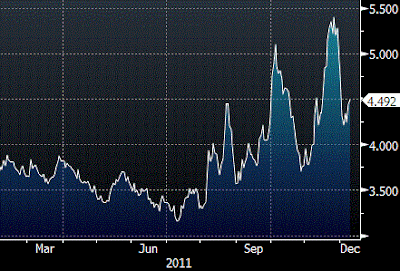
The chart below shows the yield on Goldman's 2016 notes.  The yield can easily swing some 100 basis points in a short period, making it tough to manage the business, creating uncertainties about future revenues.

GS 3 5/8, 2-2016 notes (Bloomberg)
GS is obviously looking to diversify its sources of funding, particularly through wholesale funding.  The tremendous drop in certificate of deposit (CDs) rates in recent months clearly looks particularly attractive to Goldman. CDs present funding opportunities that are almost 3.5% cheaper (below) than the capital markets (above).

Source: BankRate.com
 As a new bank holding company (since 2008), Goldman is now able to tap retail deposits funding that affords the usual FDIC protection.  But without a retail network, tapping retail deposits could prove particularly difficult.   The fact that the firm (as well as other large banking institutions) tends to be poorly regarded by the public does not help in raising retail funds.
Chartered Quality Institute: The decline [in trust] has been blamed on a series of public crises at organizations including the ongoing backlash against bankers, fueled by widely publicized problems at Goldman Sachs. The survey showed that only 25% of Americans now trusted banks, down from 33% in 2009 and 71% before the financial crash.
As usual in situations like this, GS gets creative and offers "structured" CDs that may differentiate its product from the standard sleepy bank product paying under 1.2% per year.  In this case the product is a 4-year CD linked to the performance of the DJI index.  This type of product is not unique and was often used by banks in the 90s, particularly in Europe.  But not by Goldman, because they were not a bank holding company then.

This particular CD provides a minimum return of 2% over the life or roughly 0.5% per year - guaranteed (vs. say 1.2% for a standard CD).  Principal is FDIC insured.  The maximum return is the sum (not compounded) of monthly returns on the Dow, capped at 1.5%-2% per month.  The final return therefore is what some refer to as "path dependent".  Even if the Dow ends up in the same place, a more volatile path will produce a lower return on the CD because the holder would be subject to full drops in the index, while monthly increases would be capped.  The holder is in effect "short volatility".

Goldman on the other hand views this as purely a financing product and therefore will hedge it.  Here is what the hedge will look like:

1. Goldman will buy a 4-year call on the Dow Jones index (or a group of stocks that closely resembles the index).  The call will be struck close to at-the-money.
2. On a monthly basis Goldman will sell short term (around a month in maturity) calls that are 1.5-2% out-of-the money.

By cutting the guaranteed rate on the CD from "market" by some 0.7% and by selling short-term calls on a monthly basis, Goldman can finance the long-term call option (above) and the FDIC insurance costs.  On average after accounting for the net cost of the hedges, Goldman's funding cost will likely be close to a typical CD rate, certainly much cheaper than issuing a bond.  The straight sum of monthly returns vs. the compounding makes it even cheaper.

Obviously a sophisticated client can replicate this structure in her own portfolio and get a better return.  But for a typical retail investor who wants some upside, this might look interesting.

If it works, Goldman can diversify its funding sources and more effectively compete with banks that have a retail presence.  It may also open a new funding avenue for Morgan Stanley, which is is even more vulnerable than Goldman to funding risks.

Goldman Sachs Bank DJIA MLD Sum of Mo Incr 4Yrs 12-30-11

SoberLook.com

Thursday, October 22, 2009

FDIC gets creative in bank liquidation

A typical FDIC transaction involves what's called "Whole Bank with Loss Sharing”. That means the bidder has to be a bank or be pre-approved for a bank charter. The acquirer takes over the failed bank, all of it's deposits and the bulk of it's assets. The FDIC shares in future losses on the acquired portfolio.

Banks willing to acquire other banks are few and far between these days due to significant capital constraints. Non-bank capital is sometimes easier to access. Therefore the FDIC decided to take a slightly different path with respect to Corus Bank in Chicago. The bank (11 branches) with most of it's deposits ($7 billion - mostly CDs) went to MB Financial Bank. The bulk of the assets however was sold to a consortium of private equity firms including Starwood, TPG, Perry Capital, and a JV between Wilbur Ross and LeFrak Organization. The consortium bought $4.5 billion of condominium loans and foreclosed properties.


By involving non-bank capital, the FDIC was able to get MB Financial to take over the bank. MB Financial did not have the resources nor the stomach to take risk on the $4.5 billion of condo assets. The FDIC will need to do more of this in order to place failed banks in the hands of someone who can operate them. It needs to be open for more non-bank capital to bid on bank assets in order to make it palatable for "healthier" banks to step in.

The question that still remains is how Corus (and banks like it) used taxpayer insured CDs to finance a concentrated condo loan portfolio and whether the condo developers "encauraged" the bank to lend.

SoberLook.com

Thursday, October 8, 2009

Ed Pinto's testimony on FHA

Attached below is a recent House testimony from Ed Pinto (Fannie Mae's chief credit officer back in the 80s) pointing to a potential funding gap at the Federal Housing Administration (FHA). FHA is the government agency that (among other things) provides mortgage insurance to the lenders for home buyers who do not have sufficient downpayment. In some ways the agency also helped contribute to the housing bubble by helping homeowners leverage their home beyond what would be considered prudent.

Ed Pinto Testimony

Mr. Pinto's testimony points to a potential gap between the claims liabilities on insured mortgages and the Mutual Mortgage Insurance Fund set up to cover these liabilities. The chart below shows the historical levels (in billions of the fund) and if one was to believe Mr. Pinto, the fund will be significantly in the red in the near future.


That means a potential rescue from the tax payer (in addition to the continuous bleeding of the GSEs and the FDIC). Mr. Pinto's estimate of the rescue required is between $40 and $60. As a general comment, it is unsettling to see the current administration focusing on numerous other issues without at least an attempt to address this situation.

Wednesday, October 7, 2009

PPIP to the rescue

The "bad bank" program to purchase loan assets from the balance sheets of banks called PPIP was supposed to be the mother of all bank balance sheet cleanups. The program was divided into two components: the loan program and the securities program - the Treasury would provide leverage and investors will come for the returns. The loan program was supposed to buy actual loans from banks - mortgages, consumer loans, leases, commercial property mortgages, etc. Great idea in principle, but there was a problem.

Banks don't mark loans to market, particular loans they originate (banking book). Instead banks take reserves for impaired loans or loans about to become impaired. With the reserves taken into account, the carried value of these loan portfolios had been over 90 cents on the dollar. But as an investor would you pay 90+ cents for a mortgage loan portfolio? Even with leverage, you would probably bid less, probably much less. If there is one thing investors learned from the crisis, it is that having access to cheap leverage does not justify overpaying for assets. But banks can not sell these assets at steep discounts simply because they would immediately wipe out a chunk of their already thin capital base and some would become insolvent. They need those assets to stay at 90+. Therefore the FDIC-led loan PPIP just didn't work.

So that leaves the securities portion of the PPIP, spearheaded by the US Treasury. Since generally just the larger banks were involved in running portfolios of securities backed by loans (vs. loans themselves), this portion of PPIP would only help the larger banks. All those struggling small and regional banks will have to muddle through on their own. The justification the Treasury will give for trying to help the larger banks is that the securities PPIP will raise senior tranche prices, which may stimulate new securitization (nice pipe dream), which in turn will stimulate new lending and refinancing. Somewhere down the road this would help the smaller banks. Right.

But unlike the loan program that had a major price disconnect between buyers and sellers, the securities program had a better chance. Many of these securities have been marked to market (sort of). So the Treasury offered to do the following (see attached term sheet):

Option I (called "Full Turn"):
1. Investor commits $1 of equity to invest in RMBS or CMBS senior tranche securities that used to be "AAA" (currently sitting on Jumbo Bank's balance sheet.)
2. The Treasury commits $1 for the same investment (co-invest).
3. The Treasury commits to lend $2 to finance this portfolio.

This way a dollar of private funds generates $4 of buying power and 1:1 (debt to equity) leverage (hence "full turn"). The loan term is 10 years and investor's money is locked up as well. The cost is basically LIBOR + 1%, which is what makes this attractive. The investor has 3 years to "trade" the portfolio, after which point any sale goes to pay down the government's loan.

Option II (called "Half Turn"):
Investors also have a choice to take $1 instead of $2 (in the example above). This puts the leverage at 0.5 : 1 (hence "half turn"), but allows the investor to get additional leverage. For example if these are CMBS assets, the investor can get financing via TALF in addition to the PPIP. That could really juice up the leverage.

And here is the result. The Treasury has committed $40 billion to PPIP (corresponding to $10 billion of private money). So far $12.5 billion (out of 40) has been done, all with Option-I, corresponding to $3 billion of private money. The Treasury of course is claiming success as RMBS and CMBS have rallied since the program was announced earlier in the year. We are to believe that a $12.5 billion investment has moved pricing significantly on a $2+ trillion market. But hey, in this euphoria driven credit market, who is counting?


Securities PPIP Term Sheet

Friday, August 21, 2009

Meredith Whitney: 300 more bank failures

Meredith Whitney is predicting 300 additional bank failures, putting continuing pressure on the FDIC. The FDIC insurance fund, which may already be in the red is going to require more taxpayer funds.


Many of the smaller banks played the same game that the Wall Street firms have, chasing more spread and loading up on real estate related assets. The chart below shows rapidly expanding real estate loan balances at small US banks.


source: the Federal Reserve Board


In fact in some ways many of the smaller banks have been more aggressive on their portfolios than the large ones due to limited devirsification. Now it's the taxpayer's problem.


Tuesday, August 18, 2009

FDIC's new rules on bank acquisition reek of socialism


The industry comments are in for the proposed FDIC rules dealing with failed bank acquisitions by private equity funds. If these rules go into effect as they are, the FDIC will not be able to sell another failed bank directly to an alternative investment firm - one of the few sources of private capital still available. And in some instances failed bank liquidation may become the only option, putting FDIC and the taxpayer deeper in the hole (see FDIC looking for half a trillion dollar life )

The rules, as proposed, make no sense. If a bank wants to acquire another bank, the target bank must have a post-acquisition capital ratio (book equity to assets) of 5%. If someone wants to start a brand new bank, the ratio needs to be 8%. But under the new proposal if a private equity were to purchase a bank, the capital ratio needs to be 15%.

One of the reasons the FDIC is pushing for this rule is their concern that private equity firms expect to make high teens to low twenties returns on their bank purchases. How dare they! Making money is a crime these days. So let's force them to put up more capital to bring the returns down to single digits. That will teach those PE firms. Now if you are a state pension fund and a private equity firm told you they are targeting an acquisition with a 9% expected return, would you invest? No way.

The other rule the FDIC is trying to impose is to force PE firms who have more than one bank in their portfolio to use profits from one bank that's in good shape to prop up another bank that may be struggling. If you are an employee or a creditor of the healthy bank and the regulator tells you that it's time to give up some profits to feed a failing bank that has nothing to do with you, you would call that socialism.

FDIC would also require that private equity firms hold on to banks they have purchased for at least 3 years. If you buy a bank, turn it around in a year, and now a larger bank offers to buy it from you, why should you be forced to wait?

Here is another example of a US agency cutting off the nose to spite the face. The FDIC should ensure that the new owners run the bank effectively and prudently, working to rebuild a failed institution. Setting up socialist type rules will only serve to keep private funds away from failed institutions, ultimately hurting the FDIC and the taxpayer.

Related Posts Plugin for WordPress, Blogger...
Bookmark this post:
Share on StockTwits
Scoop.it