Showing posts with label consumer credit. Show all posts

Saturday, August 9, 2014

US loan growth rate the highest since the recession

US credit growth continues to accelerate, reaching the highest year-over-year pace since the Great Recession.


In 2012 the growth was primarily driven by corporate debt (chart below) as banks remained cautious on real estate and consumer lending. While corporate loan growth remains strong - at around 11% per year - other sectors are now experiencing faster credit expansion.


In a complete contrast to the situation in the Eurozone, both real estate (particularly commercial) and consumer credit growth rates have improved materially this year. Consumer credit is no longer just driven by autos, with credit card debt picking up as well.


The only major headwinds for this trend currently are some of the geopolitical risks (Iraq, Russia, etc.). Consumers, companies, and banks are still fairly jittery and it won't take much to dampen the supply of and/or the demand for credit.


_________________________________________________________________________


SoberLook.com
Sign up for our daily newsletter called the Daily Shot. It's a quick graphical summary of topics covered here and on Twitter (see overview). Emails are distributed via Freelists.org and are NEVER sold or otherwise shared with anyone.


From our sponsor:

Thursday, August 7, 2014

Credit card debt growth exceeds wage growth in the US

Over the past three months, the year-over-year growth in credit card debt has exceeded wage growth in the United States. This is the first time we've seen this trend since the Great Recession. While it clearly indicates improved US consumer confidence (and all the spending helps boost China's trade surplus), in the long run this is not going to be sustainable.

Year-over-year growth in credit card deb minus growth in average hourly wages 

_________________________________________________________________________


SoberLook.com
Sign up for our daily newsletter called the Daily Shot. It's a quick graphical summary of topics covered here and on Twitter (see overview). Emails are distributed via Freelists.org and are NEVER sold or otherwise shared with anyone.


From our sponsor:

Saturday, June 21, 2014

After years of contraction, credit card balances at large US banks are starting to rise

The pace of US consumer credit expansion remains brisk. A quick look at consumer loan balances at large US commercial banks shows a spike that started in February of this year.

Note: This data excludes mortgages and government-held student loans

It is useful to look at the breakdown of this growth. As discussed earlier (see post), we know that auto loans have been the darling of large US banks, particularly as mortgage refinancing slowed. The steady growth in auto finance at these institutions continues.

"Other Consumer Loans" are mostly auto loans (nonrevolving credit)
(note: this excludes mortgages and government-held student loans)

But auto loans only partially explain the spike in consumer finance in recent months. The other component of consumer finance on banks' balance sheets is revolving credit, which is mostly credit cards. In late March of this year, credit card debt balances at large US banks have bottomed - after years of declines. With credit card and auto finance now both on the rise, the overall US consumer credit expansion has accelerated.

Revolving credit at large banks - mostly credit cards (note: this excludes home equity debt)

________________________________________________________________________________


SoberLook.com
Sign up for our daily newsletter called the Daily Shot. It's a quick graphical summary of topics covered here and on Twitter (see overview). Emails are distributed via Freelists.org and are NEVER sold or otherwise shared with anyone.


From our sponsor:

Saturday, June 14, 2014

US bank-held consumer credit on the rise

Bank-held consumer credit in the US continues to rise. It's impossible to tell from this weekly data what portion is credit cards debt vs. auto and other. This of course does not include any new student loans, which are all held by the federal government. With wage growth remaining tepid, the consumer is starting to put on some leverage.


________________________________________________________________________________


SoberLook.com
Sign up for our daily newsletter called the Daily Shot. It's a quick graphical summary of topics covered here and on Twitter (see overview). Emails are distributed via Freelists.org and are NEVER sold or otherwise shared with anyone.


From our sponsor:

Sunday, June 8, 2014

US consumer and domestic stimulus reducing risks to China's economy

American consumers are helping to pull China out of its economic malaise. The recent credit card driven spending surge in the US (discussed earlier) sent China's trade surplus to new highs. The trade balance clocked at almost $36 billion (vs. $23 billion expected).


Risks surrounding China's credit markets, stemming from property developers and "wealth" products, will persist.  However Beijing's stimulus efforts, combined with increased US consumer spending, should keep China's economy avoid a more severe slowdown.
Scotiabank: - China’s economy is on the mend compared to concerns that spanned the winter months.
...
As the government increases spending on targets including railways and broader infrastructure and the People’s Bank of China lowers reserve ratio requirements and injects fresh liquidity into markets, the policy bias in China is to take out insurance against further downside risks in an effort to preserve its 7.5% GDP growth target. Default risks across China’s shadow banking sector remain material over 2014H2 but improved fundamentals may be a significant offset from a market standpoint.

________________________________________________________________________________
SoberLook.com
Sign up for our daily newsletter called the Daily Shot. It's a quick graphical summary of topics covered here and on Twitter (see overview). Emails are distributed via Freelists.org and are NEVER sold or otherwise shared with anyone.


From our sponsor:

Saturday, June 7, 2014

Americans warming up to credit cards again

A few days back we posted this chart on Twitter that clearly indicates an increase in US consumer spending.

One of the questions discussed was "how is this increased spending financed?". It's a fair question, given the painfully slow wage growth in the US.


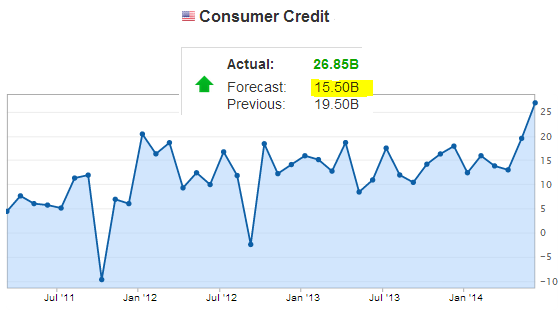
On Friday we got our answer. US consumer credit outstanding spiked way above expectations. While the media focused on the jobs report, this was the key news item:

Source: Investing.com

Unlike in previous Fed reports that showed consumer credit growth driven by student loans and to a lesser extent auto finance, we saw something new this time around. The increase was caused by a jump in revolving credit. Americans are warming up to using plastic again.


This is certainly a positive signal because it shows that household confidence is improving sufficiently to send consumers shopping. Unfortunately a great deal of what Americans bought came from abroad, causing the US trade deficit to jump unexpectedly (see post). The effect on GDP growth from this jump in consumer spending will therefore be relatively muted.


SoberLook.com
Sign up for our daily newsletter called the Daily Shot. It's a quick graphical summary of topics covered here and on Twitter (see overview). Emails are distributed via Freelists.org and are NEVER sold or otherwise shared with anyone.


From our sponsor:

Wednesday, May 7, 2014

What's fueling consumer credit growth in the US?

US consumer credit report surprised to the upside today, beating forecasts by nearly $2bn.
Source: Investing.com

One positive aspect of this report is that for the first time in months we are seeing a jump in credit growth outside of the government sponsored student loans.


The key to this report however is that the bulk of that growth increase was driven by auto finance. Revolving credit, which mostly represents credit cards, has remained subdued for quite some time now.


In fact auto finance balances in the US have increased by 4% from a year ago. Who is funding all this growth?

Banks have certainly been active, with Wells Fargo for example growing its auto loan book by 15% over the past year. And then we have the securitization markets, where asset-backed securities (ABS) are used to finance pools of auto loans and leases. ABS spreads have tightened since the taper-driven fixed income selloff last summer as demand for this paper remains strong.


According to Deutsche Bank, we've had some $39bn issued in the first quarter alone.

Source: DB

And it's not just about auto loans - securitization has been heating up in auto leases as well. Tracy Alloway has a great article in the FT (here) on auto lease securitization (which involves taking exposure to residual value of cars that come off lease.) 2014 could be a record year for such issuance. All of this activity has helped to improve consumer credit growth this year.

As an aside, these are precisely the types of markets the ECB would love to jump-start in the euro area (see post). With the banking system still undergoing deleveraging, the central bank is looking for a way to get the "shadow" banking involved in order to boost consumer (and corporate) credit growth.


SoberLook.com
From our sponsor:

Monday, April 7, 2014

Non-student-loan consumer credit growth leveling off

Consumer credit growth for February came in considerably better than expected in spite of the economic soft patch this winter.
Source: Investing.com
BW: - The $16.5 billion advance in credit exceeded all estimates in a Bloomberg survey of economists and followed a revised $13.8 billion gain in the previous month, Federal Reserve figures showed today in Washington. The median forecast in the Bloomberg survey called for a $14 billion increase.
It is important to point out however that in order to track the actual private sector consumer credit measures, one must remove the government-sponsored student loans that have been distorting these reports. The non-student-loan consumer credit growth has leveled off recently, rising at around 2.5% per year (as opposed to over 5.5% when student loans are included).

FRED:  TOTALNS - TOTALGOV (YoY)

This spring we will probably see an improvement in this rate, especially as auto loan demand picks up. However with wage growth remaining subdued at just above 2% per year (see chart below), it should not be a surprise that consumer credit growth has leveled off. Households still remain cautious on leverage.


Non-student-loan consumer credit outstanding was growing at a rate that is in the neighborhood of 6% during the years preceding the financial crisis. With wage growth constrained for now, there is little chance we are returning there in the near future.


SoberLook.com
From our sponsor:

Saturday, February 8, 2014

Consumer credit and deleveraging

US consumer credit showed an impressive increase at the end of last year as Americans went shopping. Consumer credit outstanding, excluding real-estate debt, stood above $3.1 trillion in December, rising in a nearly linear fashion since 2011.
Reuters: - U.S. consumer credit in December grew by the most in nearly a year due to a sharp increase in credit card usage, a potentially positive sign for the economy.

Total consumer credit rose by $18.8 billion to $3.1 trillion, the Federal Reserve said on Friday. That was the biggest gain since February.
But let's put this number in perspective by making a couple of adjustments. First let's look at consumer credit trend without the government-held student loans. As discussed before, student loans are not market-based and do not represent private sector credit expansion. A very different trend emerges - with non-student-loan consumer credit barely rising until mid 2013. One could argue that student debt is in effect "crowding out" private credit.

Not seasonally adjusted (source: FRB)

Even the ex-student loan measure does not tell the whole story. The overall US economy (and the population) has grown since the financial crisis and in order to make a fair comparison one needs look at the trend relative to the nation's GDP. A very different picture emerges - one of significant consumer deleveraging that is only now beginning to stabilize.

Not seasonally adjusted (source: FRB)

While the absolute level of consumer credit indeed had a nice pop in December, one needs to look beyond the headline numbers to see the full picture.

SoberLook.com
From our sponsor:

Tuesday, December 31, 2013

One of these things is not like the other ...

This is the time when everyone is making financial and economic forecasts for the upcoming year and beyond. Here is a simple forecast from Sober Look that did not require much analysis. By the end of 2014, student loan balances held by the federal government will exceed $850 billion and by the end of 2015 the number will be above a trillion. And this is on top of some half a trillion of loans that are not directly held but guaranteed by the federal government.
Source: FRB

So what? We've gotten numerous e-mails asking this question. The problem of course is government-subsidized and rising consumer debt burden - all on the back of the taxpayer. When the government is involved on such a large scale, there are usually unintended consequences and market distortions (elevated tuition costs for example). But it's the borrowers who are stretched to the limit due to outsize student loans and limited employment opportunities that is the growing problem - both for the borrowers and the taxpayers.

Remember the old song from Sesame Street: "One of these things is not like the other..."? The chart below from Wells Fargo shows the one thing that is definitely not like the other.

Source: Well Fargo

Happy New Year!


SoberLook.com
From our sponsor:

Saturday, November 16, 2013

Banks piling into auto loans as demand picks up

After less that two years of modest but positive growth, real estate loans in the US banking system have recently gone into the red again. Lower demand and banks' unease with real estate keep this sector from growing.

Source: FRB

On the other hand, banks are making a big push into auto loans. Auto loan portfolios are up 6.4% from a year ago as car sales remain brisk. Note that non-bank (shadow) lenders including ABS buyers (see post) are also a major part of this market (just check Carfinco's shares on the Toronto Stock Exchange for example).

Source: FRB

Crain's Cleveland Business: - Columbus-based Huntington Bank enjoyed a record quarter in originations in indirect auto lending, the industry's term for when borrowers secure financing from a lender through a dealership. The bank's originations totaled $1.2 billion in the third quarter of 2013, up 10% from the year-ago period and nearly 19% from the third quarter of 2011.
...
Auto loan growth also has accelerated in 2013 at Firefighters Community Credit Union in Cleveland. Its auto loan balance in this year's third quarter was 13.6% higher than the year-ago quarter. That's a greatly improved performance over the 3.3% increase Firefighters recorded in the third quarter of 2012 over the like quarter in 2011, and the 7.5% decrease it saw in the third quarter of 2011 versus the third quarter of 2010.
Given the relatively low default rates in auto loans, banks' credit departments have loosened lending requirements. And as the average age of light vehicles in the US continues to rise (above 11 years), auto sales pick up (with US baby boomers now dominating sales - see story).
Detroit Free Press: - A boom in auto loans continues to support a resurgence in U.S. car buying that has hit its highest sales pace since 2007. The total amount of outstanding auto loans topped $782.9 billion as of Sept. 30, up $103 billion from the same period last year, according to Experian Automotive’s quarterly report.
...
[Experian] said the availability of credit, combined with consumers’ strong track record of repaying loans, is helping banks justify greater access to loans and helping to boost U.S. automotive sales.

Through October, consumers have purchased 13 million new cars and trucks in the U.S., up 8.4 percent from the same period last year. The auto industry remains on track to sell about 15.5 million new cars and trucks this year - the most since 2007
But of course as the auto loan boom replaces the real estate boom of 7 years ago, signs of excessive lending and risk taking by banks are beginning to appear. Just as real estate lending was "safe" back then, auto lending is "safe" now.
Detroit Free Press: - Banks have become increasingly willing to provide loans to sub-prime customers and are allowing consumers to finance over a longer period, with some loans extending as long as eight years.
Indeed, longer dated auto loans are becoming increasingly common.
Montgomery Advertiser: - More new-car buyers are stretching out their loan payments for as many as seven years, and some experts worry that’s another financial time bomb.

While Not so long ago, remember the days when ads touted 48-month loans. Today the biggest growth is coming in loans lasting up to 84 months — That’s longer than most people are expected to want to keep their new car.

The longest-term new-car loans — 73 to 84 months — have jumped 25.1 percent in the past year and now make up 19.5 percent of total new-car lending, according to Experian Automotive. All other loan-length categories, in fact, have become less popular as buyers shift to longer terms to get lower payments.

The next-shorter category — 61 to 72 months, considered a very long loan only a few years ago — now is 41.7 percent of new-car loans, Experian says. That’s down 3.2 percent from a year ago, but it’s still by far the biggest single loan-length category.
One of the problems with risk management departments at banks is that they often "fight the last war". As a new asset class becomes in vogue - sometimes because of historically low default rates, banks pile into it and profits flow. With competition heating up, lending standards suffer, and risks of another systemic credit problem rise.


SoberLook.com
From our sponsor:

Wednesday, August 7, 2013

Consumer credit numbers show the same frightening trend

Today the Fed released the latest data on US consumer credit. Once again, student loans represent the dominant component of consumer debt growth (see post). This debt shows up as "non-revolving credit" owned by the federal government in the Fed's data.

Source: Barclays Capital

Barclays Research: - .. since the start of 2011, total revolving consumer credit outstanding has risen by just $15.9bn while nonrevolving credit has increased by $312.6bn. Nonrevolving consumer credit held by the government, which is comprised of federal student loans, has risen by $266bn over that period, according to our seasonal adjustment process. ... we think that the costs of federal student loan programs are being understated and that they could pose a significant fiscal challenge to the US government in the future.
This is not going to end well.


SoberLook.com
From our sponsor:

Wednesday, April 10, 2013

ABS meets EBay - the disintermediation of consumer finance

Can unsecured consumer lending be disintermediated? At least one fairly successful company thinks it can - as long as you get large groups of people willing to borrow and investors willing to lend. The company is called Lending Club. The firm allows for pooling of personal loans, with borrowers rated from from A to G based on the credit profile. In this low rate environment returns generated by this lending look attractive and are available to investors who don't own a credit card provider.

Source: Lending Club

Lending Club charges both the investors and the borrowers some fees - with the riskier borrowers paying higher charges. Investors can come into this program through their IRA account to get tax free interest income.

Sounds risky? It all depends on how diversified the portfolio is. About $20k buys some 800 "notes". An investor can build a portfolio by selecting pieces of loans from rated borrowers as they come online. The system also tells investors a very indicative "use of proceeds" as well as what portion of each desired loan has been raised so far. Each investor effectively becomes "the bank", electing how much to lend to whom (although for regulatory purposes it seems that loans are funneled through "WebBank, a Utah-chartered Industrial Bank").

Source: Lending Club

What's good about this program is that unlike credit cards who generally charge a high rate to all borrowers, the credit scoring provides cheaper capital to the strongest borrowers. These are credit markets at work - applied at the retail level.

According to the company almost $1.5bn has been funded this way. It's a drop in the bucket compared to trillions in consumer finance, but is certainly a good proof of concept.

Is this a sign of where consumer lending is headed? Should the credit card industry be concerned that technology-based free market will one day disintermediate them?

SoberLook.com
From our sponsor:

Saturday, December 8, 2012

Consumer credit trend remains the same; guess who is doing all the borrowing?

The latest increase in consumer credit finally showed some increase in revolving credit for October as consumers started to spend a bit. Once again some are attributing this increase in credit card purchases to homeowners stocking up in preparation for Sandy, a storm that ending up leaving millions on the Eastern Seaboard without power. But the growth in non-revolving credit continues unabated, driven primarily by government sponsored student loans.
Econoday: - Consumers are active borrowers with credit outstanding, up $14.2 billion, up sharply for a third month in row. Much of the gain is once again tied to loans for students who, limited by the soft jobs market, continue to stay in school. Strong sales of autos are also driving up borrowing. Student and auto loans are part of the nonrevolving component which is up $10.8 billion in the month. The revolving side, where credit cards are tracked, popped up $3.4 billion following the prior month's $2.2 billion decline. Willingness to borrow money and willingness to make big ticket commitments like auto purchases are good signs for the holiday shopping season.
Student loans owned by the federal government now constitute nearly a fifth ($0.52 trillion) of US consumer credit (excluding mortgages). Based on the pace of the past 12 months' growth, government-owned student debt will be at $1.7 trillion in 10 years. That's roughly 39% of total consumer debt, assuming other consumer credit also grows at the current pace. And this number doesn't include student loans guaranteed by the government but owned by banks (included in blue below), which represent another half a trillion. As discussed earlier (see post), this allows universities to rapidly increase tuition costs, often with little incentive to do otherwise. And that ends up creating even more demand for student loans.

Owners (lenders) of consumer credit (source: FRB)


SoberLook.com
From our sponsor:

Friday, November 9, 2012

Direct government student loans exceed half a trillion; higher education costs out of control

The report on consumer credit from the Fed today showed another sharp increase in government financed student loans. The balance now exceeds half a trillion dollars, which is in addition to the student loans guaranteed (but not funded) by the federal government. Consumer credit is once again driven by this sector, as credit card balances actually declined.
Econoday: - Another big increase in student loans drove consumer credit higher, up $11.4 billion vs August's very large revised gain of $18.4 billion. The non-revolving component, home to the student loan category, rose $14.3 billion in the month on top of August's $14.1 billion gain. Revolving credit, where credit card debt is tracked, actually fell, down $2.9 billion for the third decrease in four months. 

Source: FRB

In an attempt to address the problem of rapidly rising student indebtedness, the U.S. Department of Education made it easier to repay student loans taken out from now on.
WSJ: - The U.S. Department of Education last week issued the final regulations for the new, more-generous student-loan repayment program announced by the president last October. The plan, known as “Pay as You Earn,” will allow some graduates to peg their federal loan payments to 10% of their discretionary income and then have any remaining balance forgiven after 20 years.
This effectively makes the taxpayer responsible for funding a larger portion of higher education costs. Clearly it is a worthy cause, except that most funds available to universities from external sources (with no strings attached) will be drawn and spent, often irrespective of the need. In fact most colleges will always have some financial needs, no matter how expensive the tuition is. Obviously a portion of the tuition increases are used to help students from low income households, but middle class families are forced to pay more as a result. And the only way many middle class families can make these tuition payments is by tapping student loans in ever-larger amounts.

Unfortunately colleges often raise tuition simply because they can or because their competitors are doing it. Very few private sector enterprises enjoy (on a large scale) the benefits of products with such inelastic demand (courtesy of the US taxpayers). And items such as fuel, cigarettes, and some pharmaceuticals, which may fall into this category, are heavily taxed and/or regulated.

To put things in perspective, take a school like Boston University for example (very good university by the way). Here are the costs per year to attend as an undergraduate:


Source: BU

BU's tuition cost is by no means unusual. This is at the time when the private sector is struggling and US personal income growth has stalled (see discussion).

With the taxpayer funding higher education in such an unlimited fashion, it is time to put spending and tuition caps on institutions that benefit from this massive government program. Loans should be given only to those students who are enrolled at qualified institutions that curtail spending and tuition increases. That would limit the taxpayer burden as well as student indebtedness, which is currently growing uncontrollably. The rest of the academic establishments should finally face reality and start competing for student dollars without the benefit of taxpayer assistance.


SoberLook.com

Thursday, October 25, 2012

Weakness the Eurozone credit growth persists; stark contrast with the US

Tight credit conditions continue to persist in the Eurozone, inhibiting growth and dampening plans for fiscal consolidation.
AP via Yahoo: - Another drop in lending to companies in the 17-country eurozone showed the economic downturn is deepening, as a brighter mood on financial markets fails to catch on with businesses.

The European Central Bank said Thursday that loans to non-bank businesses shrank 1.4 percent year on year in September, double the 0.7 percent contraction reported the month before.
In fact loan growth to households trajectory shows an ongoing decline, while ...

Eurozone banks: loans to households  (YoY; source: ECB)

... loan growth to companies is declining sharply as well.

Eurozone banks: loans to non-financial corporations (YoY; source: ECB)

The stagnation in lending is in part due to banks deleveraging in order to improve capital ratios for Basel III. But a big part of the issue is simply lack of demand from borrowers.
AP via Yahoo: - The numbers show the economy is struggling despite efforts by the central bank to stimulate credit and calm financial markets fearful that the eurozone might break up. The ECB has cut its main interest rate to a record low 0.75 percent and made €1 trillion ($1.3 trillion) in cheap loans to banks that don't have to be paid back for three years.

Even so, that easy money is not making it from banks to businesses and consumers, largely because demand for credit remains weak. Businesses see no reason to borrow to invest in expanding production. Meanwhile, banks in some countries have less to lend because they are struggling to recover from losses on real estate loans that didn't get paid back and on government bonds that have fallen in value due to fears about those governments' finances.
Liquidity is trapped in the Eurozone core where businesses are borrowing less, while periphery banks have limited liquidity even if there was demand. Either way, liquidity provided by the ECB is not making it into the private sector, as the growth in money supply diverges materially from growth in lending to the private sector.

Source: GS

Note that this weakness in credit growth in the Eurozone is in stark contrast with the US, where banks continue to lend at a steady pace. This trend started in early 2011 (driven mostly by corporate lending) and seems to be ongoing.

Loans and leases on balance sheets of US-chartered banks (source FRB; click to expand)


SoberLook.com

Friday, October 12, 2012

Zero rate consumer loans - come and get one in NYC

It's Friday. Let's change things up a bit by asking the following question: How low are the consumer loan interest rates in the US these days? The average mortgage rate is now 3.41%. Credit cards still charge some 14%. However if you walk the streets of New York City, you just might find an interest free loan.


So who is New Liberty and why are they offering a no-interest loan? It turns out they call themselves "collateral loan specialists/brokers". They provide "secured lending" if the collateral is right.
New Liberty: - Our mission is to provide you with professional, friendly, and expert fast service [whatever that expression means], offering you fair and favorable value for your loan, at the best competitive rates.

We offer instant cash loans for gold, silver, diamonds, jewelry and watches on the spot and provide you with free verbal appraisal for your merchandise.

All standard loans are issued for a 4 month period. For new clients, our interest rate on the 1st month of your loan is 0%, compared to the standard 4%, charged by our competitors. The 4% interest rate is set by New York State, and it is deemed one of the lowest rates in the country.

If you decide to sell your merchandise, our affiliate owned company NY Estate Buyers will be able to buy it.
Wait a minute here, this sounds like another line of business. That's right, it's a pawn shop, regulated by the city of course. Welcome to NYC where money is free - you just need to know where to look.


SoberLook.com

Saturday, October 6, 2012

Reports on US consumer credit missed the elephant in the room

Lee Adler has a nice post (here) on the latest employment data, pointing out that some of the seasonal adjustments in the government report are flawed. That's in part why there was so much confusion when the numbers came out yesterday (post).

It is therefore sensible to look at other government statistics without the seasonal adjustments. One such set of numbers is the latest report from the Fed on consumer credit which showed a spike in borrowing by US consumers.
Reuters: - U.S. consumer credit rose $18.12 billion, the biggest gain since May, following July's revised $2.45 billion decline. Revolving credit, which mostly measures credit-card use, climbed $4.2 billion. Nonrevolving credit, which includes student and auto loans, rose $13.92 billion.
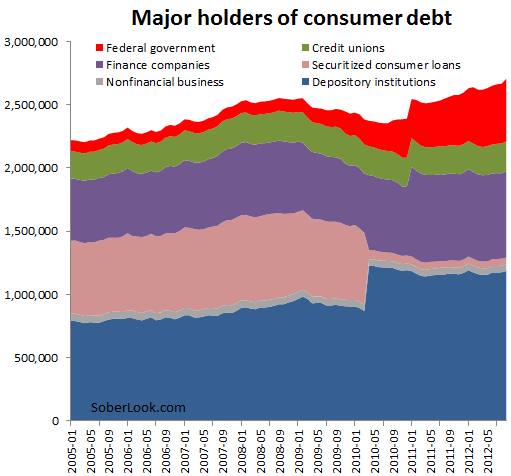
This increase looks strong, but let's take a look at who the credit providers are and how their holdings changed over time - without the seasonal adjustments that add noise to the data. The chart below shows that 25% of the increase in August is coming from banks and 6% from credit unions. That's mostly due to an increase in credit card debt (remember this data does not include mortgages). The 9% increase in holdings by finance companies is from auto loans. And then there is the elephant in the room - 58% of the increase in consumer credit came from the federal government. That is all student loans. For some reason the media is refusing to zero in on this.


Here is an example of how even the more sophisticated financial journalists seem to miss the point.
Reuters (same report as above): - Credit has been expanding almost continuously since mid-2010 as the country recovered from the 2007-2009 recession. The decline in July was the first drop since August of last year
But if one plots the holders of consumer debt over time (again without the seasonal adjustments), a familiar picture emerges. Yes, consumer credit has been growing since the recession, but all of the growth came from the federal government and not from credit institutions. In fact without the rapid increase in government student loans, consumer credit would still be down from the end of the recession. That explains why consumer spending has been subdued in spite of growth in consumer credit.

Source: FRB (NSA)

Celebrating these large increases in consumer credit is premature because these numbers do not mean vigorous retail credit expansion by financial institutions. Nor are they pointing to increases in consumer spending. Instead, consumer credit growth these days goes to fund the relentlessly rising cost of higher education, which the US consumer can hardly afford at this time (see discussion).


SoberLook.com

Monday, September 3, 2012

Student loan delinquencies soar (right after OWS protests end) leaving the taxpayer on the hook

Take a look at the chart below. It represents the total consumer debt outstanding in the US. What stands out?

Source: NY Fed (click to enlarge)

That's right, student loans. Mortgage balances are moving lower, home equity and credit cards look stable or declining slightly, car loans have been constant for years. Yet student loan balances are rising.

But that is just one side of the story. Not only do we have rapidly rising student loan balances but we are also looking at an unprecedented spike in delinquencies - the highest increase on record.

Source: JPMorgan

This may be just a coincidence (although there is some anecdotal evidence out there), but around the time the Occupy Wall Street protests ended, numerous borrowers around the country chose to just stop paying - all to punish the "fat cats" of course. Given that it takes 30 days after a missed payment for loans to be called "delinquent" and 90 days for the "seriously delinquent" label, the chart above lines up quite well with the OWS movement.

Whatever the case, this trend is quite troubling because the US taxpayers are on the hook. The Obamacare bill has a less well known component in it called the Student Aid and Fiscal Responsibility Act. It makes the US government the sole originator of student loans. That's why the loans owned directly by the federal government have spiked since 2009 (chart below).

Student loans owned directly by the federal government (source: FRB)
The chart above of course does not include loans owned by banks but guaranteed by the government.

The Republican Party, sensing a unique opportunity here, has made getting the US government out of the student loan origination business part of their national campaign platform.
The GOP: - The federal government should not be in the business of originating student loans; however, it should serve as an insurance guarantor for the private sector as they offer loans to students. Private sector participation in student financing should be welcomed. Any regulation that drives tuition costs higher must be reevaluated to balance its worth against its negative impact on students and their parents.
The private sector however will not get involved on any material scale without the federal guarantees. One way or another the US government will absorb the losses associated with student loan delinquencies. And in the mean time the balances continue to grow. Here are the latest facts from the NY Fed pertaining to the current student loan problem in the US (also discussed here):
  • Outstanding educational debt stood at $914 billion as of June 30, 2012. 
  • Since the peak in household debt in 2008Q3, student loan debt has increased by $303 billion, while other forms of debt fell a combined $1.6 trillion. 
  • Student loan delinquency rates increased for the second consecutive quarter; The percent of student loan balances 90 or more days delinquent increased to 8.9% from 8.7% during the second quarter of 2012.


SoberLook.com

Friday, August 17, 2012

In spite of easier underwriting standards, home equity balances continue to decline

According to the latest OCC survey, banks in the US have been easing credit standards for home equity loans. Except for the poorly collateralized loans (HLTV), the survey indicates banks are once again becoming increasingly comfortable with this sector.

Underwriting standards (source: OCC)

Moreover banks now view their home equity portfolios as less risky. What's surprising is that even the risky HLTV home equity portfolios (loans with "high loan-to-value" ratios) are viewed by banks as posing lower credit risk. The concern over high rates of default for these loans has eased sharply.

Credit risk (source: OCC)

With these facts in mind, one would think that the holdings of these loans on bank balance sheets should be growing. But the reality is quite different. Home equity usage spiked in 2008/09 as consumers tapped revolving credit in fear of losing access to financing. Balances have been declining since.

Source: FRB

Clearly banks reduced home equity availability in cases where consumers refinanced their primary mortgages (refinancing of first lien mortgages usually required consent from the second lien lenders to make sure they retain their lien status). Balances also came down in cases of foreclosure via write-downs. But as the bank survey shows, a great deal of this reduction has been driven by lower demand from the borrowers rather than tightening credit standards. The US consumer deleveraging continues.


SoberLook.com
Related Posts Plugin for WordPress, Blogger...
Bookmark this post:
Share on StockTwits
Scoop.it