Tuesday, April 9, 2013

Taking QE to a whole new level

The Bank of Japan is taking the concept of quantitative easing to a whole new level. Unlike the Fed who is only focused on treasuries and agency MBS securities, the BOJ is authorized to purchase ETFs and REITs in addition to JGBs.
Reuters: - "The BOJ can buy whatever amount of ETFs and REITs it can. It can even buy government bonds more forcefully, as if it were to buy the entire amount in markets," Hamada said in an interview with Reuters.

"There are also other various measures, although the BOJ must also be mindful of the drawbacks."
According to Credit Suisse, the BOJ's balance sheet as a proportion of the nation's GDP will far outstrip that of the other major central banks (excluding the SNB) within the next two years. This is uncharted territory - nothing of this magnitude has been tried before in a developed economy.  As a result, dollar/yen is at 99 (the yen is down some 25% over the past 6 months) and Japan's stock market just hit a 5-year high.

Source: Credit Suisse


SoberLook.com
From our sponsor:

Sunday, April 7, 2013

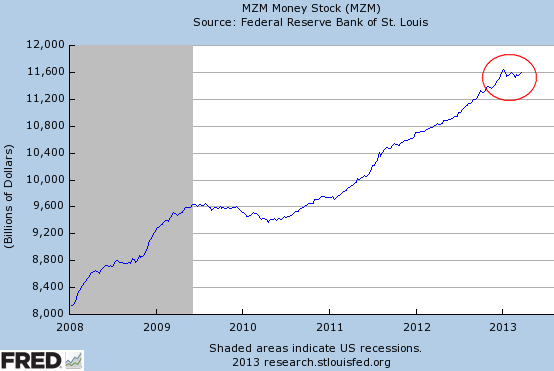
Why has the US broad money supply flat-lined in 2013?

The US money indicators have been showing something odd in the last few months. While the monetary base (M0) has been rising sharply due to increasing bank reserves (the liability side of the Fed's balance sheet), the broader money supply has stalled.


Both M2 and MZM measures of money stock have been relatively flat this year.


Some attribute this to limited bank lending driving the so-called velocity of money lower, "trapping" liquidity from entering the broader economy. That would explain the growing monetary base and stagnant M2 and MZM.

But stalled credit growth can not be the explanation - simply because bank lending in the US continues to increase at a fairly constant pace since mid 2011.

Loans and leases for all commercial banks chartered in the US (source: FRB)

The answer has to do with cash balances, particularly in money market funds. The amount of cash in dollar money market funds has declined sharply since the beginning of the year. The retail accounts show a particularly large relative drop.


Source: ICI

In preparation for higher federal taxes, both individuals and institutions took capital gains, received special dividends, and pushed incomes into 2012 where possible (see discussion). And these accounts have been deploying this cash from the beginning of the year - with a big chunk of it apparently going to equities. That should explain part of the equities rally we've had this year.

In fact a closer look at the broad money supply trend shows that the growth has been fairly linear except for the late 2012 jump which has dissipated this year. That's why the broad money supply looks flat from the beginning of the year. Here is another example of "unintended consequences" of government policy and policy uncertainty.


Now that the excess liquidity has essentially been used up, what does it say about the stock market rally going forward?


SoberLook.com
From our sponsor:

Saturday, April 6, 2013

Egypt's descent into chaos

Egypt's cities are erupting in protests once again. Commentators have been focused on the nation's politics and the government's attempts to suppress certain freedoms. After all that's what usually makes for great news. The reality however is grounded in Egypt's deteriorating economic conditions. It goes back to James Carville's "it's the economy, stupid" that helped Bill Clinton win the presidential election.

At this stage the Egyptian government is not hiding the fact that the nation is on the brink of a crisis.
Reuters: - After two years of political turmoil, Egypt is struggling with an economic crisis and a high budget deficit. Foreign currency reserves are critically low, limiting its ability to import wheat and fuel.

An International Monetary Fund (IMF) delegation resumed long delayed talks with the government on Wednesday on a loan, which would throw Egypt a financial lifeline and potentially unlock a much larger amount in foreign aid and investment.

"The economic situation has become worrisome and quick measures are needed to restore (economic) activity," Planning Minister Ashraf al-Araby said, according to MENA.
As the government runs out of foreign reserves, diesel shortages are becoming acute.
FT: - Egypt imports up to 70 per cent of its diesel, which it uses to fuel cars, farm equipment and power plants. In addition, it subsidises diesel to the tune of at least $1.5bn a month, draining the country’s already perilously low hard currency reserves. A spate of shortages in recent weeks has raised questions about Egypt’s ability to keep the lights on, feed its people and prop up its moribund economy in the coming months.
Economic data out Egypt is difficult to come by but two indicators point to grim conditions.

1. The nation's currency continues to deteriorate in value in spite if tight capital controls. Dollars and euros trade in the black market at a premium as businesses and wealthy families convert what they can into hard currency.

EGP/USD (source: Reuters)

2. Business surveys indicate an ongoing contraction.


Markit - Egyptian non-oil producing private sector companies faced further declines in output and new orders during March. The rates of contraction were sharp, and picked up from the previous survey period.

... vendor performance continued to worsen. According to anecdotal evidence, the rise in average lead times was driven by increasing instability in the country, shortages of fuel and an increased desire amongst suppliers to be paid in cash.

March data signalled further job shedding at non-oil producing private sector firms in Egypt, and companies commonly linked this to lower business [activity]. Workforce numbers have now decreased for eleven months in a row.
Signs of inflation propagating through the economy have been particularly troublesome.
Markit: - ... input prices rose sharply in March, and the rate of cost inflation accelerated to a series high. Most of the cost increase was attributed to a rise in average purchase prices, where 55% of panellists reported higher costs. An increase in raw material prices and the high dollar price were the main drivers behind the latest rise. ... In response to increased input costs, non-oil producing private sector companies in Egypt raised their output charges. ...

Williams, Chief Economist for the Middle East at HSBC said: “A fourth consecutive monthly score printing well below 50 leaves little to cheer. Falling output and weakening new orders would be big enough concerns on their own, but the data also show a sharp rise in inflation, suggesting real incomes and corporate margins are under acute strain. With the political outlook still so uncertain and the domestic economy subject to ongoing disruption, it seems unlikely that prospects will improve materially in the near term.
The rage in the streets of Cairo and other cities is less about Muslim Brotherhood's attempts to suppress opposition and more about the day-to-day survival of ordinary people. Without the loan from IMF, the country is likely to descend into chaos, potentially endangering stability in the Middle East.


SoberLook.com
From our sponsor:

Paul Krugman's new Japan

Paul Krugman's dream for Japan is finally coming true as BOJ embarks on a round of massive monetary expansion.
Paul Krugman (NYT): - Let it not be said that the scribblings of academic economists have no effect. Some of us have been urging the Bank of Japan to get truly aggressive and adventurous on monetary policy — and it’s happening!

And it only took 15 years.

Seriously, this is very good news. Japan is finally, finally making a real effort to escape from its deflation trap. We should all hope it succeeds.
Indeed we should all hope that Japan's central bank can solve the nation's problems, which are ultimately structural in nature. Krugman is referring to the ongoing deflationary trend resulting from the burst of Japan's property bubble - as shown in the land price index below.


Source: Land Institute of Japan

Japan's monetary base has already expanded dramatically in the past three years and is now expected to grow to multiples of that.

BOJ Monetary Base (source: BOJ)

Markets have responded in a "textbook" fashion. The yen sold off sharply, while banks and property shares rallied.

USD/JPY (Investing.com)

Daiwa ETF TOPIX-17 Banks (Bloomberg)

Daiwa ETF TOPIX-17 Real Estate (Bloomberg)

The "reflation" of Japan is on.


SoberLook.com
From our sponsor:

Friday, April 5, 2013

Trends behind declining LTRO balances; Italy overtakes Spain as the largest LTRO borrower

As European banks find some private sources of capital to fund themselves, they continue to repay their ECB loans - particularly in the 3y LTRO program.
FoxBusiness: - Next week, nine banks will repay just over 4 billion euros ... in loans during the first round of three-year financing in late 2011, ECB data showed Friday. Eleven banks will repay just under EUR4 billion of the second borrowing spree in early 2012. Total repayment is just over EUR 1 billion more than was repaid this week.
LTRO balances in the Eurosystem (unit = €1mil; source: ECB)

Part of this repayment trend however is coming from over-borrowing in early 2012. As banks, particularly in Spain saw their deposits dwindle, they went into a panic mode, borrowing all they possibly could - particularly with Spain's government "encouraging" them to buy government paper. But as portions of the deposits came back (see post) and banks being able to sell some government paper (thanks to the ECB's commitment to buy it), they are repaying some central bank borrowings.

One of the issues Eurozone banks are facing is that they simply can't grow their assets - in fact balance sheets are shrinking. Due to tougher regulatory capital environment as well as general fear of extending credit, lending has been grinding to a halt. Loans to corporations have been declining steadily for some time.

Change in loan balances to companies year-over-year (source: ECB)

And loans to households are basically not growing.

Change in loan balances to households year-over-year (source: ECB)

With banks not willing to extend credit nor sit on cash, the only viable option is to repay some of the liabilities - hence the decline in LTRO balances.

Of course the repayment of LTRO has been uneven across the Eurozone.

Source: Credit Suisse

Spain, having been the largest borrower, also had the largest (in absolute terms) reduction. Clearly most German banks don't need this funding, given the growth in the nation's deposit base. Italy on the other hand remains a problem. In fact Italy is now the largest borrower from the Eurosystem, as Spain dropped to second place. Given the devastating recession and the political uncertainty Italy is facing, LTRO balances of Italian banks will be critical to watch going forward.


SoberLook.com
From our sponsor:

Tuesday, April 2, 2013

Small business loan approval rates - latest trends

The latest statistics on small business lending show application approval rates rising at banks. It seems however that banks are still relying on taxpayer support to provide credit.
Biz2Credit: - "Smaller banks are making more and more loans through the SBA's Small Loan Advantage Program, which range in amounts from $50,000 to $350,000 and require little collateral," said Biz2Credit CEO Rohit Arora, who oversaw the research. "Big banks, including Sovereign and Citizens Bank, are also increasing their approvals of loans between $50,000 and $500,000. We have even seen an uptick by giants such as TD Bank and Bank of America. Small business lending is a profitable business.

Source: Biz2Credit

Credit Unions on the other hand are declining more applications than in the past as they lose ground to banks. Shadow banking ("Alternative Lenders") still has the highest loan application approval rates. These lenders include "accounts receivable financers, merchant cash advance lenders, Community Development Financial Institutions (CDFI), micro lenders, and others".


SoberLook.com
From our sponsor:

Monday, April 1, 2013

A shift away from RORO?

Something strange happened in the market today. The dollar (DXY) and the US equity indices traded lower - together.

Source: MarketWatch

Historically one would indeed expect a positive correlation between these markets. After all, a healthier US economy - at least in principle - should benefit both the US dollar and the stock market. And the reverse also holds true. But these are not normal times. Since the financial crisis, the correlation has been consistently negative, making today's move unusual.
.
Correlation between the dollar (DXY) and the S&P500 (daily returns, rolling 90 day correlation)

That’s because markets switched into the “RORO” (risk on/risk off) mode after the Lehman collapse. And the dollar has clearly been viewed as a “safety asset” – an asset that rallies in a risk-off scenario (see discussion from 2009).

So does today's bout of positive correlation point to signs of normalization? Only time will tell. But this relationship is important to watch, as it will signal any major regime changes in the market and a potential shift away from RORO.


SoberLook.com
From our sponsor:

Complete confusion over the trajectory of the US manufacturing sector

The divergence between the two US manufacturing gauges (discussed here) is making market participants uneasy - again. The Markit PMI measure (both seasonally adjusted and unadjusted) for March was clearly in growth territory.

>50 = expansion

Markit's commentary on US manufacturing was incredibly upbeat.
Chris Williamson, Chief Economist, Markit: - “Manufacturers enjoyed another month of strong output and order book growth in March, finishing off the best quarter for two years. The sector will have provided a firm boost to the economy in the first quarter, with output possibly growing by as much as 2% (roughly 8% annualised) compared to the final quarter of last year.

“It is encouraging to see the upturn generating more jobs, with the survey suggesting that approximately 15,000 extra employees were taken on in the sector in March.
The Institute for Supply Management (ISM) however published a rather different report.
LA Times: - Growth in the crucial manufacturing sector unexpectedly slowed in March as companies reported fewer new orders and less production compared with the previous month.

The Institute for Supply Management's widely watched purchasing managers index dropped to 51.3 last month compared with 54.2 in February. The reading came in below analyst expectations of about 54.

A reading above 50 indicates growth in the sector, which covers a wide variety of industries.
... 
Purchasing managers' comments highlighted by ISM indicated that reduced government spending and uncertainty about federal regulations were among the reasons for the March slowdown.

Source: ISM

Both measures are above 50, showing at least some expansion, but it feels as if these surveys came from two different countries. A number of questions remain unanswered. Is the sequester starting to have a material impact on manufacturing orders? Are we entering the seasonal growth slowdown experienced over the past 3 years (discussed here)? Whatever the case, market participants responded by taking equity indices lower.


SoberLook.com
From our sponsor:
Related Posts Plugin for WordPress, Blogger...
Bookmark this post:
Share on StockTwits
Scoop.it