Showing posts with label France. Show all posts

Monday, June 23, 2014

France faces prolonged stagnation

France remains the Eurozone's Achilles heel, as its economy stagnates. Estimates continue to show that the euro area ex-France is doing significantly better. Today's flash Markit PMI report for June showed French manufacturing and service sectors contracting faster than expected. Manufacturing orders were particularly poor.

PMI below 50 indicates contraction (source: Investing.com)

Markit: - There remained little sign of any turnaround in the performance of France’s economy at the end of Q2, with output falling for a second successive month and at a faster rate. The data are consistent with another disappointing GDP outturn for Q2 following stagnation in the first quarter... On these trends, the economic underperformance of France seems set to persist well into H2 2014.
A number of factors contributed to this weakness, including elevated political uncertainty in France. Here are some other problems that continue to plague the nation: 

1. The unemployed in France now number 3.4 million, over 10% of the workforce. And the long-term unemployment rate is still rising.


2. French residential construction is mired in red tape, which discourages homebuilding. As a result, the nation's home affordability is worse than in the UK, a nation that is struggling with expensive real estate. With weak construction activity and tepid housing market, the French housing sector continues to put downward pressure on the GDP growth.
Reuters: - Strangled by regulation and high prices, weak French housing investment is proving a major drag on the euro zone's second-biggest economy as it struggles to stage a convincing recovery.
...
President Francois Hollande pledged more than a year ago to slash red tape holding back construction, hoping to bring within reach an oft-repeated promise to build 500,000 new homes a year.

But property developers complain that government measures since then have even discouraged home building and say they simply cannot make houses at prices would-be buyers can afford.
...
Figures from the OECD suggest prices relative to household income are now less affordable in France than in Britain, where the central bank has warned of a potential housing bubble.
3. Finally, the nation's public finances are a mess. Hollande's big tax increases did not produce the results expected. In fact, it's hard to understand how budget estimates could be this far off.
Daily Mail: - Francois Hollande is facing more criticism tonight after it emerged that France could have a 14 billion-euro black hole in its public finances after hugely overestimating tax returns. Following a week that has seen his position weakened further by the National Front's European election victories, statistics revealed last year's receipts from income tax, VAT and corporation tax were wildly inaccurate. The President raised the tax when he was elected two years ago, but the surplus from 2013 was only half the 30 billion-euros that was forecasted.

The Court of Auditors, which oversees the government's accounts, said the revenue projections in 2013 were wildly inaccurate, overly optimistic and based on inaccurate projections.
While most economists do not see another recession on the horizon for France, most expect this stagnation to persist for some time, dragging the Eurozone's growth lower.
________________________________________________________________________________


SoberLook.com
Sign up for our daily newsletter called the Daily Shot. It's a quick graphical summary of topics covered here and on Twitter (see overview). Emails are distributed via Freelists.org and are NEVER sold or otherwise shared with anyone.


From our sponsor:

Thursday, May 22, 2014

Risk of disappointment from the ECB in June remains high

The euro area recovery continues to be uneven. The economy is clearly expanding, but while growth accelerated in the service sector, it is slowing in manufacturing (based on Markit's Purchasing Managers Index report.) Some are blaming the slowdown in manufacturing on weakness in the export sector - driven by factors such as China and the strong euro.

Eurozone Markit PMI (source: Markit/Investing.com)

Moreover, growth has been uneven across the region, with France now shifting back into contraction mode.
Reuters: - An earlier PMI from Germany showed Europe's largest economy was again the driving force - its composite PMI held steady at 56.1. But it was a different story in France, the euro zone's second largest economy, where the composite PMI slumped back below the 50 mark after just two months in growth territory.
French Markit PMI - note that a reading below 50 indicates contraction (source: Markit/Investing.com)

As France slows, the Eurozone's ability to pull out of the current disinflationary mode will be limited.
WSJ: - ...with the French economy struggling to generate even modest growth, any pickup in the euro zone as a whole is unlikely to be strong enough to boost consumer prices and end a period of low inflation that stretches back to October.
However, the fact that the Markit report continues to show expansion in aggregate increases the risk that the ECB may stay on the sidelines in June. Alternatively the action could end up being limited in scope. That will certainly generate a sell-off across fixed income markets in the EU and even in the US. It's one of the reasons euro government bond yields have backed up in recent days (see chart).
Markit: - Deflationary pressures remain a major issue ... and the ongoing fall in average prices charged for goods and services adds to the likelihood of the ECB taking action to boost the economy at its June meeting. However, policymakers will also be minded of the steady recovery the region appears to be undergoing, suggesting that anyone expecting any aggressive policy initiatives may be disappointed.
In fact, Bundesbank is still ambivalent about the need for the ECB to act next month. The risk of a major "disappointment" in June remains high.
WSJ: - The jury is still out on whether the European Central Bank will need to take action at its next policy meeting in June, ECB governing council member Jens Weidmann said in an interview with the daily Sueddeutsche Zeitung.

"It's not clear if we even need to act," Mr. Weidmann was quoted as saying.

His remarks diverge somewhat from a message earlier this week offered by ECB executive board member Yves Mersch, who said the probability of action by the ECB has risen considerably.

SoberLook.com
From our sponsor:

Wednesday, March 26, 2014

France vs. Germany - a Eurozone puzzle

Here is a puzzle. We are seeing an unexpected divergence in private sector activity indicators for Germany and France. The manufacturing report for France came in materially better than was forecast by economists while the one for Germany was worse.

Source: Investing.com & Markit

The services sector PMI measures show a similar divergence to those for manufacturing. What's particularly puzzling is how broad based this divergence has been.
  • Markit (France): - Expansion was broad-based across the service and manufacturing sectors. Services activity increased for the first time in five months during March. Growth was at a 26-month high, albeit modest overall. Manufacturers reported a solid rise in output that was the sharpest since May 2011. [ - see story]
  • Markit (Germany): - The easing in the rate of activity growth was broad-based, with both manufacturers and service providers indicating weaker expansions than seen in February. Companies in the goods producing sector reported the slowest rise in output since November, while growth in the service sector eased to a two-month low. [- see story]
Thoughts, comments?


SoberLook.com
From our sponsor:

Monday, December 16, 2013

Germany and France economic divergence

The Eurozone recovery continues to be uneven, powered primarily by a pickup in export-driven manufacturing and with only some nations participating. In particular we are witnessing a significant divergence between the area’s two largest economies, Germany and France. As German manufacturing firms gain momentum (see post), the French recovery has stalled.
The Telegraph: - Figures showing private sector growth across the Eurozone have underlined the widening chasm between the bloc's economic giants, Germany and France, with the latter increasingly looking like the "sick man of Europe". …

… looking at the separate surveys, it is clear that Germany is pulling away from France. Germany's manufacturing sector grew at its fastest clip in 30 months, and services are expanding too. But in France, both sectors are in a sharpening decline.

… it's the unbalanced nature of the upturn among member states that is the most worrying. France looks increasingly like the new 'sick man of Europe', as a second successive monthly contraction may translate into another quarterly decline in GDP, pushing the country back into a technical recession. In contrast, the December survey data round off a solid quarter of growth in Germany, in which GDP looks set to rise by 0.5pc.
The following chart of manufacturing PMI trends tells the story of divergence. Note that a reading below 50 represents a contraction in the manufacturing sector.

Source: Investing.com


SoberLook.com
From our sponsor:

Friday, November 15, 2013

Deflationary risks rising in the Eurozone; time for LTRO redux?

The euro area may be facing renewed deflationary pressures. Inflation measures are now near multi-year lows and falling.

Source: Investing.com

The area's already uneven economic recovery has stalled in a number of countries. We've seen the French GDP growth dip into the red again (see Twitter chart). The employment situation in France also remains shaky.

French payrolls (source: Tradingeconomics)

Similarly, growth in broad monetary aggregates (M3 money stock) has turned lower. This has been driven by tight credit conditions (some of which is due to poor demand), with loan growth remaining extraordinarily weak (see discussion).

Source: ECB

Perhaps the most alarming indicator that may give Mario Draghi nightmares is the German housing index. German economic conditions remain quite stable as the nation continues to show strong export growth (see discussion). Nevertheless the German housing market is exhibiting signs of a correction (chart below). Bundesbank has been warning that the nation's housing market may be overvalued - so a correction may indeed be in order. But based on the experiences in Japan and the US, a sharp housing correction from bubble levels could quickly ignite deflationary pressures.

Source: Investing.com

Some are attributing these risks to the fact that the ECB (Eurosystem) balance sheet has seen a massive decline this year. While this is a positive development since it was caused by the area's banks repaying MRO and LTRO obligations, some view the reduction in the size of the central bank balance sheet as a form of monetary policy tightening.


Putting together the data discussed above would suggest that the ECB will be moving toward another non-traditional monetary policy action. With the overnight rate near zero (25bp), there is little room for lowering rates further. Setting the rate on excess reserves to negative could be one option. But a more likely outcome is another longer dated LTRO program (see discussion) or even a new securities purchases initiative (Fed-style QE). While the effectiveness of another nontraditional monetary easing program could be debated, the ECB may soon be running out of options.


SoberLook.com
From our sponsor:

Tuesday, September 10, 2013

French growth still lagging; is economic improvement on the way?

France is having a difficult time generating economic growth. While PMI indicators show signs of stabilization, economic data in general has not been great  Consider the unemployment rate for example. Even Italy, who has undergone a severe recession and some political turmoil (see post), is showing some slight improvement.


French unemployment on the other hand is trending in the wrong direction. August data will of course provide further insight.


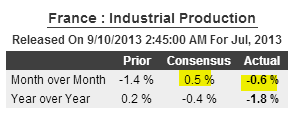
Today the INSEE reported that industrial production for July declined quite sharply, which came as a complete surprise to economists who track the euro area progress.

Source: Econoday

Just to put things in perspective, Germany saw its industrial production rise by 2.4% over the same period. The French factory output growth moving into the red is particularly disappointing, given the recent upward momentum.

Source: INSEE

There is some hope however that this weakness may be transient. French large cap equities (CAC40) have been outperforming other European shares (Euro STOXX 50) starting earlier this year. Is the market signaling better days ahead for the French economy? We should know more by the end of the month, as a number of key economic indicators (French manufacturing PMI, business confidence, consumption, etc.) will provide better guidance.


SoberLook.com
From our sponsor:

Tuesday, July 2, 2013

France and the Eurozone recovery

The biggest threat to near-term recovery in the Eurozone is not the periphery. It's France - which represents over a fifth of the area's GDP.
CNBC:  - The figures showed the euro zone's second-largest economy, hit by lagging trade competitiveness and a caught in a shallow recession, will not be able to count on its traditional driver - consumer spending - to rebound.

The sickly growth will leave France's 2013 public deficit near 4 percent of economic output, overshooting an already revised target of 3.7 percent and further away from an EU goal of 3 percent, the state auditor said in a report on Thursday
French consumer confidence is now worse than the lows of the Great Recession.


In contrast, German consumer sentiment (as measured by GfK) jumped to a 5.5-year high in June.

GfK German Consumer Sentiment (Bloomberg)

Even Italy is showing improved consumer mood, which is now at a 15-month high. Assuming the banking system deleveraging slows (and many expect that it will), stabilization of economic conditions in France could set the stage for recovery in the Eurozone as a whole.


SoberLook.com
From our sponsor:

Wednesday, May 29, 2013

The gap between France's "hard" and "soft" economic indicators poses risks

France continues to pose the biggest near-term risk to the euro area's economic recovery. Why France some may ask? After all it was Italy and Spain who presented the biggest challenge to the union's stability in 2011 and 2012. The situation in those two nations is dire indeed. However the so-called "hard" economic measures in Italy and Spain have generally "caught up" with the "soft" indicators (surveys). For example the Italian GDP growth is now roughly in sync with the service PMI measure (below).

Source: Markit

Spain's hard indicators may have even "overshot" the "soft" ones to the downside. Spain's and Italy's recession is effectively "priced in" - i.e. reflected in the hard measures such as the GDP or the industrial production. Furthermore, there are signs of the periphery nations' contraction bottoming out (see discussion). France however is a different story. The nation still shows a relatively small GDP contraction, while survey indicators look horrible (chart below).


That gap creates a risk that France is yet to undergo its deep "official" recession, which would hold back the Eurozone as a whole. And France's "soft" measures of output continue to lag the rest of the Eurozone (see discussion). What's particularly troubling is that France's "soft" economic indicators show a broad deterioration - in both business as well as consumer sentiment.

Business sentiment:


Consumer sentiment (record low for France):


Given that France is over a fifth of the area's GDP output (see chart below), there is a clear risk that if the nation's "hard" indicators catch up with the "soft" ones, the Eurozone's recovery may take considerably longer.


SoberLook.com
From our sponsor:

Wednesday, April 24, 2013

With the ECB easing inevitable, periphery yields hit new lows

As France and Germany PMI measures converge on the rest of the Eurozone and with the area as a whole in a contraction mode, it is becoming increasingly clear that the ECB is likely to ease monetary policy further.

Composite Output PMI (reading below 50 indicates contraction; source: Markit)
Markit: - Activity fell sharply again in both manufacturing and services. While the former saw the steepest rate of decline for four months, the latter saw the downturn ease slightly compared with March.

New business fell for the twenty-first successive month, with the rate of deterioration accelerating for the third month in a row to signal the steepest decline since December. Marked falls were seen in both manufacturing and services.
Some have been hoping that the ECB will follow the Fed, the BOJ, and the BOE into the brave new world of QE on an unprecedented scale. The probability of such action is quite low however because the ECB does not have the dual mandate of the Fed and (for now) is only focused on price stability. The ECB also may hold back on buying periphery debt until/unless the nations request "assistance".

Even if the central bank commences some bond buying, it is unlikely to be large and would probably end up being sterilized. Nevertheless in preparation for this easing action by the ECB, yield hungry investors bought sovereign bonds across the board. Italian and Spanish yields dropped to the lowest level since 2010.


In an economy that may be close to becoming deflationary, the drive for yield seems to override sovereign risks. This move in yields is especially remarkable given that less than a year ago the Spanish banking system was teetering on collapse (see post).

SoberLook.com
From our sponsor:

Friday, March 29, 2013

French consumer recession worse than Italy's; Euro area economy in trouble

As discussed earlier (see post) the French economy continues to struggle. The nation's consumer recession is now thought to be worse than Italy's.
Markit (Trevor Balchin): - “France has overtaken Italy as having the worst performing retail sector of the three largest euro area economies. Sales fell at a survey-record pace, as did employment. Italy registered another steep drop in sales, while German retailers witnessed a flat trend in March.”
French economic output data suggests that the GDP growth - which has been lagging the Output PMI Index - will be in the red for a good portion of 2013.


A big part of the economic stagnation in France was caused by the implementation of the country's own version of the "fiscal cliff".
WSJ: - Mr. Hollande's government responded to the weaker economy in 2012 by raising taxes by €7 billion ($9 billion) to try to limit the damage to public finances. If the government hadn't done this, along with a smaller effort to curb public spending, the deficit would have increased above 5.5% of output, finance minister Pierre Moscovici said in a radio interview Friday. Another €20 billion of taxes have since been introduced for 2013.

But there is now evidence that tax increases are hurting the economy with Insee reporting that consumer spending power fell last year for the first time since 1984. Households, who typically make up well over half of GDP, cut their spending for the second month in a row in February and haven't spent as little since June 2010, Friday's data showed.
Retail sales indicator in France now points to conditions that are worse than during the 2008 recession.

Source: Markit

As the French recession deepens, it is dragging down economic activity indicators for the Eurozone as a whole.

Source: Markit

Moreover, the current crisis in Cyprus is expected to reverberate across Europe. In spite of being a tiny portion of the EMU's GDP, the psychological impact of Cyprus' botched "bailout" on the area consumers (and possibly banks) is expected to be material. The markets have in fact begun pricing in worsening economic slump in the Eurozone, particularly relative to the US. The recent decline in the euro has been relentless.

EUR/USD (source: Investing.com)

The confluence of Cyprus events and the recession in France and elsewhere across the area has prompted JPMorgan economists to downgrade their expectations for the Eurozone 2013 GDP growth - once again significantly below consensus. Europe just can't catch a break.

Source: JPMorgan

SoberLook.com
From our sponsor:

Wednesday, February 27, 2013

French consumer recession is likely driven by job losses

Recent retail numbers from France are showing an ongoing consumer recession in spite of signs of improvement in confidence elsewhere in the EU. In fact the EU economic sentiment numbers today beat expectations to the upside -  nothing to write home about, but there are signs of stabilization (for now). French Retail PMI on the other hand shows highly stressed consumers generating the sharpest fall in retail sales in six months. French retail PMI materially dragged down the Eurozone's overall PMI.
Markit: - The French retail sector was caught in a deepening downturn during February. Sales fell sharply on both a monthly and annual basis, while there was a survey-record shortfall versus previously set plans. Retailers’ gross margins continued to be squeezed by a combination of higher purchasing costs and strong competitive pressures.
France Retail PMI® (source: Markit)

Job losses in France are likely the culprit, as French jobless claims hit a 15-year high last month.
Reuters: - The number of people out of work in France shot up again in January after a smaller rise in December, piling new pressure on Socialist President Francois Hollande who has made tackling joblessness his top priority.

The number of jobseekers in mainland France jumped by 43,900 or 1.4 percent, signalling a return to the rapid pace of increase seen over 19 straight months to December - although half of the rise was due to a change in methodology in January.
Source: Deutsche Bank

Until job losses are under control, it is hard to imagine consumer sentiment and spending improving. And as we've seen in the US, the time period from job market improvements to pickup in consumer spending can be fairly long.


SoberLook.com
From our sponsor:

Tuesday, February 19, 2013

France's fiscal tightening is inhibiting growth

France seems to be the only EMU nation who is undergoing a larger fiscal tightening in 2013 than it did in 2012.

Source: JPMorgan

While many of its austerity measures are clearly necessary, such action (combined with poor private sector competitiveness) is translating into a significant divergence in growth between France and the rest of the Eurozone. As discussed earlier (see post), the French composite PMI (manufacturing + services) has deviated sharply to the downside.

Source: JPMorgan

With this weakness in the corporate sector, it was not surprising to see Hollande announcing that France will miss its target on GDP growth this year.
Fox News: - French President Francois Hollande has said his country will miss its economic growth target this year. Speaking during a brief visit to Athens on Tuesday, Hollande said that "everyone knows that for 2013, we will not reach our target, which was 0.8 percent."
There may be a lesson here for the US, which is quickly approaching the so-called "sequestration" (see discussion). An ill timed, sharp fiscal tightening could have a severe impact on a nation's economic growth.


SoberLook.com
From our sponsor:

Sunday, February 3, 2013

As the Eurozone tries to turn the corner, one member nation continues to lag

It increasingly looks as though the Eurozone's overall economy is close to bottoming out (as discussed here). This improvement may turn out to be transient, but it's real nevertheless. As an example, the January manufacturing PMI numbers are still in a contraction mode, but the trend is no longer downward.

Source: Markit

Markit (Chris Williamson): - The Eurozone economic picture continues to brighten, with the final reading of the manufacturing PMI for January coming in ahead of the earlier flash estimate. The survey continues to signal an overall deterioration of business conditions, but rose to an 11-month high to suggest that the industrial sector is close to stabilising after contracting throughout much of last year.

The improvement was led by Germany, which saw the strongest gain in output of all eurozone states, but rising exports are also helping to revive the manufacturing sectors of other countries, most notably Spain and Italy.
There is however a major exception to this trend - one that exists in the Eurozone's "core". The exception is France, whose economic conditions continue to deteriorate.
Markit (Jack Kennedy): - The deterioration in French manufacturing sector business conditions continued in January. The fact that new orders fell at the sharpest rate for nearly four years is a particularly concerning development and suggests further steep falls in output are likely as we progress throughout the first quarter. Confidence seems to have evaporated in the face of an increasingly uncertain economic environment, leading manufacturers to make sharper cuts to employment, purchasing and input stocks in the latest survey period.
In fact the trends in the composite PMI measures for France vs. the rest of the Eurozone have diverged.

Source: JPMorgan

Poor competitiveness continues to be one of the key issues (as discussed here).
JPMorgan: - A longstanding issue for the corporate sector is its lack of competitiveness. This concern is best illustrated by the European Commission survey data, which show that an increasing number of French firms are expressing a lack of competitive advantage in both domestic and foreign markets. The French trade deficit seen since mid-2004 partly corroborates this argument. Competitiveness issues are part of a broader problem facing France: anemic potential growth (the government assumes potential growth at 1.6% oya) and the structural changes that would be required to raise it.
With France's government now representing almost 57% of the nation's overall economic activity, the much needed austerity measures will be a major drag on the GDP growth going forward. And some of the Socialist government's heavy-handed policies (particularly with respect to taxation) are not helping either.


SoberLook.com
From our sponsor:


Saturday, November 17, 2012

This is what happens when regulators don't understand the market place

Dumb regulation will usually result in "unintended consequences". In the area of securities regulation, it is often the "unintended participants" who end up paying the price. Just as the derivatives regulation in the US is potentially hurting energy merchants (see discussion) and could even disrupt the energy markets, the latest anti securities industry drive in France is not achieving what it was supposedly designed for.

After Hollande claimed that his main adversary “was the world of finance”, he pushed to implement transaction tax on those evil speculators. Except that it didn't quite work out the way he intended it.
SFGare: - As France begins collecting its financial-transactions tax this month, it is becoming evident that President Francois Hollande’s levy is hitting all but the people it was aimed at: speculators.

Hollande, who called finance his “main adversary” during his election campaign, pushed through in August a 0.2 percent transaction tax on share purchases, making France the first and only country so far in Europe to have such a levy. Many investors have been escaping the tax using so-called contracts for difference, or CFDs, offered by prime brokers that let them bet on a stock’s gain or loss without owning the shares.
The small investor will indeed end up paying that tax. But the larger, more sophisticated players, including institutional funds, will simply move to the CFD market. A CFD contract is basically a forward agreement on a stock, and index, a commodity, or anything else for that matter (see attached overview). It is illegal in the US to trade forwards on a single stock, but the practice is quite common in Europe, Asia, and Australia.

In fact a fund that wants to trade a French stock (including shorting it), can simply execute a CFD with a UK (or some other) broker. One doesn't physically own the shares, but will get all the economics of the stock without fully paying for it. That's right, not only does the "speculator" avoid the new French tax, but the CFD market allows these investors to put on leverage that would be difficult to achieve in trading the stock directly. It is also a more efficient way to short stocks.

So while the small French investors are paying these new taxes, the institutional "speculators" that use leverage, active trading, and shorting, have a loophole that would be quite difficult for French regulators to close. Well done, Mr. Hollande.


CFD market information sheet

SoberLook.com

Wednesday, November 7, 2012

Convergence between the core and the periphery economies in the Eurozone

Here is a quick follow-up to an earlier post on Germany's weakening economic activity. The convergence between the Eurozone core and the periphery in terms of economic growth is now clearly visible in the PMI data.

Under 50 means contraction (source DB)

We may be looking at a situation in which some periphery nations have become a cheaper option for manufacturing (and other business activity), as companies shift some of their production out of the Eurozone core. In response, France for example is now taking steps to improve competitiveness and try to keep businesses and jobs from leaving. The latest idea is to provide tax incentives to companies, paid by an increase in VAT and cuts spending.
WSJ: - A day after the release of a highly anticipated government-commissioned report that sounded the alarm on French companies' declining competitiveness, Socialist Prime Minister Jean-Marc Ayrault unveiled €20 billion worth of tax breaks over three years that will allow domestic firms to cut labor costs.

The resulting shortfall in the government finances, equivalent to about 1% of gross domestic product, will be funded in equal parts by spending cuts and by an increase in the value-added tax. During his election campaign, Mr. Hollande had ruled out a VAT increase, a move that was strongly advocated by his predecessor, Nicolas Sarkozy.
In effect the painful periphery adjustments are forcing the core to adjust as well, contributing to the convergence.


SoberLook.com

Tuesday, October 23, 2012

The INSEE survey shows more jitters within the French business community

The National Institute of Statistics and Economic Studies (Institut national de la statistique et des etudes economiques or INSEE) of France conducts a monthly survey of French business conditions. The October results show a continuing deterioration. In fact the indicator hasn't been this low since 2009. It is entirely possible that survey indicators ("soft" data) do not fully represent the reality on the ground, but it certainly speaks to the lack of confidence within the French business community.
INSEE: - According to the business leaders of the main economic sectors, the French business climate loses one point again in October to reach 85 points, still under its long term average (100). Business climate indicator in manufacturing industry decreases by 5 points in October and the indicator in services loses 1 point. The indicator in the building sector remains stable whereas that of retail trade gains 2 points.

Source: INSEE


Economists who monitor developments in France will be looking to the PMI release tomorrow to see of this weakness in business climate is also reflected there. The PMI number for September was quite bleak (see discussion). Economic conditions in France provide a good glimpse into the trajectory of growth in the Eurozone as a whole.

SoberLook.com

Monday, October 1, 2012

France facing double-dip recession

Bad economic news from France continues to pour in, pointing to weakness in the Eurozone core states. As discussed earlier (see this post), France is facing a second recession in 3 years. This morning's manufacturing PMI numbers confirmed the nation's economic difficulties. The chart below compares Markit Manufacturing PMI with INSEE Production index, which is reported on a lag. The PMI survey has been a good predictor of the country's manufacturing output and is now at levels not seen since 2009.


Markit: - Business conditions in the French manufacturing sector worsened further in September. The headline Purchasing Managers’ Index® – a seasonally adjusted index designed to measure the performance of the manufacturing economy – recorded 42.7, down from 46.0 in August. That was the lowest reading since April 2009 and indicative of a substantial deterioration in operating conditions.

Underlying the latest weak PMI figure was a steep reduction in the volume of new orders received by French manufacturers during September. The rate of contraction in new work accelerated to the sharpest for three-and-a-half years, with panelists commenting on a tough economic climate and clients postponing orders.
As an example of how serious the situation has become, Alen Mattich had a nice write-up this morning looking at France as "Spain in disguise". A comparison such as this would have been inconceivable a few months ago, but that is no longer the case.
WSJ: - France’s difficulties aren't as dramatic as Spain’s. But all the signs are that France will turn in Spain’s direction. And if France’s rather expensive albeit not quite bubbly property prices start to come down, French banks could be in trouble on the domestic front, and not just because of the bad loans they were making to the rest of Europe.
The economic contraction is clearly visible across the board, including consumer spending such as auto sales.
FT: - Registrations of new passenger cars in France fell 18 per cent last month compared with a year ago to just under 137,000 units, the CCFA carmakers’ association reported on Monday. The French market is down 14 per cent for the year to the end of September at 1.43m units, CCFA said.
As France battles budget deficits in the area such as social security (something the US has unfortunately been avoiding), cuts and tax increases will exacerbate this contraction.
NASDAQ: - The French government Monday presented a social security budget with over €5 billion of fresh cuts and tax increases as part of the country's wider effort to bring its deficit down to 3% of gross domestic product in 2013.

France has run large deficits in its social security system for many years, totaling €60 billion between 2002 and 2012.

"Social security spending is a day-to-day expense. It is unjustified to pass the financing of this to future generations," the government said in the presentation of the measures.


SoberLook.com

Thursday, September 20, 2012

France's economic conditions dim; Eurozone core growth in trouble

We are seeing further evidence of the Eurozone-wide recession that is more entrenched than numerous economists have been projecting. The slowdown in Germany (discussed here) demonstrates that the core states are not immune. Today's MarkIt flash PMI numbers, particularly from France also show ongoing economic weakness. French composite PMI hit a new post-09 low, and as the chart below shows, the GDP (which is reported on a lag) is sure to follow.

France PMI (Source: MarkIt Partners)
MarkIt: - September, falling at the steepest rate in nearly three-and-a-half years. All the more concerning was the fact that new business and employment also showed accelerated declines, while service providers’ future expectations slipped into negativity for the first time since early 2009. GDP may have stagnated for three successive quarters up to Q2, but yet more weak PMI data points firmly towards a contraction in Q3.
Employment PMI out of France is pointing to weakening labor markets across the board (both manufacturing and services).

France PMI (Source: MarkIt Partners)

One of the major issues for France (and the nation's manufacturing sector in particular) has been poor labor competitiveness. The recent closure of a Peugeot plant exemplifies this problem. And more factory closures are on the way.
The Economist: -  The decision by Peugeot-PSA, a loss-making carmaker, to shut its factory at Aulnay, the first closure of a French car plant for 20 years, and to shed 8,000 jobs across the country has rocked France. It has become an emblem both of the country’s competitiveness problem and of the new Socialist government’s relative powerlessness, despite its promises, to stop private-sector restructuring.
...
Over the past 12 years, a competitiveness gap has opened up between France and Germany, its biggest trading partner. This shows both in manufacturing unit-labour costs, which have risen by 28% in France since 2000, but only 8% in Germany, and in France’s declining share of extra-EU exports. A cross-border study of two chemicals firms by Henri Lagarde, a French businessman, points to part of the problem: the German company pays only 17% of its employees’ gross salaries in social charges, next to 38% for its French counterpart. A recent study of competitiveness ranked Germany in sixth place; France came 21st.
Hollande is beginning to talk about a taboo subject for France's left-leaning politicians - labor reforms. But given the difficulties involved in implementing such reforms, especially in France (reforms may make it easier for companies to lay off workers - a difficult subject in France), it may be years before competitiveness improves and manufacturing returns. In the mean time with the Socialists in power, there are few other government initiatives on the horizon that may help the nation's output growth. Anti-financial-services regulation, numerous austerity measure, and tax increases (75% top tax rate) - all point to further weakening of economic conditions. And since France is 21% of the Eurozone's GDP, this does not bode well for the area's economic recovery.


SoberLook.com

Thursday, June 28, 2012

The Fiscal Compact is in trouble

In the US the public had little interest in the recent French elections. But as predicted here some months ago, Hollande's victory has shifted the balance of power in the Eurozone (which will have a significant impact on the global and the US markets). Some investors in the US should have paid more attention to this.

Today in support of Italy and Spain, Hollande is putting the Fiscal Compact (to which Sarkozy agreed late last year) on ice.
Bloomberg: - Hollande put French endorsement of a German-inspired deficit-control treaty on hold, and Italy and Spain withheld approval of a 120 billion-euro ($149 billion) growth-boosting package unless Germany authorizes steps to calm their bond markets.

By provoking an open breach with German Chancellor Angela Merkel, the new French leader overturned the austerity-first consensus that has dominated the debt-crisis response and risked fracturing the Berlin-Paris alliance that built the European Union and euro.
Monti will walk away from the Fiscal Compact unless the ESM and/or the ECB are used to buy Italian bonds. He is basically saying he's done all he can domestically, and now it's the Eurozone's turn to help him bring down borrowing costs. And Hollande is on board with that. However Germany, who has the most to lose by indirectly becoming the biggest owner of hundreds of billions of periphery bonds, is clearly opposed to this move. The Fiscal Compact is in danger of collapsing. Without it there is little hope of pulling out of the Eurozone crisis.


SoberLook.com

Wednesday, June 20, 2012

Eurozone's leadership political rift is widening

The Eurozone has always struggled with lack of cohesion among its leaders. But any semblance of coordination that existed last year may now be breaking down. There is significant risk that Germany and France will no longer be able to reach joint strategic decisions (such as the one described here) as they did in the past. As discussed back in January, Hollande's potential victory posed a risk to the Franco-German leadership in the euro area. Now that Hollande has won the election, signs of discord are becoming apparent.
WSJ: - After the new French president lashed out at Ms. Merkel's austerity policies during his election campaign, their first meeting commenced with a handshake rather than the pecks on the checks she traded with Mr. Sarkozy. And while Berlin has sought to play down the perceived rift with Paris, Mr. Hollande's decision to lower the legal retirement age for some workers put France back on collision course.
Of course other than Germany, the Eurozone nations' economies have deteriorated (including France). Italy is in deep recession, and Spain is living from auction to auction (the nation has to sell 2, 3, and 5-year government notes tomorrow). The Eurozone's economic landscape has changed considerably since the beginning of the year. And the disparity is adding to charged political frictions within the area.
WSJ: - Not only the personalities have changed. Since France's credit was downgraded in January, Germany has been the only economy among the euro zone's big four still branded triple-A by all major rating agencies. That has put Ms. Merkel in a lonely position, painted not only as the chief architect of the currency union's crisis strategy, but at the helm of the country whose economic heft provides the main scaffolding still holding it up.
The widening divide in the Eurozone does not just involve Germany. This post for example describes the Italy - Spain high level political spat that took place recently. Barclays Capital has put together a collection of quotes from Eurozone's leaders that shows the intensifying disagreements and political pressures they are facing.

Source: Barclays Capital (click to enlarge)

This deepening political divide does not bode well for the Eurozone's ability to develop and fund the so-called "firewall" that would reduce the risks of Spain or Italy taking the Eurozone to the brink. That's why the recent lull we've had in the markets is likely to be short-lived, as hopes of much needed decisive solutions are quickly dashed.

SoberLook.com
Related Posts Plugin for WordPress, Blogger...
Bookmark this post:
Share on StockTwits
Scoop.it