Showing posts with label Gold. Show all posts

Sunday, February 7, 2016

The Golden Age

Guest post by $hane Obata


Some people say that gold is dead. They point to deflationary pressures and a bear market that started back in September of 2011. The bulls have been wrong for years; however, that may be about to change…

At present, there are multiple reasons to consider gold:
  • Sentiment is very negative and almost everyone is underweight
  • Supply & demand fundamentals are positive
  • Chinese demand continues to rise
  • Gold is a means to portfolio diversification
  • The main risks to prices are overblown
In the next sections, we will examine the bull case for gold and the risks facing it. In conclusion, we will try to answer the following question: Is this the beginning of a new golden age?

Sentiment & Positioning

In the latest Barron’s Big Money Poll, only 3% of respondents thought that gold was the most attractive asset class. Moreover, 71% were bearish on the yellow metal. Volume traded in $GLD (the SPDR Gold Trust ETF) has come down dramatically, which indicates a lack of interest in gold bullion. Volume traded in $GDX (miners) and $GDXJ (junior miners) has been increasing; however, interest in “gold mining stocks” has been falling since mid-2011. This suggests that traders are trying to catch the falling knife, even though investors are not convinced that gold is undervalued.

In terms of positioning, market participants are heavily underweight materials and commodity stocks. Is this a contrarian buying opportunity? It could be. Especially because the current bear market is getting old. The following table shows the 5 most recent bull and bear markets:


Gold prices fell by 44% over the 52 months from September of 2011 to January 7th of 2016. Those numbers match the median length and average cumulative return of the previous 4 bear markets. Gold may continue to fall from here; however, we are probably closer to the end of the bear market than to the beginning…

Supply & Demand

~46% of gold production is FCF negative at current prices. In other words, $1100 is not the equilibrium price. If we stay at these levels then supply will likely decline. Analysts at Credit Suisse ($CS) are projecting a deficit to begin in 2016. They expect that mine supply will fall by 11.5% from 2015 to 2018:


Even at higher prices, gold miners will be unable to replace all of their depleting reserves. Also, it will be very expensive for them to bring new projects online. Lastly, it is important to note that major gold discoveries have become scarce. These trends are negative for supply and positive for prices.

On the demand side, Asia and Europe should continue to support the market. Total bar and coin demand (in tonnes) increased 33% YoY from Q3’14 to Q3’15. Furthermore, consumer demand was up across the board, with exceptionally big numbers in the US. According to the World Gold Council (WGC), “coin sales by the US mint during the quarter were on par with that of Q4 2008.” Another key source of demand is central banks. They have continued to buy as they look to diversify their reserve assets. This speaks to gold’s utility as a portfolio diversifier. Total demand has been falling; however, the quarterly numbers suggest it could be stabilizing. Going forward, consumer demand is likely to offset ETF outflows.

India & China are the main drivers of demand for gold. In 2014, they accounted for ~1710 tonnes of demand. To put that in perspective, 1700 tonnes = 53% of total consumer demand:


Gold is a big part of both India’s and China’s culture. As such, it is likely that demand will remain strong.

 China’s Gold Market

There is an interesting divergence taking place in the physical gold market. China’s demand numbers, as measured by withdrawals from the Shanghai Gold Exchange (SGE) are much higher than those reported by the World Gold Council (WGC). SGE withdrawals exceeded the WGC’s demand estimates by 3,193 tonnes from 2007 to 2014.

The following passage is from Bullion Star’s Koos Jansen helps to explain the discrepancy. “The difference was labeled as net investment (in the CGA Gold Yearbook 2013 at 1,022.44 tonnes), which is calculated by the China Gold Association (CGA) as a residual between what is withdrawn from the SGE vaults and gold sold at retail level (jewelry shops and banks). The WGC doesn’t count net investment on its demand balance, but only measures what is being sold at retail level. Net investment, which roughly equals the difference, can only be caused by direct purchases from individual and institutional customers at the SGE that withdraw their metal.”

In China, gold imports must pass through the SGE before entering the market place. In addition, bullion exports are prohibited. It follows that Imports + Mine Supply + Scrap = Total Supply = SGE Withdrawals. Said another way, SGE withdrawals are equivalent to domestic wholesale demand. The preceding formula is supported by reports from the CGA and the SGE. For example, the SGE reported that 2197 tonnes were withdrawn its vaults in 2013. That is the same number that the CGA reported for total demand in 2013. More evidence comes from the SGE’s chairman, Xu Luode, who said the following in 2014:

The main conclusion is that the SGE’s measure of Chinese gold demand is much higher than the WGC’s. If the SGE’s number are correct then China is absorbing most of the world’s mine supply. Gold withdrawals from the SGE for 2015 amounted to 2596 tonnes, or 91% of world gold production:


Diversification & Protection

Gold has a negative correlation with US stocks during expansions. More importantly, its correlation with both global and US stocks is more negative during contractions:


As a result, gold tends to rise when stocks fall, which is good for portfolio diversification.

Gold is also an FX hedge for foreign investors. In 2015, it performed relatively well in non-dollar currencies such as the Brazilian Real, the Russian Ruble, the Chinese Yuan and the Canadian dollar. This is important because non-US countries are the main consumers of gold.

Loose monetary policy is here to stay. This cycle, every central bank that tried to raise rates has had to reverse course. That is bad for currencies and good for gold, since no one controls its supply.

Gold can also protect us against a rising cost of living because it tends to hold its value over time. If you look at the CPI then inflation seems relatively low. That said, the CPI is a utility index, not a measure of the cost of living. Most people would agree that cost of living is rising. For example, education and medical care costs have been outpacing the CPI for years.

Risks

Gold’s main threats are…

1) A stronger USD

Typically, the US dollar index and gold are negatively correlated. Said differently, when the dollar index does up, gold goes down. Even so, last year, the US dollar (USD) influenced gold prices more than it usually does. In 2015, the correlation between the two was -0.50 in 2015, much higher than -0.36, which is the 30-year average. Going forward, it’s likely that the correlation between gold and the USD will revert back to normal.

An additional concern is rising rates. One may assume that higher interest rates are good for the dollar. Actually, that is not the case. Historically, the dollar has stopped appreciating when the US raised rates. If the USD index has peaked then that would be good for gold prices.

2) Rising rates

Despite the fed’s intentions, the yield curve (2s10s) has flattened to its lowest levels of the expansion. The short end has increased but the long end, which is driven by growth expectations, has not. Basically, the market is not convinced that the era of low rates is over.

Even if rates do increase, gold may perform well. According to Sundial Capital Research, gold actually does quite well in rising rate environments. Gold prices increased by an average of 25.2% in each of the rising rate environments from Dec31’76 to Dec27’13. The median gain was 5.2%, which is much less impressive but still positive. Low rates are probably better for gold than high ones. That said, it may show good returns either way.

3) Leverage

In the US, the paper gold market is much bigger than the physical one is. In other words, many contracts are traded but not much gold changes hands. The level of gold dilution has reached unprecedented levels. In a recent blog post, zerohedge showed that there are 40 million ounces worth of open interest but only 74 thousand ounces of registered gold at the Comex. This works out to a gold cover ratio (open interest/registered gold) of 542! The takeaway point is that the amount of gold that is traded is much greater than the amount that actually exists.

The downside risk is that supply in the futures market overshadows demand in the physical market, thereby weighing on prices. Still, there is an upside risk. If demand for physical gold remains strong and inventories continue to fall then then the Comex may run out of supply. If that happens then gold prices will rise as market participants start to question the divergence between the paper and physical markets.

Conclusion

Gold should be considered as a contra buy…

  • It is hated
  • Its fundamentals are improving
  • Demand from the east is robust
  • It is negatively correlated with stocks
  • The benefits outweigh the risks

Gold is massively under owned. If sentiment improves then it could easily outperform other asset classes in 2016…


$hane Obata & Richardson GMP AM

Edited by Matt Garrett.
_________________________________________________________________________

Sign up for our daily newsletter called the Daily Shot. It's a quick graphical summary of topics covered here and on Twitter (see overview). Emails are NEVER sold or otherwise shared with anyone.
_________________________________________________________________________

From our sponsor, Fitch Solutions: Sign-up for Inside Credit - a weekly wrap-up of noteworthy Fitch content delivered every Friday.

SoberLook.com

Sunday, October 26, 2014

The "Save our Swiss gold" initiative is incompatible with the EUR/CHF peg

This is every gold bull's dream. The Swiss just might force their central bank to begin accumulating massive amounts of gold via the so-called "Save our Swiss gold" referendum. The Swiss National Bank (SNB) unwound a large portion of its gold holdings prior to the financial crisis and now it could be forced to buy it back over the next five years. Here is what the accumulation is likely to look like assuming the rest of the balance sheet stays constant.

Source: SNB

If the proposal passes in November, the SNB will also need to repatriate its physical gold holdings stored abroad (particularly in the US and the UK) back to Switzerland. The most difficult part of the law is that once the SNB buys any gold, it would no longer be permitted to sell the holdings at any time.

The law would require the SNB to hold at least 20% of its assets in gold (from less than 8% currently), likely forcing the central bank to unwind some of its foreign reserves.

Source: SNB

To understand why the SNB would need to sell its FX reserves, let's start with a bit of background. The reason the SNB's foreign reserves are so elevated is to a large extent the result of the 2008 financial crisis and more importantly the Eurozone crisis. Since the default of Lehman and through the euro area debt turbulence, depositors/investors moved assets out of the Eurozone into Switzerland. They feared a potential collapse of EMU banks, haircuts on euro-denominated deposits (which is what ultimately happened in Cyprus), and even the breakup of the euro - followed by redenomination back to pre-euro currencies and devaluation of the lira, drachma, escudo, etc.

Many moved assets to the relative safety and independence of the Swiss franc, which resulted in Swiss currency's sharp appreciation against the euro (the chart below shows the euro depreciating against the franc).


The currency spike made Swiss products/services much more expensive in the Eurozone, driving Switzerland toward recession.


Moreover, the currency strength had generated deflation in Switzerland that was as severe as what we saw right after the financial crisis.


The Swiss National bank had to arrest the franc's appreciation, which it did by imposing a currency peg to the euro. But in order to maintain the peg while everyone wanted to buy the Swiss franc, the SNB was forced to do the opposite - sell the franc and buy the euro. That's why the SNB foreign reserves spiked during the eurozone crisis (see post from 2012) - with nearly half the reserves in euro.

Now back to the situation with the SNB's gold holdings. It's unlikely that the SNB would use Swiss francs to buy gold if forced to do so.  That's because the SNB would need to "print" the currency (similarly to the Fed buying treasuries via QE), which would result in the central bank's balance sheet expanding. But gold reserves would have to stay at 20% of total assets, forcing the SNB to buy more gold than planned due to larger balance sheet.

That means the central bank would need to sell something and replace it with gold in order to avoid unwanted balance sheet expansion. The SNB is therefore likely to sell foreign currencies, particularly the euro. And that could potentially put pressure on the EUR/CHF peg discussed above by weakening the euro.

Furthermore, if there is another "run on the euro" and the SNB is forced to defend the peg by buying more euros, the central bank would be also forced to buy more gold (by selling the euros). Such downward pressure on the euro is actually quite possible, should the ECB embark on a new QE effort on order to arrest disinflationary pressures.

In such a situation, large market participants would simply go long gold while shorting massive amounts of euro against the Swiss franc (possibly via options). If the SNB buys a great deal of euros to keep the peg fixed, it would also be forced to buy gold. In such a scenario the traders win on the gold appreciation. If the SNB gives up the peg and no longer buys gold, the euro falls sharply against the franc and the traders win - again. The peg becomes unsustainable.

The "Save our Swiss gold" initiative is therefore simply incompatible with the longer term EUR/CHF stability objectives.

Over the long run, the inability to sell any gold could in theory force the SNB's balance sheet to be 100% gold. If the central bank assets for example grow to 5 times the current size (with the 20% rule in place), and then shrink back to their original size, the Swiss National Bank would be holding nothing but gold. It would no longer have the ability to do much of anything, especially address deflationary pressures. 

What's the likelihood that the "Save our Swiss gold" proposal passes? According to the GFS Bern poll for the November 30th referendum, 44% of respondents currently support it, 39% are against it and 17% are not yet decided. This is obviously too close to call, but the possibility of a "yes" vote is now quite real.


_________________________________________________________________________


SoberLook.com
Sign up for our daily newsletter called the Daily Shot. It's a quick graphical summary of topics covered here and on Twitter (see overview). Emails are distributed via Freelists.org and are NEVER sold or otherwise shared with anyone.


From our sponsor:

Tuesday, August 12, 2014

What has been supporting gold prices?

As the chart from Reuters shows, gold has outperformed all the major asset classes this year.


Most explanations for these results point to the various geopolitical risks that have generated jitters across a number of markets. However there is another explanation. Expectations that monetary policy will remain loose across major economies longer than originally anticipated have been driving gold higher. Here are some key indicators supporting this thesis:

1. As discussed earlier (see post), China's monetary policy continues to be quite supportive for credit expansion.

2. Japan's growth will likely fall short of BOJ's projections (see chart), prompting the central bank to accelerate QE or at least maintain it over a longer period. Credit Suisse: "We see additional BoJ easing coming in November."

3. The Australian unemployment rate has been considerably higher than expected (see chart), suggesting that the risk to the RBA rates is to the downside (or at least low for a longer period of time).

4. Economic reports from the euro area continue to point to a slowdown (chart below), and while the ECB is unlikely to undertake outright QE or other such measures, the expected period of accommodation has clearly been extended. This is particularly true with inflation rates in a number of member states at dangerously low levels (see chart).

Source: Centre for European Economic Research (ZEW)

5. While the US recovery remains stable and the Fed continues to taper securities purchases, the "effective" monetary policy has become looser that it was a year ago. One can gauge this by looking at longer-term real (as opposed to nominal) rates. The 10-year real rates in the US for example have been declining, now below 20bp. That is clearly an accommodative trend.


6. Even in the UK where we had some saber rattling from the BOE about potentially raising short-term rates in 2014, real yields of government bonds remain deep in the negative territory across the curve.


The level of monetary accommodation in world's major economies remains quite high, with little indication of near-term withdrawal. That has provided substantial support for gold prices and may continue to do so in the near future.

_________________________________________________________________________


SoberLook.com
Sign up for our daily newsletter called the Daily Shot. It's a quick graphical summary of topics covered here and on Twitter (see overview). Emails are distributed via Freelists.org and are NEVER sold or otherwise shared with anyone.


From our sponsor:

Monday, June 2, 2014

Survey results on gold price declines

Thanks everyone for participating in the survey from yesterdays post discussing reasons for the recent selloff in gold (here). Almost half of the participants provided reasons other than the ones listed in the survey. Of those who chose an answer from the list of choices, here is the breakdown.


The "other category" was dominated by two items:
  • Global deflationary/disinflationary trends and expectations (high gold/CPI ratio, etc.)
  • Market manipulation by central banks and "the bullion banks"
We got a number of comments as to why "manipulation" wasn't included in the list of possible choices and that somehow Sober Look is part of the manipulation process. Hmmm ...

Here are some other answers in no particular order (apologies if your answer wasn't included):
  • Indian consumers blocked by new import duties (this was actually listed as a choice - see dark blue in chart above)
  • Lack of momentum / bearish sentiment
  • Mistrust of gold "paper" products vs. physical gold
  • Chinese commodity carry trade unwinding, with gold often used as collateral 
  • Seasonal effect - less demand for physical gold
  • Misguided belief in global recovery
  • Investor complacency/declining market volatility
  • Less need for gold as "insurance" against "monetary Armageddon"
  • Algo trading
  • Continued bursting of the gold bubble that peaked in 2011


SoberLook.com
IMPORTANT: We require that any re-published posts preserve ALL embedded links to previous Sober Look and Twitter posts. Sober Look represents an ongoing discussion which relies on continuity as well as references to key external materials.

From our sponsor:

Sunday, June 1, 2014

Gold weakness is inconsistent with loose monetary conditions in the US

Gold has been selling off sharply recently.

spot gold (source: barchart)

Investors have been reacting to a number of factors which include the following:

1. The easing of tensions with respect to the Russia/Ukraine crisis - the so-called "Putin factor" (as discussed here).
2. Continued strength in US equity markets
3. The economic slowdown in China and increased tariffs on imported gold in India have reduced physical gold demand
4. The US dollar has been firmer recently, which is generally a bearish sign for gold and other commodities
5. Reduced fiscal and monetary policy uncertainty in the US (see chart)

In spite of all the headwinds for gold, one factor remains puzzling. US real rates have collapsed recently. The 5-year treasury real (inflation-adjusted) yield is now deep in the negative territory and the 7-year real yield is approaching zero. It means that those who hold 5-year treasuries right now are losing money after inflation is taken into account - even if treasury prices remain stable.

This is telling us that the monetary policy in the US has become even more accommodative - in spite of the Fed's taper.

Source: US Department of the Treasury

At least in theory, low or negative real yields make gold more attractive. And as US inflation picks up (see chart), real yields could move even lower. Moreover, if the ECB embarks on a new round of aggressive easing (see post), the euro area monetary stance will become highly accommodative as well.

The recent weakness in gold price is inconsistent with these looser monetary conditions in the US and potentially in the Eurozone. If you have a view on the topic, please answer this single-question survey. Results will be published shortly.


SoberLook.com
IMPORTANT: We require that any re-published posts preserve ALL embedded links to previous Sober Look and Twitter posts. Sober Look represents an ongoing discussion which relies on continuity as well as references to key external materials

From our sponsor:

Thursday, September 19, 2013

Who benefits from the Fed's decision?

The FOMC's decision yesterday to continue buying securities at the same pace moved a number of markets. But who exactly benefited from these moves (h/t George H)?  Here are a few select markets.


Stock investors got a nice boost and precious metals investors enjoyed a strong spike. These folks should be quite happy. But then we also saw copper spike almost 4%. It's not difficult to predict how US manufacturers and building contractors feel about that.

Mortgage rates declined - a full 14 basis points. So that's the impact on the "real economy" of delaying "taper"? To make matters worse the decline in jumbo mortgage rates was higher than in conforming mortgages. Between the pop in investment portfolios and the drop in jumbo rates, those who are well off to begin with are more likely to benefit from this policy decision. Was that the intent?


SoberLook.com
From our sponsor:


Wednesday, September 11, 2013

Gold demand from Asia offsets ETF selling

Gold ETFs have seen significant outflows since March,  as investors concerned about tighter monetary conditions and rising real rates, have been exiting precious metals. ETFs' gold holdings peaked at the beginning of the year and have been on a decline since. 

Source: JPMorgan

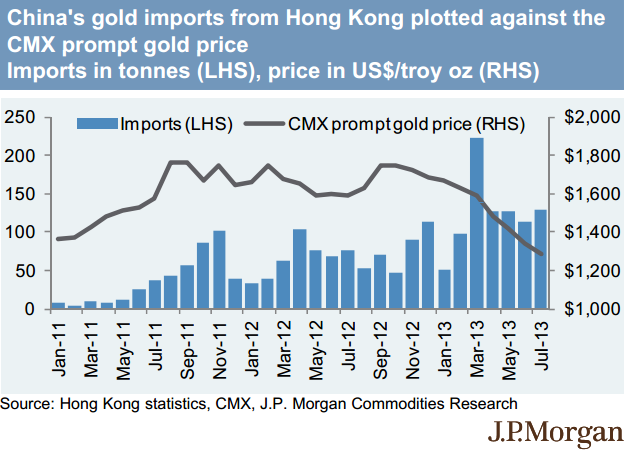
But as prices fell, the declining demand from ETFs and other investment products (such as hedge funds) was to some extent offset by demand from Asia. China has ramped up imports materially this year. Moreover, as the nation's economic growth stastabilizes (see post), the demand should remain robust. 


SMM: - On a net basis, China’s gold imports from Hong Kong totaled 113 tons in July this year, more than double net imports of 46 tons in July last year.

“Physical gold demand in China has clearly picked-up in July after gold prices hit the year-to-date low of $1,181/oz on June 28. This increase in demand helped contributed to bullion’s price recovery to over $1,300/oz at the end of July,” the bank added.

“More recently, bullion’s premium on the Shanghai Gold Exchange, an indicator of demand, has softened to low double digits from the $20-30/oz range seen in July and August, they continued.

“However, the recent pull-back in gold prices sub $1,400/oz level may be an encouraging sign for price sensitive physical buyers to step back into the market. That said, China’s gold imports may remain at elevated levels for the medium term, in our view,” the firm concluded.
India's imports rose 45% in the first half of the year, and in spite of the recently imposed controls, demand by jewelry manufacturers remains strong. Once these controls are lifted, the inventory rebuild will commence. Other nations such as Turkey, Pakistan, Saudi Arabia, UAE,  and even Vietnam are continuing to generate demand. This offsets some of the volatility created by financial sellers and in effect acts as a floor on price. As price declines, physical (as opposed to financial) buyers in Asia enter the market in size. 

From our sponsor:

Tuesday, August 20, 2013

Rising gold lease rates and the front-end backwardation

Gold lease rates have risen dramatically this year. In fact on the short end, lease rates are now higher than US dollar interest rates - which is quite unusual.

Source: KITCO (click to enlarge)

Part of the reason for rising lease rates this year is an increase in hedging activity ahead of the Fed's series of decisions on QE3. Investors, mining firms, banks, etc. who are long gold are selling gold forward contracts as a hedge against their positions. The providers of these forwards (usually dealers) hedge themselves in the physical market by borrowing gold for a fixed period and shorting it into the spot market. A forward contract provider thus becomes long a gold forward in the derivatives market (via forward they bought from a client) and short a gold forward in the cash market (via a combination of lease and a physical short) - thus fully hedged. The demand to borrow physical gold in order to short it is forcing lease rates higher.

One interpretation of this trend from an economic perspective is that gold lease rates to some extent mirror global real rates - if one thinks of gold as an international "inflation-free" currency (h/t Ed Grebeck). Gold lease rates move higher due to expectations of rising real rates. That to some extent explains why gold lease rates were negative last year.

The combination of much higher lease rates and low short-term dollar rates has created an unusual gold forward curve. Here is what the COMEX gold futures curve looks like now. The curve is quite flat in the front and even inverted in the first two months.


Note that the futures curve begins to rise in the first half of 2015, around the time of the Fed's first expected rate hike. The inversion in the front end (Aug-Sep backwardation) is highly unusual for gold (would only happen when lease rates exceed short-term dollar interest rates.) In fact this has not happened over a 4-week period at any time during the past 30 years - until now.

Source: JPMorgan

As long as hedging activity stays strong, demand to borrow physical gold will keep lease rates elevated. In the intermediate term this is probably a positive for spot gold prices because if the hedging activity slows, dealers will be covering their spot short positions and not rolling into new ones.


SoberLook.com
From our sponsor:

Thursday, August 15, 2013

Long-term rates and gold prices

"What's the correlation between long-term treasury yield and gold price?" was an e-mail question from one of the Sober Look readers recently. The answer of course is - it depends. During periods of inflationary pressure, inflation risks tend to drive yields and gold in the same direction (bond prices and gold move in the opposite direction.) That is why historically gold was viewed as a strong hedge for traditional assets. Here is an example covering one of the periods when inflation was a major concern: 1978 - 1979 (24 months).


The relationship looks dramatically different over the last couple of years, with two different regimes visible over the period. The link between the two asset classes prior to April 2013 was quite weak, with no consistent correlation in their movements. But after April, the correlation between rates and gold price turned negative.


What happened in April that forced a switch to the new regime? On April 10th Goldman became bearish on gold due to (among other things) expectations of economic improvement in the US and risks of rising real rates (see Fox News story). Below is part of Goldman's report.
GS (April 10, 2013): - Over the past month, events in Cyprus triggered a rise in Euro area risk aversion while US economic data has been disappointing. Remarkably, gold prices are unchanged over that period, although US 10-year TIPS yields are back at their lowest level since late 2012, highlighting how conviction in holding gold is quickly waning. This is particularly visible at the ETF level, with gold holdings continuing to decline quickly. Given gold’s recent lackluster price action and our economists’ expectation that the acceleration in US growth later this year to above trend pace will see US real rates move gradually higher, we have lowered our USD-denominated gold price forecast once again. Our new forecast is further below the forward curve, with year-end targets of $1,450/toz in 2013 and $1,270/toz in 2014.
Some other investors and analysts started shifting their views in that direction as well. That was the turning point. Expectations of rising real rates, driven in large part by the trajectory of the US economic recovery and subsequently the Fed's next steps, began to move both gold and treasury prices in the same direction.


SoberLook.com
From our sponsor:

Sunday, August 4, 2013

Bundesbank gold holdings decline

All the conspiracy theories aside, Bundesbank gold holdings (in euros) are down about a third from the peak. Of course a large portion of this can be explained by gold price depreciation, but not all.  It is clear that Bundesbank has been a net seller. And while a portion of the sales were to the ministry of finance to make coins, some was sold into the market directly. This is somewhat surprising, given that most central banks have been buyers of gold recently and Bundesbank has always been committed to maintaining its gold reserve.


Source: Deutsche Bundesbank


SoberLook.com
From our sponsor:

Wednesday, July 10, 2013

India's foreign reserves declining

Barclays Capital had a sobering update on India today. Apparently June saw the largest outflows on record from India bonds and equities portfolios.

Source: Barclays

As a result, declines in India's foreign reserves are becoming material.

Source: Barclays

Moreover, India's gold holdings constitute a significant portion (more than other countries) of the nation's reserves. And the recent declines in gold price have not yet been included in the official numbers (not in the chart above).

While the reserves a currently sufficient to defend the currency if the RBI chooses to use them, these recent declines will probably make them hesitate. India has other tools it can deploy, should the officials decide to become more aggressive in defending the currency.
Barclays Capital: - ... government officials are likely to use other policy options to stem INR weakness, including further liberalisation of the financial account (eg,reducing restrictions on debt purchases by foreign investors and relaxing FDI limits) in an effort to support sentiment. Most recently the Securities and Exchange Board of India (SEBI) announced measures to reduce speculative INR trades “in view of the recent turbulent phase of extreme volatility”, which are likely to help stabilise the currency to some degree. In consultation with the RBI, SEBI has instructed relevant exchanges to reduce client position limits and increase margin requirements for currency derivatives.
Therefore for those concerned that the central bank will be forced to sell gold, at this stage there are a number of other alternatives. And given the nation's cultural attitude toward gold, politically that's just not an option. Nevertheless in the near-term the currency remains vulnerable to capital outflows, should confidence deteriorate further.


SoberLook.com
From our sponsor:

Sunday, March 17, 2013

The thesis for higher gold prices remains intact

A number of strategists continue to call for significant price increases in gold. Apparently investors have been ignoring those calls. In particular hedge funds have been exiting positions in precious metals recently, driving prices lower. The chart below shows changes in holdings of GLD (gold ETF) by the two major investment groups.

Source: Merrill Lynch

Hedge funds have been responding to the recent strength in the US dollar as well as a number of technical signals.

Dollar Index (DXY; source: MarketWatch)

With some of the fast money out of the market however, there is a potential for firmer gold prices. In spite of the recent talk of the Fed exiting the aggressive monetary expansion policy, so far all signs point to more asset purchases by the central bank - at least in the near future. Historically gold price roughly followed the US monetary base (or bank reserves), particularly since the Lehman collapse in 2008. Recently the two trends have diverged. But as bank reserves continue to increase at a steady clip in response to Fed's purchases, this divergence is unlikely to grow further.


Moreover, Merrill Lynch analysts point out that over time investors will play a diminished role in determining the price of gold.
ML: - The reduced importance of investors in the medium-term is heavily influenced by more affluent emerging markets, which should translate into steady increases of spending on non-essential items like jewelry in the coming years.
Their model suggests that in the next few years, even if demand from investors declines, gold price could reach new highs. In fact by 2016, investor demand would only need to be at the level of 2008 to keep the price at $2,000/oz.
ML: - Our data shows that to sustain gold prices at $2,000/oz by 2016, investors need to purchase a similar amount of gold than in 2008, when prices hovered around $872/oz.

Source: Merrill Lynch

According to these models, in the coming years even a moderate investor participation will drive gold prices higher. And it won't take much to entice investors to keep buying at least at the same pace they were five years ago.


SoberLook.com
From our sponsor:

Wednesday, January 16, 2013

Currency wars should provide support for precious metals

As nations see Japan's success in weakening the yen (see discussion), some begin to take notice. Emerging markets nations often attempted to devalue their currencies in the past in order to improve competitiveness. But these days developed economies are doing it as well. This morning the Russians called these policies "currency wars", which is a good way to describe the latest developments. And such policies are not limited to Japan.
Bloomberg: - The alert from the country that chairs the Group of 20 came as Luxembourg Prime Minister Jean-Claude Juncker complained of a “dangerously high” euro and officials in Norway and Sweden expressed exchange-rate concern.

The push for weaker currencies is being driven by a need to find new sources of economic growth as monetary and fiscal policies run out of room. The risk is as each country tries to boost exports, it hurts the competitiveness of other economies and provokes retaliation.

Yesterday “will go down as the first day European policy makers fired a shot in the 2013 currency war,” said Chris Turner, head of foreign-exchange strategy at ING Groep NV in London.
In an environment such as this it is somewhat surprising to see gold treading water.

Gold (spot price, source: Barchart.com)

The key concern on the part of precious metals investors is the risk of rising US dollar - as Europe and Japan focus on pushing their currencies lower. Stronger dollar tends to put downward pressure on commodity prices.

As discussed earlier (see post), the Fed's activities in 2012 did not materially increase US bank reserves or the monetary base. 2013 however will be a different story, as the dovish Fed keeps buying assets at an accelerated pace (see discussion). That's why in spite of this latest news from Europe on "currency wars", the dollar remains subdued.

Dollar index (DXY, source: MarketWatch)

At least in the near term, precious metals and some other commodities should benefit from this global policy of "currency wars", which include a large contribution by the Fed.


SoberLook.com
From our sponsor:

Saturday, December 15, 2012

Barclays' forecast for gold in 2013

Just as DB, Barclays Commodities Research has been fairly constructive on gold. Here is their reasoning:

1. Although non-commercial positions remain elevated, they are off the recent highs reached in the run-up to the QE3 announcement. Tactical allocators have taken some profits due to the recent stability of the dollar (see discussion). That reduced some of the "fast money" in the market.

Net non-commercial gold futures positions (CFTC)

2. There is a common belief among metals investors that retail activity in the US is a good leading indicator for the direction of gold prices. This is quite different from equities, where large retail participation tends to indicate frothy markets.
Barclays: - Physically backed ETPs rose for the fourth straight month, taking total metal held in trust to 2645 tonnes, yet another fresh high and almost the equivalent of our annual mine output estimate for this year. US gold coin sales more than doubled m/m and trebled y/y.
3. Central banks continue to be net buyers. Demand from China's official sector is expected to increase (see discussion).

Source: Barclays Capital

4. Interest from China's private sector seems to be improving, as the Shanghai Gold Exchange volumes pick up.

Source: Barclays Capital

5. On the supply side, global gold mining output is expected to remain roughly flat in 2013.

Clearly the largest risk for gold remains the strength of the US dollar. That is why Barclays' projection is not nearly as aggressive as DB's. They forecast gold to reach $1815/oz in 2013.


SoberLook.com
From our sponsor:

Thursday, December 13, 2012

Precious metals hit by the Evans’ Rule

There seems to be a great deal of confusion about why gold (and silver) sold off in response to yesterday's announcement from the Fed.

Source: Barchart

The Fed will be undertaking an even more aggressive expansionary policy than originally announced in September. Balance sheet will expand dramatically and so will the reserves and the monetary base. Treasuries sold off again today with higher inflation expectations (see discussion).

Dow Jones Credit Suisse 30-Year Inflation Breakeven Index (source: S&P)

So what's up with gold?

Clearly there is no single explanation. But the main thrust of the selling has to do with the introduction of the Evans’ Rule. Now that the end of this ultra-accommodative policy is linked to the unemployment rate, some gold investors are beginning to think the date is much closer than people had originally anticipated (as discussed here). The Fed has been known to be "behind the curve" and investors were betting the Fed will "overshoot" as usual (maintaining the policy of zero rates and extreme liquidity for much longer than necessary.) But with the Evans’ Rule in place, some funds involved in precious metals (including silver - silver March futures are down 3.5% today) think the exit is now much closer - simply because now the Fed will effectively be "forced" to exit based on their own rule.
Reuters: - Gold fell 1 percent on Thursday as fears the Federal Reserve might withdraw its economic stimulus if the job market improved dramatically prompted funds to reduce their bullish bets.

The metal fell below $1,700 on Thursday for the first time this week on economic worries about the U.S. "fiscal cliff," overshadowing its safe-haven appeal. Liquidation by large institutional investors in gold futures on fears of tax hikes in the new year also pressured prices, traders said. Silver dropped 3 percent for its biggest one-day decline in a month.

Gold's drop came a day after the U.S. central bank adopted numerical thresholds for its monetary policy. It said it would keep interest rates near zero until the U.S. unemployment rate fell to 6.5 percent.

Analysts said the move stirred fears that the U.S. central bank could put an end to its loose monetary policy which has boosted the metal's inflation-hedge appeal.

"With the economy showing some signs of recovery, we may see a 6.5 percent unemployment rate sooner than previously anticipated, so longer-dated funds that are heavily invested in metals are looking to reduce their gold positions," said Phillip Streible, senior commodities broker at futures brokerage R.J. O'Brien.
This effect is visible in the currency markets. The dollar index initially sold off after the treasury purchases announcement, but then recovered as soon as the Evans’ Rule was brought up. And dollar's stability is a negative for precious metals - even if inflation expectations are picking up steam again.

Dollar Index (DXY) futures (source: Barchart)


SoberLook.com
From our sponsor:

Monday, December 3, 2012

DB's bullish case for gold

DB is maintaining its bullish stance on gold. Here is their reasoning:

1. As discussed earlier (see post), the impact of QE3 on bank reserves has been modest thus far. That may explain in part why gold is lagging previous QE cycles (see discussion). As base money expands, gold prices should be supported (particularly if we see further dollar weakness).

2. US long-term real rates are staying in negative territory (see post). Cash is increasingly expensive to hold, which also provides support to gold prices.

US 10y Real Yield (source: DB)

3. DB is also looking at China as the reason for stronger gold prices.
  • China's demand for gold is expected to outstrip supply.
DB: - China's Ministry of Industry and Information Technology launched a new guidance regarding the development of the gold industry this week. In contrast to discreet gold reserve purchases, it is worth noting that the central government is now officially emphasizing the property of gold as currency and its irreplaceable role in preserving wealth during financing crises and safeguarding national economic security.

According to the Ministry, China's gold demand has grown rapidly in recent years, a function of increased need of hedging inflation and financial risks, growing interest in gold reserves by global central banks and rising demand from the private sector. In 2011, China's jewelry, gold bars, gold coins, industrial and other gold consumption reached 761 tons, the second in the world after India. On the supply side, China’s gold producers faces a number of challenges including scattered resources, low grade, high cost and deep extraction, which will constrain gold production growth. As a result, China’s gold demand will continue to exceed supply over the next few years. The Ministry expects that in 2015 China’s gold demand could exceed 1000t while domestic supply could only reach 450t.
  • Longer term, DB expects the RMB to challenge the US dollar as the world's reserve currency. To support its currency China will need gold reserves that at least rival that of the US. That means significant new central bank purchases.


SoberLook.com
From our sponsor:

Wednesday, November 14, 2012

What makes gold so unique

Source: NPR

Sanat Kumar, a chemical engineer at Columbia goes through the periodic table and simply using the process of elimination (crossing out elements one by one) determines what makes gold such a unique element in human history. Just listen to the audio below...

SoberLook.com

Friday, November 9, 2012

Gold lagging previous QE cycles but DB remains bullish

Deutsche Bank maintains its bullish stance on gold, in spite of missing their aggressive projection a few weeks ago (see discussion). Gold has underperformed the previous post-QE price moves, as shown in the chart below.

Source: DB

Part of the difference in this monetary expansion cycle from the previous ones is that the new program is having a fairly slow start in terms of its impact on base money. As shown in the chart above, Operation Twist for example had little effect on gold prices because it didn't involve increasing the monetary base (what some refer to as "money printing"). For every dollar in securities bought, there was roughly the same amount of securities sold, keeping base money from rising. Bank reserves, which is the primary mechanism for impacting base money, actually declined over the period since the Twist program was started (chart below). And the recent asset purchase initiative (QE3) has barely moved the reserve balances so far.

Source: FRB

Once the latest program begins to ramp up and bank reserves start growing again, real interest rates should move deeper into negative territory (see discussion) and the dollar should weaken (see discussion). That is likely to create a fairly bullish environment for gold. According to DB, the US fiscal uncertainty and potential risks of another debt downgrade will also support that market.
DB: - ... during the remainder of this year we expect the US fiscal cliff and further efforts by the Fed to extend QE will not only push long term real interest rates deeper into negative territory, but, also resume US dollar weakness. Moreover any speculation of an additional downgrade in US Treasury debt would be supportive to gold prices, in our view.


SoberLook.com

Monday, October 22, 2012

With speculative money exiting, central bank actions should provide support for precious metals

Precious metals have been under pressure recently as investors took profits from the recent QE3-driven rally. Some of the sell-off has also been on the back of industrial commodities such as copper, which have been impacted by weak global demand.
FT: - The selling in the metals came as Caterpillar, the manufacturer of earthmoving, construction and mining equipment seen as a barometer of economic activity, cut its full-year forecast, raising uncertainty about global economic growth. Weaker than expected third-quarter profits at US copper miner Freeport-McMoRan, also worried traders.

$/oz, source: Barchart

But as discussed earlier (see this post) investors should have remained cautious on precious metals due to an increase in speculative activity back in August/September. However we are now seeing some of the speculative money fleeing the market with ETP inflows reversing for the first time in months.

Source: JPMorgan

This may be a bullish sign for precious metals, particularly gold. With the start of an unprecedented open-ended monetary expansion by the Fed last week (see post), the accumulation of excess reserves by the banking system will increase inflation expectations. And as a number of other central banks (BOE, BOJ, ECB, etc.) pursue similar policies, precious metals prices are likely to see some support. Certainly the heavily negative real dollar rates (see post) across the curve make any rate product and cash far less attractive on a relative basis.

We are also seeing some support for gold coming from Asia - something we haven't seen recently. Much of it of course is also driven by the expectations of central bank stimulus measures.
Businessweek: - India’s imports are set to climb for the first time in six quarters as a decline in domestic prices stokes jewelry and investment purchases before major festivals, according to Bachhraj Bamalwa, the chairman of the All India Gems & Jewellery Trade Federation. Prices also gained as a report showed Japan’s exports fell the most since the aftermath of last year’s earthquake, increasing speculation that the nation will enact more stimulus measures.

“Physical demand is providing some support,” Phil Streible, a senior commodity broker at R.J. O’Brien & Associates, said in a telephone interview. “The pressure is clearly on the Bank of Japan to introduce fresh easing measures.”


SoberLook.com

Monday, October 8, 2012

Average forecast for gold is $1,900/oz by 4Q13

It seems that DB's projection for gold at $1,900/oz by the end of October (discussed here) is aggressive. Nevertheless the latest 10 forecasts expect this level to be reached in about a year. DB of course is the most aggressive on that list forecasting $2,300 by Q3 of next year.

Source: Bloomberg

Bloomberg Briefs: - Gold prices will climb this week on the back of another round of quantitative easing by the U.S. Federal Reserve and expectations of additional easing measures by global central banks, according to 63 percent of analysts surveyed by Bloomberg. Bullion will increase to $1,900 an ounce by the end of 2013, according to the median of the 10 most recent forecasts, compared with an overall consensus of $1,813 an ounce, highlighting rising bullish sentiment in the precious metal.

SoberLook.com
Related Posts Plugin for WordPress, Blogger...
Bookmark this post:
Share on StockTwits
Scoop.it