Showing posts with label ABCP. Show all posts

Sunday, November 4, 2012

A good paper on shadow banking, finally

Finally here is an easy to follow, comprehensive, well researched, and unbiased paper from FRBNY (Tobias Adrian and Adam Ashcraft) on the so-called shadow banking (many thanks once again to Kostas Kalevras for pointing it out). A few comments:

I. This chart from the paper shows the breakdown of the "traditional" vs. the "shadow" banking market sizes. It is important to point out the precise definition of traditional banking sources of funds.
Traditional Intermediation [sources of funding] refers to net interbank liabilities [banks borrowing from each other] plus checkable and savings deposits of depository institutions plus reserves of life insurance companies and pensions plus [unsecuritized] corporate debt.
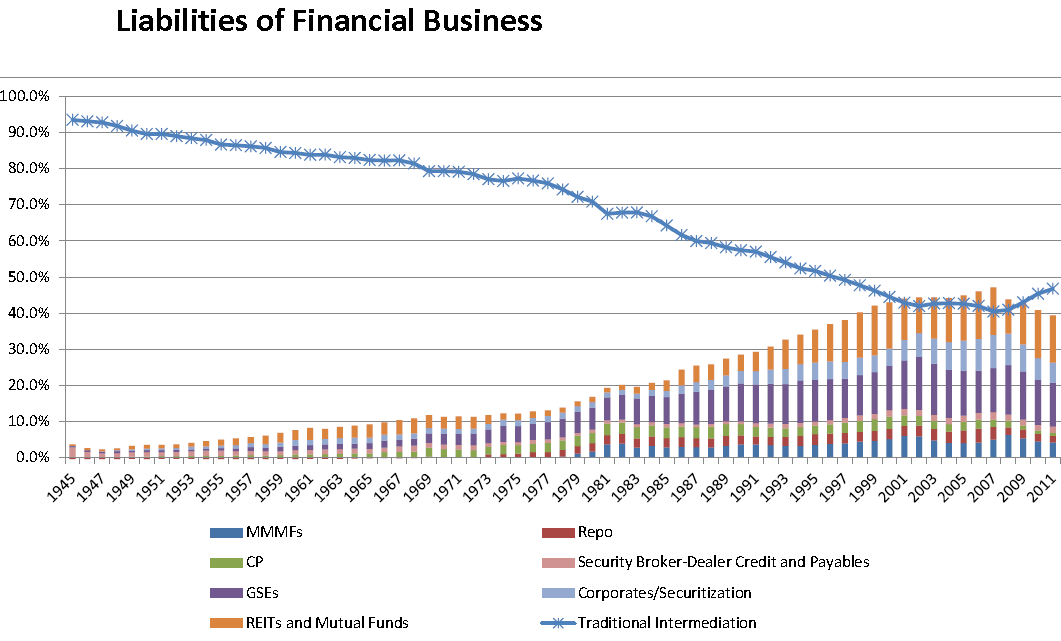
Source: FRBNY (click to expand)

Note that a big chunk of shadow banking is comprised of the GSE (Fannie Mae, Freddie Mac), something the mainstream media often misses. Also this does not include government sponsored student loans, which many would classify as shadow banking (and could become a serious issue at some point).

II. The authors may have overemphasized the complexity of the securitization process with the 7 steps (chart below). Yes, in the few years leading up to the financial crisis, with CDO squared, etc., one could potentially count this many steps. But those days are over. Modern securitization usually involves only the first three steps. For example, in CLOs one has the following:

  1. Banks lend to corporations and syndicate those loans.
  2. The CLO manager uses a "warehouse line" to purchase some large portion of the loans needed for the CLO.
  3. A permanent entity is set up, which issues the liabilities (tranches) and buys the loans out of the warehouse. It than uses excess cash from issuing the tranches to buy more loans in the market.

ABS deals (autos, cards, etc.) also have three steps and are even simpler. The use of ABCP has declined dramatically and with it went some of the more complex securitization (see discussion).

Source: FRBNY (click to expand)

III. The authors also put too much emphasis on regulation. Investors need to do their own homework rather than relying on rating agencies as they often did prior to 2008 (rating agencies had some serious conflicts of interest - also discussed in the paper). If a sophisticated investor buys a complex bond without understanding the risks, it has to be his/her problem. The government should stay out of it because in trying to protect such investors the authorities will create moral hazards. Plus the fact that something is regulated doesn't make it a safe investment by any stretch. There are plenty of "regulated" stocks and ETFs out there that could do serious damage to one's portfolio. Regulation of shadow banking should be limited to how it impacts regulated banks (such as not allowing Citibank or Wachovia to run a massive off-balance-sheet portfolio via CP conduits with a relatively small regulatory capital allocation - regulatory capital arbitrage).  Assigning appropriate levels of capitalization to liquidity backstops and credit guarantees is where the focus should be.

The other type of regulation that would be helpful is in products that are marketed and sold to retail investors/borrowers. For some reason mortgage brokers do not have to have the same level of regulatory scrutiny and licensing requirements as securities brokers. Yet for many households a mortgage is a much more risky transaction than their securities purchases (see discussion) - as we have discovered during the financial crisis.

IV. What many people (particularly the mass media) don't fully appreciate is that much of the securitization activities - which if done properly can be extremely helpful to the US consumers and to the economic growth as a whole - were started by the US government.
FRBNY: - In many ways, the modern shadow banking system originated in the government sector. Securitization was first conducted by government-sponsored enterprises (GSE), which are comprised of the FHLB system (1932), Fannie Mae (1938), and Freddie Mac (1970). The GSEs have dramatically impacted the way in which banks are funded and the way in which they conduct credit transformation: The FHLBs were the first providers of term warehousing of loans, and Fannie Mae and Freddie Mac pioneered the originate-to-distribute model of securitized credit intermediation.

Like banks, the GSEs fund their loan and securities portfolios with a maturity mismatch. Unlike banks, however, the GSEs are funded not through deposits, but through capital markets, where they issue short- and long-term agency debt securities. These agency debt securities are bought by money market investors and real money investors such as fixed-income mutual funds. The funding functions performed by the GSEs on behalf of banks and the way in which GSEs are funded are the models for wholesale funding markets. The GSEs use several securitization techniques. They use term loan warehousing services provided by the FHLBs. They also use credit risk transfer and transformation through credit insurance provided by Fannie Mae and Freddie Mac. Securitization functions are provided by Fannie Mae and Freddie Mac. Maturity transformation is conducted on the GSEs’ balance sheets through retained portfolios. These securitization techniques first used by the GSEs were adopted and imitated by banks and nonbanks to generate the nongovernmental shadow banking system. The adaptation of these techniques gave rise to the securitization-based, originate-to-distribute credit intermediation process.


Enjoy!

Shadow Banking - Dan Freed, you'll appreciate this one.


SoberLook.com

Saturday, October 27, 2012

ABCP market declines to new lows

After reaching its peak of over $1.2 trillion reached in 2007, Asset Backed Commercial Paper (ABCP) outstanding has continued its decline. The rapid growth was originally triggered by the use of commercial paper to fund RMBS, CDO bonds, SIVs, etc. But in early 2007, as subprime defaults picked up, US money market funds stopped buying ABCP, forcing banks who backstopped the commercial paper programs to move CDO bonds, etc. onto their balance sheets (that's the sharp decline in late 2007 on the chart below). This is what ultimately caused Citibank and Wachovia to become insolvent.

Source: St. Louis Fed

The ABCP market has undergone a dramatic change since then. Most of the programs are now so-called bank sponsored multi-seller facilities (multiple issuers use the CP program to fund their assets) - which provides some diversification. And the assets funded are much simpler these days - generally short-term ABS (autos, cards, etc.)
JPMorgan: - Today, the ABCP market comprises mainly of plain vanilla, traditional multi-seller conduits. Gone are the days when the market included more-sophisticated structures such as SIVs (structured investment vehicles) or securities arbitrage conduits. Although there are some securities arbitrage programs still outstanding, most are in the process of winding down as they let their securities run off. These are securities such as RMBS, CMBS, and CDOs, which most sponsors/investors would rather not continue to fund. Indeed, based on data we collected from our partners in banking, 75% of the ABCP market today comprises multi-seller conduits sponsored by banks or independent companies versus 54% five years ago — a reflection of investors’ preference for this type of structure.

Source: Blackrock

However even the multi-seller programs are shrinking. The sharp declines in ABCP this year have been driven by the Eurozone crisis, as money market funds no longer fund programs set up by French, German and UK banks in the US. No money market fund wants to show European exposure on its regular investor reports - even exposure to stronger EU institutions. Japanese, Canadian, and US banks, particularly Citibank, continue to manage some of the active ABCP programs.
JPMorgan: - It’s not surprising then that the largest ABCP programs currently are multi-seller conduits sponsored by US, Canadian, and Japanese banks—credits that investors have sought after away from the Eurozone. These programs continue to benefit from better pricing and market access compared to European administrators. For example, an A- 1/P-1 US ABCP conduit could obtain 1 [month] funding around 15bp (LIBOR - 5bp) versus an A-1/P-1 French ABCP conduit around 25-35bp (L + 5/15bp). Even Citigroup (A1/P- 2/F1) remains the largest overall and US sponsor of multiseller conduits. They currently fund below the French conduits in 1 [month maturity]. With that said, [Citibank's] funding capacity would likely be severely limited if they suffer any more ratings erosion such that they become a Tier 2 issuer.
Source: JPMorgan

Banking organizations in the US with strong ratings will continue to run relatively small ABCP programs. They are quite useful to facilitate non-bank consumer lending (a form of "shadow banking"). Often if you buy or lease a car in the US, the loan or lease ultimately becomes part of an ABS and is financed with ABCP. But the ABCP market is now a shadow of its former self and the amount outstanding continues to decline to new lows.


ABCP primer


SoberLook.com

Wednesday, September 2, 2009

Fidelity sends a letter to the SEC on money fund regulation

Fidelity has sent a letter to the SEC (included below) to comment on the recent SEC proposal to regulate money market funds. Here are some highlights:

* Fidelity points out that the proposed SEC rules, if implemented without changes, will essentially force their money market funds to yield zero in the current environment.
...we estimate that the potential yield reduction could be as high as 25 to 43 basis points for an institutional non-rated fund, 19 to 32 basis points for a rated institutional fund and 14 to 31 basis points for a retail fund. In today's low-rate environment, the average taxable fund is yielding 0.18% and the average municipal fund is yielding 0.17%.

* Fidelity is pushing to keep the 90 days limit on the average asset maturity, which the SEC has proposed to shorten. Fidelity's point is that 60 vs. 90 day maturity is not the issue when it comes to the risk profile of a money fund.

* Fidelity is asking to include Government Securities as "Liquid Assets" to avoid being restricted on the amount of government paper they can hold in the "prime" money markets fund. With the dearth of eligible corporate assets, Fidelity needs this option.

* They are trying to keep the 10% bucket for assets that don't qualify as "liquid" securities. Their view is that the daily and weekly liquidity requirements the SEC is proposing should be enough.

* Fidelity wants the ability to buy some amount of paper from "second tier" issuers (smaller corporates). Again, their view is this was not what caused the problem in money market funds - the Reserve was destroyed because it had Lehman CP, which was a "first tier" issuer.

* One of the biggest problems for money funds has been a push by some, including the SEC, to mark the portfolio to market and have investors come in and out at NAV, like any other fund. That completely destroys the appeal of a money market funds, and Fidelity wants to keep money funds at one dollar NAV.

* Related to that, the SEC has proposed that money funds disclose the mark to market of their portfolio (Market Value Pricing). Fidelity doesn't like that at all. Their view is that if an investor sees the mark to market at $1.001, thew will jump in because they will be getting in at a dollar. But as soon as anyone sees a market value of $0.999, they will move out, pressuring the fund (potentially creating a run on the fund).

* Fidelity slammed traditional approaches to asset backed CP investing:

Fundamental to the analysis of whether an asset backed security represents minimal credit risk is an evaluation of the sources of liquidity available to repay the security when due. Examples of sources of liquidity that appropriately should be considered in making a minimal credit risk determination include third party committed liquidity facilities and the cash flows generated by the underlying assets. Taken alone, neither an issuer's sale of underlying assets at market value nor its continued access to the market to issue new securities is sufficient.

The Commission could consider requiring that, in order to be an Eligible Security, an issuer of an asset backed security cannot rely solely on the sale of assets at market value or continued market access.

This may cause a further hit to the ABCP market as money funds leave that space altogether.


Tuesday, July 14, 2009

The contraction of the US commercial paper markets

The commercial paper market volumes are continuing to drop. The decrease in paper outstanding has in fact accelerated. A large portion of the change is coming from the Asset Backed Commercial Paper market (ABCP).

Source: the Fed


This is the market that used to support the various types of ABS financing, including the sub-prime markets. In fact when a sub-prime borrower asks where the funds for her mortgage came from, a big chunk of that money came from ABCP investors. ABCP funded the senior tranche of the pool of mortgages bought from the originators. ABCP investors were generally money market funds.

The ABCP market size took it's first hit in 2007 when investors got uneasy about the collateral. What remained after 07 was ABCP sponsored by banks, who in many cases were (or started) providing full credit support to the CP programs. Non-bank supported programs such as SIVs had to be unwound (liquidated).

The problem with commercial paper in general is that every week, month, or quarter (mostly every day during the crisis) some paper matures. The borrower has to borrow again, i.e. roll the paper. Until recently we've had decades of rolling commercial paper with practically no issues. If it was rated by the rating agencies, it could be refinanced. 2007 changed all that, and banks could no longer rely on the market to be there for them.

The banks are now reducing ABCP conduits (the off-balance-sheet entities that issue bank supported paper) and are using other, more stable forms of funding. Whether it's the FDIC guaranteed notes, longer term bonds, or the interbank funding, these sources are replacing commercial paper. Some of the financing is accomplished via TALF, which was specifically designed to replace the lost ABCP.

The type of ABCP programs that remain are now dominated by "multi-seller" bank supported financing. These programs involve multiple originators of credit card or auto loans tapping the commercial paper markets. The SIVs and the securities arbitrage programs are disappearing (see chart).

Source: Moody's


The overall decline in the commercial paper markets (to nearly half the peak levels) is another sign that the recovery will be extremely bumpy, and the GDP growth is unlikely to return to pre-recession levels. The shrinking ABCP markets powered a great deal of the consumer spending that contributed to that growth.

Related Posts Plugin for WordPress, Blogger...
Bookmark this post:
Share on StockTwits
Scoop.it
