Showing posts with label high yield. Show all posts

Wednesday, June 18, 2014

As Janet Yellen talks about low risk premium in the markets, risk premium declines further

It was quite strange listening to Janet Yellen's press conference this afternoon. She clearly expressed concerns about declining volatility in the markets, saying that “volatility both actual and expected in markets is at low levels”. She proceeded to say that we have plenty of uncertainty associated with the trajectory of the Fed's monetary policy and market participants should take that into account when making their decisions. The message is: investors are not pricing in enough risk premium. She was echoing comments made by the Fed's William Dudley, who recently expressed concerns about declining volatility across multiple asset classes, saying it "makes me a little nervous".

Similarly, Janet Yellen proceeded to point out - once again - how the Fed is concerned with the lofty valuations in US corporate high yield markets. As she was talking however, implied volatility (VIX) declined sharply and high yield bonds rallied.

Intraday movements in VIX and HY bond ETF in reaction to Janet Yellen's press conference

The Fed officials continue to be surprised and even annoyed by the diminishing risk premium in the markets. By striking a rather dovish tone however, the Fed is directly creating the issues that Janet Yellen is uneasy about. The irony is that we saw risk premium decline further today - while she was speaking about these concerns.

________________________________________________________________________________


SoberLook.com
Sign up for our daily newsletter called the Daily Shot. It's a quick graphical summary of topics covered here and on Twitter (see overview). Emails are distributed via Freelists.org and are NEVER sold or otherwise shared with anyone.


From our sponsor:

Friday, June 6, 2014

Worsening risk/reward fundamentals in US corporate credit

US corporate credit markets, particularly high yield bonds, are becoming quite frothy, as risk/reward dynamics continue to worsen. Here are some key indicators:

1. In the last couple of years high yield supply has been massive relative to equities. HY has had no shortage of buyers thus far, but the market is becoming increasingly comfortable with the primary market buyers always being there. Investors are ignoring the fact that such demand may not always be the there.

Source: Barclays Research

2. High yield bond spreads have declined to new post-recession lows, with the latest spread tightening driven by yesterday's ECB's easing. Bond holders are simply not being compensated for the risk they take.


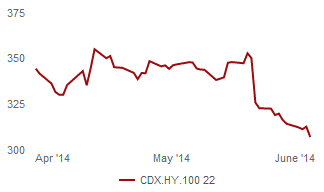
3. Similarly, corporate credit default swap spreads are falling as well. Here is what CDX (index of CDS) spreads have done recently for both investment grade and HY indices.

Investment grade CDX spread; current on-the-run series (source: Barclays Research)

High yield CDX spread; current on-the-run series (source: Barclays Research)

4. Valuations in the most leveraged and lower quality portion of the credit spectrum have risen dramatically. Over 60% of corporate bonds rated CCC by Fitch now trade above par.

Source: Fitch Ratings

To be sure, improving economic fundamentals in the US have reduced default risks considerably. But we are now back to the days when the ability to refinance is taken for granted and current cash flow to service debt is starting to become less relevant. With banks' ability to hold inventory impaired, these markets are becoming quite vulnerable to a sharp correction.

___________________________________________________________________________
SoberLook.com
Sign up for our daily newsletter called the Daily Shot. It's a quick graphical summary of topics covered here and on Twitter (see overview). Emails are distributed via Freelists.org and are NEVER sold or otherwise shared with anyone.


From our sponsor:

Sunday, June 1, 2014

Failure of Guidance on Leveraged Lending resembles the War on Drugs

About two years ago the various US bank regulatory agencies (the OCC, the FDIC, and the Fed) have started pushing through the so-called Guidance on Leveraged Lending. They were alarmed at the rising leverage and weaker covenants (see post) in new sub-investment grade corporate finance transactions that involved senior loans.
US Regulators (March 2012): - Credit agreement covenant protections, including financial performance (such as debt to cash flow, interest coverage or fixed charge coverage), reporting requirements, and compliance monitoring. Generally, a leverage level after planned asset sales (i.e., debt that must be serviced from operating cash flow) in excess of 6x for Total Debt/EBITDA raises concerns for most industries.
The guidelines ultimately went into effect, as US regulators made it known that they will be watching these transactions closely. Particular emphasis has been given to the "6x" leverage cutoff that regulators view as the "danger zone".
Bloomberg (October 2013): - The Federal Reserve and the Office of the Comptroller of the Currency sent letters to some of the biggest U.S. banks asking them to avoid arranging debt that may be classified by regulators as having some deficiency that may result in a loss, according to nine people with knowledge of the communication.
Of course a great deal of this paper is not held on banks' balance sheets and instead sold to CLOs, traded loan funds, and other asset managers. What the regulators fear however is that a major market disruption will prevent banks from unloading this risk, resulting in "hung" deals that could jeopardize bank stability.

Recently, Deutsche Bank researchers took a closer look at how effective the Guidance on Leveraged Lending policy has been. What they found so far is that this regulatory effort does not seem to have much of an impact at all, as the percentage of loans with leverage of 6x and above continues to rise.

"Pct of Deals" = percentage of  the number of leveraged finance transactions with leverage > 6x
"Pct of Face" = percentage of  the face value of leveraged finance transactions with leverage > 6x
Deutsche Bank: - Aggressiveness of new deals has been rising consistently over the past few years, and currently stands at levels similar to those last seen in 2006 as measured by both of these datasets.
Part of the problem with this failed regulatory effort is its similarities to the so-called War on Drugs. The demand for yield has been so strong lately that cutting off supply remains extremely difficult and will take time. Instead the Fed should be focusing on the demand side of the equation. By raising interest rates more aggressively, the Fed could improve fixed income yields, thus reducing the need to chase such high-risk paper.
Deutsche Bank: - ... while we realize that it takes time for the market to conform to new leveraged guidance and future disciplinary actions by regulators will help such an adjustment gain its urgency, the single most important action the Fed can take in addressing these trends is to continue normalizing monetary policy faster rather than slower. The reach for yield in leveraged finance, after all, is primarily a function of scarcity of yields in other markets.


SoberLook.com
IMPORTANT: We require that any re-published posts preserve ALL embedded links to previous Sober Look and Twitter posts. Sober Look represents an ongoing discussion which relies on continuity as well as references to key external materials.

From our sponsor:

Monday, May 5, 2014

The unprecedented chase for yield

The major market surprise of 2014 so far has been the extent of investors' appetite for yield in the developed fixed income markets. It has been quite spectacular. The Eurozone in particular has been a key beneficiary of this trend. We've seen German government bond yields hit a low not seen in almost a year (see Twitter post), but the real action has taken place in the periphery bonds. We are seeing multi-year and even all-time lows in government bond yields.

Source: Investing.com

And this trend is not limited to sovereign paper. European corporate high yield bonds are now yielding  just over 3.6% on average - a record low. Let's just put this in perspective - this is sub-investment-grade paper trading at these levels.


While European fixed income markets clearly feel frothy, it is not clear if there is a near-term catalyst to bring about a correction. With the Eurozone inflation still MIA, capital seems to be chasing anything with a reasonable yield. The shift in attitudes from just two years ago is unprecedented.
Bloomberg: - “We’re still in a world where investors are starved of return,” said John Wraith, a fixed-income strategist at Bank of America Corp. in London. “People are still happy to diversify their holdings and buy bonds that not so long ago they would have shied away from. The slightly better data helps reassure people that finally some of these weaker countries are turning a corner.”


SoberLook.com
From our sponsor:

Wednesday, January 29, 2014

HY bond market weathering the storm

The US corporate high yield market remains incredibly resilient in the face of increasing global volatility. Year to date the broad HY index has outperformed the S&P500 by over 4.25%.

SPY = SPDR S&P 500 ETF; JNK = SPDR Barclays High Yield Bond ETF (source: Ycharts)

One reason for this stability is the strong performance of the treasury market this month. Also many investors have become quite comfortable (perhaps too comfortable) with junk debt. Part of the reason is the low default rates recently as well as vibrant primary markets that have been willing to refinance (roll) maturing debt. In addition, supply of new bonds has been relatively light, while fund inflows remain robust (see story). As a result HY spreads are less than 10bp higher than they were at the end of last year.

Experienced analysis and investors in this space openly admit that it's just a "matter of time" before this market "cracks". It simply needs a catalyst, such as a large unexpected corporate default. Maybe a major event in the sovereign bond market could dislodge HY. Short of that, junk bonds could remain at frothy valuations for some time. 


From our sponsor:

Wednesday, December 25, 2013

US credit risk appetite hits euphoria

Per earlier post (see discussion and chart), corporate spreads in the US are grinding lower - with new post-recession lows for both IG and HY spreads. The Merrill HY Index spread is now below 400bp and the investment grade equivalent is below 130bp. For those who track fixed income ETFs, the following chart comparing treasuries with corporate bonds (LQD vs. IEF and HYG vs. IEI) illustrates the extend of spread compression.


In fact US corporate credit is outperforming other forms of credit assets such as commercial real estate (see post). A good way to see that outperformance vs. global risk assets is in the components of the Credit Suisse Risk Appetite Index. For the first time since Bernanke began hinting about taper, US Credit Risk Appetite is at the level of "euphoria".

Source: Credit Suisse

But some argue that these credit spread levels are justified given where the US stock market is currently valued. The scatter plot below shows the S&P500 index vs the HY index spread over the past 10 years. The last time spreads were at these levels (2007), equities were priced much lower (S&P500 was around 1550). Of course corporate revenue has grown substantially since then making this comparison less relevant. Nevertheless some are suggesting that it's the stock market which is overvalued relative to credit.


Whatever the case, as monetary conditions in the US begin to tighten and interest rates rise, credit spread compression has to slow or reverse. The current trend is simply not sustainable.


SoberLook.com
From our sponsor:

Friday, December 6, 2013

US corporate spreads lowest in 6 years

While everyone talks about the "great rotation" from bonds to equities, we've had a different type of rotation taking place within the US fixed income universe - the rotation from treasuries into credit. Here is a simple comparison of total returns between high yield and treasury bonds over the past few months. Corporate credit outperformance has been remarkable.


The result of this "rotation" has been the collapse in corporate spreads, which has been persistent across the credit spectrum. Both investment and non-investment grade bond spreads have not been this tight since the bubble years.


Of course as corporate spreads come in, there is increasingly less cushion to compensate investors for the losses due to rising yields. And yields are likely to rise in 2014. There is no question that at least within corporate credit we are moving into "bubble" territory.
BW: - Spreads on U.S. investment-grade and junk bonds have contracted by almost 700 basis points from a peak of 896 in December 2008, about three months after the collapse of Lehman Brothers Holdings Inc. helped spark a seizure in credit markets, Bank of America Merrill Lynch index data show.

After average annual returns of 10.8 percent since the end of 2008, investors have been left with spreads that are 8 basis points below the average 208 basis points during the 10 years ended 2007, the index data show. That may leave investors with too thin of a cushion against losses should benchmark interest rates climb.


SoberLook.com
From our sponsor:

Thursday, November 21, 2013

Corporate credit markets back to frothy levels

This summer's growing fears of the Fed's impending policy change hit a number of fixed income sectors quite hard. While corporate credit was the best performer on a relative basis, it too was hit by some sell-off and a decline in liquidity. In September however an event in the bond markets brought investors back. Verizon's massive bond sale went so well, the whole investment grade universe perked up.
FT: - Verizon sold $49bn worth of bonds in a combination of fixed and floating-rate debt spread across six maturities that ranged from three to 30 years. The bonds jumped in secondary markets, rewarding investors who bought the securities at discount prices. The gains generated up to $2bn in profit for investors on the bonds in 24 hours, analysts estimated.

Verizon’s successful sale helped end the summer sell-off and paved the way for an upswing in the market for US corporate bonds. The Fed’s decision later in September to keep its bond-buying programme in place added a new enticement to corporate borrowers as well as investors in fixed income assets.

“There were talks earlier this year about a ‘great rotation’ out of fixed-income and into other asset classes,” says Alex Gennis, a credit strategist at Barclays. “Indications point to a very strong and healthy appetite for paper in the corporate bond market. The ‘great rotation’ has yet to happen.”
As the equity markets resumed their rally, corporate spreads - including high yield - began to tighten again. All of a sudden we find ourselves back in the frothy corporate credit environment that existed before the Fed struck a more hawkish tone in May (see discussion).

Source: FRED
SFGate: - The extra yield company bonds offer over Treasuries approached the narrowest level in six years as Federal Reserve Chairman Ben S. Bernanke said interest rates will stay low and investors sought ways to boost income.
Even within the middle-market credit space, pricing is looking quite rich. BDCs (public investment firms that focus on middle market debt - see discussion) have seen a nearly 60% total return over the past two years. In order to keep paying the same dividend they have been historically, BDCs are increasingly reaching for yield, flooding credit markets with more capital.

11/21/2011 = 100

Perhaps some of the more publicized signs of corporate credit markets overheating have been the loosened underwriting standards in the syndicated loan market. The so-called "cov-lite" loans often limit the lenders' ability to take corrective action with the borrower when the company takes a turn for the worse. And the number of such deals has reached new highs.

Source: Barclays Capital

Just as in the past, eventually someone will be suing the banks for selling these products. We will hear institutional investors testifying in court on how they were mislead by unscrupulous bankers about the "hidden" risks. And some shareholders will be complaining about the amount of leverage the lenders put on the company. Everyone will all of a sudden develop amnesia about how these assets ended up in their portfolios in the first place. And those with capital and the ability to work out distressed situations will make a fortune.
 
For now however investors don't seem to care - as long as it's rated corporate credit it's got to be good. It's not 2006 quite yet, but we are certainly moving in that direction.
 
 
SoberLook.com
From our sponsor:

Thursday, October 3, 2013

HY spreads now positively correlated to treasury yields

Here is further evidence that in this environment treasuries are driving "risk asset" valuations. Corporate HY bond spreads are now positively correlated to treasury yields. That's quite unusual because traditionally when treasury yields shrink, spreads rise (negative correlation).

Based on Merrill HY Index

By not allowing treasury yields to rise, the Fed is artificially suppressing HY spreads (as well as other "risky" bond spreads). The corporate market is therefore heavily dependent on stimulus, making any attempt to normalize monetary policy increasingly difficult.


SoberLook.com
From our sponsor:

Sunday, July 21, 2013

Diverging fund flows are reflected in fixed income performance

Capital is returning to certain fixed income sectors. Fund flows are quite uneven however, with the corporate sector remaining investors' favorite. In particular, high yield bonds have recouped a great deal of the recent outflows.

Source: Goldman Sachs

In contrast, mumi bonds have seen almost no new net inflows. The little problem in Detroit is not helping the situation (see story) and the SEC going after the city of Miami (see story) has made the sector look quite unappealing.

Source: Goldman Sachs

Outside of treasuries, fixed income performance these days is extremely sensitive to fund flows. And the returns over the past month (June 20th - July 19th) fully reflect these dynamics in mutual funds and ETFs.


SoberLook.com
From our sponsor:

Sunday, July 7, 2013

Junk bonds outperforming other fixed income markets

Here are the latest estimates of performance across the various fixed income markets over the past month.

1-month total return (including interest income)

High yield corporate bonds have been the best performer in this near-panic unwind. The reasons include low default rates and strong corporate balance sheets as well as relatively short maturities and relatively high current income (which is included in the performance numbers above).

A great deal of this outperformance recently though has been driven by the strength of the US equity markets. HY spreads tend to have a strong inverse relationship to stock prices.


And with HY spread being a significant component of the overall yield, strong equity markets have kept yield increases relatively modest. If equities come under pressure however, all bets are off for HY.


SoberLook.com
From our sponsor:

Tuesday, June 11, 2013

Pattern of negative correlation between HY bonds and treasuries has been broken

Since the financial crisis, the correlation between treasuries and many credit assets such as high yield bonds (HY) has been strongly negative. With rates at extraordinarily low levels, HY price movements were driven mostly by spreads. When treasuries rallied it usually meant that something "scary" was going on. During these periods credit spreads would widen (more than rates fell) and HY bonds would sell off. When treasuries sold off, it meant the market perceived some relief to whatever problems we were facing, and HY bonds would rally. These market dynamics created a pattern of negative correlation.

Recent events however broke that pattern. We've had a number of days with both the longer dated treasuries and HY selling off. That means the HY asset class is now responding to rate moves (not just spread). The 3-month correlation between prices of longer dated treasuries and HY bonds is nearing zero. This move toward a "less negative" correlation with treasuries is also visible in other credit assets as well. Sub-investment-grade credit investors are all of a sudden paying much closer attention to rates.


SoberLook.com
From our sponsor:

Tuesday, May 21, 2013

Headed for euphoria

On its risk appetite index, Credit Suisse views the index value of 5 as "euphoria". And we are headed there, as markets embrace risk.

Source: Credit Suisse

This is not surprising given where credit markets are trading. As an example, the Merrill European High Yield Index average yield is now below 4.5% (4.46% to be precise). Keep in mind this is sub-investment grade debt mostly from European issuers. The yield on these bonds is now less than half what it was just a year ago.


Not much else to say here other than enjoy it while it lasts.


SoberLook.com
From our sponsor:

Sunday, May 5, 2013

A natural floor on corporate spreads?

US corporate yields hit another record low on Friday. The Merrill Lynch US investment grade corporate bond index yield is now at 2.64%, while high yield is at 5.35% - both are at an all-time low. The spread to treasuries, particularly in investment grade (IG) bonds, is no longer declining. In fact IG spread tightening has stalled at just under 1.5% support level (chart below).


Since we've never been at these yield levels, this is uncharted territory in corporate bond pricing. Certainly bond spreads have been lower in the past - especially during the boom years. But in the post-crisis era, corporate spreads seem to have found a floor.

Typically as US equity markets rally, corporate spreads tighten in tandem. Higher stock prices usually indicate lower default probabilities and therefore lower spreads. But as JPMorgan analysts point out, recently that relationship broke down and corporate spreads have flat-lined.

"JULI" is JPMorgan's liquid investment grade bond index
(note that JULI represents a different set of bonds than Merrill's index - therefore a slightly different floor).

Does this "natural floor" in spreads limit how low implied corporate default probabilities can go in this environment? Anecdotal evidence suggests that investors who buy these bonds are not as concerned about defaults as they are about rising rates. On a seven-year corporate bond, it will take only a 25bp increase in yield to wipe out a whole year's worth of spread income. On the other hand a 25bp rate decline now seems far less likely (7-year treasury yield - now at 1.07% - has found a floor at around 100bp). The rate risk is perceived to be "asymmetric" in these markets. Investors therefore demand some minimum cushion spread to treasuries to compensate them for the risk of rising rates. Consequently, as long as investors remain concerned about rising long-term rates (see discussion), this floor on corporate bond spread should persist.


SoberLook.com
From our sponsor:

Friday, February 1, 2013

Fears of rising interest rates have investors focused on leveraged loans

Expectations of rising interest rates in the US are creating demand for traded HY corporate loans (also called "leveraged loans" - see discussion). These products typically pay LIBOR plus a fixed spread, which means that the coupon will grow if short-term rates increase. As an example, Invesco’s PowerShares Senior Loan fund (ticker: BKLN), which is supposed to track the price and yield of the S&P/LSTA Leveraged Loan 100 Index, has recently reached $1.5bn in assets. The fund's yield is currently below 5% (keep in mind these are sub-investment-grade companies), making it vulnerable to credit shocks.

BKLN total return (source: Ycharts)

Yet the floating-rate nature of the portfolios keeps investors flooding in, as they become less sure about the timing of the Fed's eventual tightening. In fact, relative to the the market size of each of the asset classes, leveraged loans have seen by far the largest inflows.

Source: Barclays Capital

The demand for this asset class can be seen in the outperformance of loan closed-ended funds. These funds can trade at a premium or a discount to NAV, which can result in out/under-performance vs. the underlying index.

Source: Barclays Capital

With the CLO market booming (CLO's securitize these corporate loans - see discussion), Barclays remains bullish the loan asset class (in spite of the recent rally). There simply isn't enough floating rate product in the market currently to meet this demand.
Barclays Capital: - The insufficient quantity of new loan product has forced investors to continue harvesting the secondary market to avoid accumulating too much cash, as demand technicals continue to be very strong across all major classes of leveraged loan investors. With more than $9bn in new CLOs priced, January was the busiest month for CLO creation since 2007. In addition, loan mutual fund inflows have been robust of late, as investors continue to look for ways to protect against rising interest rates. Cumulative flows for the first four weeks of the year already exceed $3bn. ... Unless rates reverse course and move materially lower, we expect favorable loan flows to continue.


SoberLook.com
From our sponsor:

Tuesday, December 18, 2012

US corporate credit market looking extraordinarily rich

One of the "side effects" of the Fed's monetary expansion is all the capital flowing into spread products, particularly corporate credit. Corporate bond yields are hitting record lows across the ratings spectrum. An average junk bond in the Merrill HY index now yields some 6.3%.

Merrill HY Index effective yield (source: St. Louis Fed)

Even emerging markets corporate HY bond yields are near all-time lows.

Merrill Emerging Markets Corporate HY Index effective yield (source: St. Louis Fed)

In fact credit looks highly overpriced relative to US equities. And equities are not exactly cheap at this stage, particularly given some 2% GDP growth expectations in the US. Goldman's relative value model now shows corporate credit at the richest levels in at least three decades.

Source: GS

SoberLook.com
From our sponsor:

Wednesday, November 14, 2012

Credit is finally getting back to reality

After months of frothy conditions, credit valuations are finally beginning to correct. High Yield has traded down materially, as investors have had enough of ridiculous pricing in this market (see discussion).

HYG (HY ETF)

HY CDX traded down to 97.5 after being as high as 101.5 a month ago - a material move even for this market.

Black line & RHS represents HY CDX price

Investment grade spreads widened as well, with IG CDX increasing to 108bp from near 90bp a month ago. Some managers are taking chips off the table before the impending political mess of the US fiscal budget fight. It's finally time to get back to reality.


SoberLook.com

Saturday, November 10, 2012

High yield debt issuance in 2012 hits an all-time record

High yield bond issuance hit an all-time record in 2012, with $306 billion worth of new HY bonds coming to market by the end of October. In fact September was an all-time record month for new issue - on the back of the Fed's latest action.

Source: JPMorgan

Leverage finance space as a whole also hit a new record. Adding  new issue HY bonds and institutional loans (see discussion) puts 2012 ahead of 2007, the previous record.

Source: LCD

Demand for yield remains strong, pushing non-investment grade yields to record lows.

Merrill Lynch HY Bond Index: yield

One of the reasons for this optimism has to do with new issue market pushing out the leveraged finance maturity wall, as companies refinance into longer maturities. Back in 2009 the wall looked quite scary (see this post from 2009), with the largest concentrations of maturities in 2013 and 2014. But the markets have been chipping away at those two years. This reduced the risk of near-term liquidity problems in case the HY new issue market suddenly dries up, lowering expected default rates in the near term.

Source: LCD

We are, however, starting to see some signs of speculative primary market activity. According to JPM, six toggle notes have been issued in October ($2.6bn). These are debt securities that give borrowers the option to skip coupon payments, increasing the face value of the debt instead (payment in kind or PIK). It is roughly the corporate equivalent of option ARM mortgages. Also October saw 11 so-called dividend deals in which the proceeds from a bond sale are used to pay a dividend to the shareholders. This is considered a more risky transaction because rather than using cash to refinance existing debt or acquire a business, the company simply pays it out, causing its leverage to increase. In the mortgage world this is the equivalent of using a home equity loan to take a vacation rather than to put an addition to the house or to repay credit card debt. In spite of some of the more risky transactions, on average the deals have been far less speculative in nature than during the 2006-07 period. This trend of potentially loosening lending standards (such as toggle notes or dividend deals) in the leveraged finance markets will be important to watch going forward.


SoberLook.com

Wednesday, October 31, 2012

Investors continue to demand a LIBOR floor for most new leveraged loans

With investor demand for leveraged loans remaining strong (see discussion), one structural component has not changed. The majority of new leveraged loans still have a LIBOR floor. That means these loans will pay a minimum coupon plus spread, no matter what LIBOR does. In fact according to LCD, the average floor of 1.25% in October has changed little this year for new-issue loans in spite of investor demand for the product.  That is investors want these loans but they will typically only buy loans that have the LIBOR floor included. A loan with a spread of 3% and a floor of 1.25% will pay 4.25% (act/360) annually, even though the 3m LIBOR is only 0.32%. The chart below shows the percentage of new issue loans with a LIBOR floor and the average floor level for each month.

Source: LCD

Those who think in terms of options will recognize that the borrower (in addition to paying the usual LIBOR + spread) has written the investor/lender a series of in-the-money put options on LIBOR (an in-the-money LIBOR floor). Even the options with longer maturities are in-the-money because the forward LIBOR curve is below the average floor level all the way out to 2016 (option strike level is above the forward underlying). And most of these loans do not go too far beyond that point. Even if the maturity is out to five years, most loans will amortize/prepay to a shorter average maturity (at least based on history).

Source: LCD

The rationale for maintaining a LIBOR floor on new deals is simple. Given the Fed's efforts to maintain near zero rates for a prolonged period of time, the probability of LIBOR rising substantially is low. In order for this product to compete with high yield bonds, which are fixed rate instruments, it needs to guarantee some minimum coupon in spite of what the Fed is doing. To be sure, investors holding these loans will receive a smaller coupon on average than with high yield bonds, but the floor makes that difference less of an issue.

What attracts some investors to leveraged loans is that they receive a minimum coupon because of the floor but to some extent they also get an inflation hedge. Should inflation surprise to the upside, LIBOR may in fact rise above the floor level, increasing the coupon. HY bonds on the other hand will continue paying a fixed coupon.


SoberLook.com

Sunday, September 30, 2012

Investment grade corporate bonds are priced to perfection

Investment grade (IG) corporate bonds continue to attract investment dollars. The latest fund flows show about half a billion inflows into IG ETFs (like LQD) and $1.8 billion into IG mutual funds.

IG fund flows (source:GS)

While junk bonds were impacted by the recent downward adjustment, investment grade bonds did not respond the same way. Even though investment grade spreads widened, the corresponding decline in treasury yields provided an offset. That kept the overall yield (treasury yield + bond spread) stable - it's a bit of a "self-hedging" product.

Year to date LQD (investment grade ETF) has outperformed HYG (high yield ETF) by about 2% as the two diverged recently.

HYG vs LQD total return (Bloomberg)

With the Fed taking investment grade MBS paper out of the market, the bid for strong credits has risen. But IG corporate bonds are now "priced to perfection".


Companies have flooded the market with new supply during the third quarter.
LCD: - ... the third quarter is on track for at least $215 billion of new supply placed to ravenous demand, more than 43% above issuance volume over the same period last year, according to LCD data that excludes sovereign, supranational, split-rated, and preferred-stock issues.
All this makes corporate bonds increasingly vulnerable to risks in the Eurozone, particularly if spreads widen more than treasury yields decline.
LCD: - After corporate credit spreads trended steadily tighter through a robust slate of new-issue supply over the third quarter, flat progressions for spreads over the last several sessions may be at risk as the high-grade market drifts into the fourth quarter against the backdrop of unrest in Europe, trade data show.

Even as cash bond levels held steady in recent sessions, derivative indications flashed warning signals for spreads. Along with a material rise in the VIX index, the CDX IG 19 index continued 2.5 bps higher this morning in an approach to 105 bps, marking a fifth-straight push higher for the index as U.S. markets opened. [see discussion]

SoberLook.com
Related Posts Plugin for WordPress, Blogger...
Bookmark this post:
Share on StockTwits
Scoop.it