Showing posts with label Emerging markets. Show all posts

Saturday, January 31, 2015

The Forces at Work as Developed World Currencies Diverge

As Europe still manages fallout from the SNB breaking the Swiss Franc peg earlier this month, we can discuss emerging market countries that might feel similar pressure from Europe and the US soon. It is easy to forget the extent to which emerging market economies rely on other currencies:


Source: Currency Substitution / Wikipedia

Of all major base currencies, the euro and US dollar have displayed the largest divergence in recent months as the US economy strengthens and the EU continues QE.


Source: @RoutersJamie

The SNB’s action earlier this month is an interesting case study on countries pegged to a depreciating base currency. The SNB’s move was unexpected largely because the relative weakness of the Swiss franc looks positive for Switzerland at first glance. As an exporting nation, Switzerland benefits greatly from a weaker currency and greater trade competitiveness.


Source: Trading Economics

The usual concern about devalued currency is inflation, though this was clearly not an issue for the Swiss.

Source: Trading Economics

Instead, the SNB was concerned with the mounting foreign exchange reserves necessary to maintain their peg. The EU’s latest expected round of QE, along with CHF’s ongoing use as a safe-haven currency, forced the SNB to reach $500 Billion in foreign reserves.


Source: Trading Economics

Such large European exposure and expected future easing outweighed the benefit of favorable terms of trade and lower risk of deflation that came from weaker currency. 

Turning to other Euro-pegged countries, we see a similar trend in foreign exchange reserves.

Source: Trading Economics

In contrast, the US dollar has appreciated on recent strong economic news, and USD-pegged countries should be drawing down on foreign currency reserves to strengthen their domestic currency. Though recent evidence is weak, we may see further draw-downs soon:


Source: Trading Economics

Unlike euro-pegged currencies, stress on US dollar pegs will be far more direct: countries will draw down on foreign exchange reserves as the first line of defense. This will generally result in tighter monetary policy at a time these nations struggle with slower global growth. Once they can no longer buy domestic currency in open markets, they may turn to grimmer deflationary measures such as seizing currency through higher taxes. For now, we’ll have to watch out for USD-peg rumblings (GCC) and avoid speculation (Hong Kong).
_________________________________________________________________________


SoberLook.com
Sign up for our daily newsletter called the Daily Shot. It's a quick graphical summary of topics covered here and on Twitter (see overview). Emails are NEVER sold or otherwise shared with anyone.

Monday, June 2, 2014

Is the emerging markets underperformance about to end?

The underperformance of emerging markets equities (see discussion from a year ago) over the past couple of years has been quite spectacular. Valuations of developed markets shares, particularly in the US, have diverged dramatically from those in emerging economies.

Blue = S&P500 ETF, Orange = iShares MSCI Emerging Markets Index ETF (total return; source: Ycharts)

Is this trend expected to persist? Investment consulting firm deVere Group is seeing a shift, as their clients show increasing appetite for emerging markets shares. The firm provides 3 key reasons for this change in investor sentiment:
Nigel Green (deVere): - “First, as developed markets approach old highs, or surpass them, the valuation discount of emerging stock markets has become more compelling.

“Secondly, the tapering of QE has not resulted in higher US Treasury yields and more expensive borrowing costs for emerging market countries. The persistent low yields on US Treasuries is something of a mystery, but it is nevertheless a ‘fact on the ground’ that supports risk assets.

“Thirdly, political uncertainty has eased a little. Russia has not invaded Ukraine; India has voted overwhelmingly for a new prime minister, Mr Modi, who is unambiguously dedicated to the cause of economic reform; whilst China has shown itself willing to step in to prevent the collapse of large savings trust companies, and a wave of bad debt coming from Chinese property-related companies and banks has not, so far, materialised.”
The jury is still out on the China property bubble situation and there is a real risk that rates in fact do rise in the US later this year. Nevertheless, this renewed interest in the asset class should not be dismissed. Nobody expects a massive rotation into emerging markets at this point, but given the underperformance, we could certainly see some rebalancing taking place this year.


SoberLook.com
IMPORTANT: We require that any re-published posts preserve ALL embedded links to previous Sober Look and Twitter posts. Sober Look represents an ongoing discussion which relies on continuity as well as references to key external materials.

From our sponsor:

Thursday, January 23, 2014

The risk-on trade sends emerging markets currencies to new lows

Today's China-induced "risk-off" trade sent emerging markets currencies into a sharp decline. As discussed before Turkey and South Africa have been hit the hardest recently and today touched fresh all-time lows.

ZAR = South African rand, TRY = Turkish lira
(chart shows dollar appreciating against these currencies; source: Investing.com) 

But even some of the larger emerging markets nations saw their currencies decline to multi-year lows. Brazil and Russia in particular experienced a significant selloff.

BRL = Brazilian real, RUB = Russia ruble
(chart shows dollar appreciating against these currencies; source: Investing.com) 

The "risk-on" currency correction was not limited to emerging markets, as the Australian dollar touched levels not seen since 2009 (at some point hitting US$ 0.874 - vs. 1.05 last spring). It seems that some of the volatility seen in global markets during the Eurozone crisis has returned.


SoberLook.com
From our sponsor:

Saturday, January 4, 2014

Turkish central bank's current predicament

Rising rates in the United States have sent shock waves across a number of emerging markets, particularly in nations with high current account deficits. At the top of the list of most vulnerable emerging economies in 2014 is Turkey. The country not only faces a large current account hole that it needs to plug but also tremendous political uncertainty - a combination of risks that can be devastating for an emerging economy. In fact the political situation has become quite precarious in recent weeks.
The Economist: - In the past two weeks a Turkish prosecutor has detained dozens of people as part of investigations into illicit gold transfers and bribes allegedly paid by the construction industry. The suspects include businessmen close to the ruling Justice and Development (AK) party, as well as officials, politicians and the sons of three cabinet ministers. The prime minister, Recep Tayyip Erdogan , combative at the best of times, reacted with fury—stoked by reports that one of his own sons was next on the list. He reshuffled his government to put loyalists in place, sought to gain control of police investigations, and got the prosecutor removed from the corruption case. His ministers justified all this with talk of a “soft coup”.
Turkish currency, the lira, has touched new lows in recent days, with the nation's bonds (see chart) and stocks (see story) punished as well.

USD/TRY (chart shows the US dollar strengthening against the lira; source: Tradingeconomics.com)

It's a dangerous development because such currency weakness can and will ignite inflationary pressures that could quickly lead to further social unrest. Turkey's central bank (CBRT) has been trying to defend the lira using foreign reserves. But that strategy is quite limited in scope, as foreign assets started a sharp decline in recent weeks.

Source: GS

With foreign investment slowing due to political uncertainty, the only other option for the CBRT is to raise short-term rates to make it more expensive to short the lira. But in an environment of such political uncertainty the central bank is no longer independent. It is therefore difficult to envision the CBRT raising rates sufficiently to stem the lira's decline. Doing something as unpopular as a major interest rate hike in an economy that is barely growing could quickly end careers (or worse) for the decision makers at CBRT.

It is therefore quite likely that the Turkish lira will continue its slide in 2014 and beyond. Sadly, with that decline will come higher consumer prices, more pain for Turkish companies who borrowed in foreign currency (see story), more social unrest, and more political uncertainty.


SoberLook.com
From our sponsor:

Friday, November 8, 2013

Emerging markets jitters are back

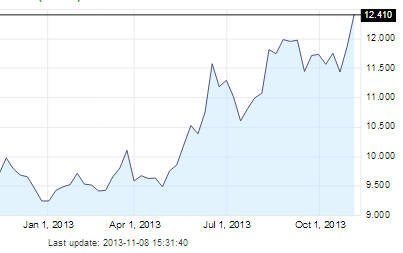
The combination of higher than expected 3d quarter US GDP (see story) and surprisingly strong payrolls report (see story) have reignited fears of near-term Fed "taper". And that in turn has woken up emerging markets bears that have been absent in recent weeks. From India to South Africa, currencies weakened once again and emerging markets bonds sold off. Brazil's 5-year and 10-year government bond yields hit a new recent high, both breaching 12%, while Bovespa gave up 4% in the past 3 days.

Brazil 10-y government bond yield (source: Investing.com)

Stay tuned.


SoberLook.com
From our sponsor:

Monday, August 26, 2013

Emerging economies sought semi-hot money through currency manipulation

As we look across major emerging economies, even some of the strongest have not been spared. Consider Turkey for example. The lira is now toying with the 2-to-the-dollar level - even after the central bank has taken a number of steps to stabilize the currency.
Hurriyet Daily News: - The Turkish central bank said it would apply more monetary tightening by not holding one-week repo auctions, halting funding from its policy rate and opening forex-selling auctions of at least $350 million.
At this point the central bank is desperate, adjusting its policy each week or even more than once a week. It is however having little success, as the currency slides, ...

Turkish lira to one dollar (source: Investing.com)

... the stock market is now in full retreat, ...

Borsa Istanbul National 100 Index (source: Bloomberg)

... and rates have gone vertical, as the three-year notes punch through 10% - more than doubling in yield since May.

Turkey 3yr government bond yield

How did we get here? How is it that the Fed's actions, which had to take place sooner or later, precipitated a severe market squeeze on one of the strongest emerging economies - among others? An interesting answer came from Donald Kohn, the former Fed vice-chair, who presented at Jackson Hole.
FT: - With cheap capital flowing in, some emerging markets failed to run a disciplined economic policy, or carry out reforms to boost future growth. Those are the economies that now face the greatest difficulties.

One argument at Jackson Hole, although expressed with much diplomacy and politesse, was whether those imbalances in emerging markets are an inevitable result of easy monetary policy in the US and elsewhere, or the fault of developing country policy makers.

“The recipient countries have considerable control over how this works out and what stability conditions are inside their own countries,” said Donald Kohn, the former Fed vice-chair, now at the Brookings Institution. “One of the ways that monetary policy from the United States was transmitted to the rest of the world was by resistance to exchange rate appreciation in many other countries.”
By holding down their currencies, these nations allowed semi-hot money to flood their economies. In a fully flexible exchange rate mechanism these currencies would have appreciated sufficiently to make it less attractive (more expensive) for this capital to enter. That would limit the semi-hot money and force these nations to grow in a more sustainable manner. Unfortunately this hasn't been the policy for a number of nations. Now the semi-hot money is rapidly exiting, leaving these countries with economic damage that could potentially become severe.

SoberLook.com
From our sponsor:

Saturday, August 24, 2013

The end of cheap US cash claims another victim: Indonesia

In a fashion similar to what became known as the "Asian Contagion" in the late 90s, the current stress in emerging economies has been spreading. One of the nations to experience financial stress recently has been Indonesia, Southeast Asia’s largest economy. The impact of capital outflows from emerging economies on Indonesia's financial markets has been swift and severe. Here are the key financial indicators:

1. Indonesia's equity markets are down 17% in the past 3 months (note that the market peaked in late May, corresponding to this event) -

The Jakarta Stock Exchange Composite Index 

2. The government bond market (sell-off also started around the same time) -

10yr gov bond yield (source: Investing.com)

3. Currency (the exchange rate went vertical last week) -

Dollar rising against the rupiah (source: Investing.com)

4. Sovereign CDS isn't very liquid but is still showing signs of financial stress.


The question some are asking is whether this is just a contagion-driven panic or are there fundamental flaws in the economy? Just as the case with India (see post), trade imbalance in Indonesia is behind some of this adjustment. In the past, foreign investment covered up the problem, but the party is now over. Investors - not surprisingly - have become uneasy with the chart below:


A massive structural problem like this is an invitation for a punishment from the markets. Indonesia (just as Brazil and others) is trying to plug the trade gap hole.
NYTimes: - Indonesia announced a package of policy measures on Friday to reduce imports and bolster investment in labor-intensive industries as it struggles to revive confidence and consumer spending in its economy, Southeast Asia’s largest.

The intervention by President Susilo Bambang Yudhoyono comes after a punishing week for emerging markets, with currencies from Brazil to India hit hard by fears of higher global borrowing costs and a reduction in cheap cash from the United States.

Indonesia has faced sell-offs in the rupiah, stocks and bonds after an unexpectedly large second-quarter deficit in its current account — a measure of foreign trade and investment — prompted fears that the weak global economy would only further erode exports at a time when a surge in inflation is crimping domestic demand.

The country’s chief economic minister, Hatta Rajasa, said the government would increase the import tax on luxury cars, seek to reduce oil imports and provide tax incentives for investment in agriculture and in metal industries.
With China being one of the large clients for Indonesia's natural resources, fixing the trade balance issue is going to be easier said than done. A few tax adjustments are simply not going to do the trick - at least not in the near-term.  The nation remains vulnerable to further market pressure.


SoberLook.com
From our sponsor:

Wednesday, August 21, 2013

The FOMC minutes exacerbate emerging markets rout

Emerging markets currencies are getting hammered across the board today on the back of the FOMC minutes. Many are touching multi-year or even all-time lows. Here are some examples of the dollar strengthening against some major EMG currencies:

Source: Investing.com

Rumors persist of some very large emerging markets hedge funds taking significant losses, as Brazil's 10-year government bond yield punches through 12%.

Brazil 10y gov yield (source: Investing.com)

This provides further confirmation that the Fed's recent monetary stimulus effort and the artificially low dollar rates have been responsible for a great deal of capital flows into emerging markets. Now we are seeing a sharp and to some extent an uncontrolled reversal of these flows. And many of these nations' central banks find themselves quite helpless in the face of this correction.


SoberLook.com
From our sponsor:

Thursday, August 15, 2013

Emerging markets feel the taper

As the realization of imminent reduction of the Fed's ongoing stimulus program sets in, emerging markets come under pressure. It is becoming clear to investors that some of the strength in emerging markets in recent years was induced by the Federal Reserve's policy of monetary expansion. And now it's time to face reality.

After the US jobless claims number came out, the usual suspects got hit with sharp currency declines (USD rose).

Brazil
USD/BRL


South Africa
USD/ZAR


Turkey
USD/TRY


SoberLook.com
From our sponsor:

Wednesday, August 7, 2013

Major economies out of sync

Investment advisors pitching actively managed accounts, funds, and other products will often draw a sine wave to represent the global economic cycle and discuss what actions they would take at different points on the cycle. The problem of course is that it's nearly impossible to tell where a nation's economy is on the "sine wave" until years later - making it hard to take some of these proposals seriously. Yet it's an exercise worth doing - if anything, just for discussion purposes. Here is how some of the largest economies could potentially be mapped onto the economic cycle curve.

1. BRIC and other key emerging market nations fall into the category of slowing economies. Of course there is plenty of dispersion among them. Russia, India, and Brazil are struggling with growth, while some argue that China's growth has bottomed out (highly debatable, given the real estate and credit issues). Saudi Arabia on the other hand is doing quite well. The overall composite however is showing a slowdown, with the EMG PMI index at the lowest level since the Great Recession.

Source: Markit

2. We've discussed Australia (see post), where the economy is definitely slowing.

3. The Eurozone is clearly beginning to recover (see post).  PMI measures across the board are showing improvements, including France, Spain, and Italy. Even Greece is beginning to stabilize.

Greek manufacturing PMI (source: Markit)

Of course we are still in the early stages of recovery and the Eurozone has a long way to go. Here is what the composite looks like for euro area as a whole.

Source: Markit

4. The UK recovery is accelerating. The latest measures show a strong rebound across multiple sectors, particularly in service industries.

UK service PMI (source: Markit)

5. It's difficult to say where the US is on the cycle. The recovery has been going on for some time - certainly longer than in the UK or the Eurozone - but it has been quite tepid. Is it about to accelerate or continue at its current pace? There is a great deal of debate about that.

6. Japan is a wild card. We've seen a sudden jump in industrial activity and exports, but more recently things have not looked that great (see post). Given Japan's short economic cycles, it's not clear if we are still in the early stage of the recovery or if growth has peaked. Much of course will depend on government policy such as the implementation of the new sales tax proposal (see story).

Based on these generalizations, here is a very rough picture of where the various economies are on the cycle. Note that this doesn't say anything about how deep the slowdown has or will be or how fast the recoveries are. This is just about where we are on the the "sine curve" (each nation's cycles could be quite different in amplitude and frequency).


One can have long debates about the relative placement of these boxes. It is a fact however that major world economies are all over the place in terms of their economic cycle. It seems that we are witnessing the long-awaited global decoupling, although it may not be exactly what some had in mind (see WSJ story).


SoberLook.com
From our sponsor:

Friday, July 5, 2013

US, EMG nations are on different economic cycles - adding to pressure on developing economies

Emerging markets are under pressure once again. The Turkish lira is touching new lows, driven by a number of factors, including civil unrest in Egypt and more importantly rising rates in the US. Turkey also surprised investors with a higher than expected inflation reading of 8.3%.

USD/TRY (Turkish lira per one dollar; source: Investing.com)

The Indian rupee touched a new low of 61 and currencies are weakening elsewhere in emerging markets as well - as capital flight continues.

Bond yields are moving up across the board, just when emerging markets nations can least afford it. The HSBC emerging markets composite PMI index hit the lowest level since 2009, showing stagnating growth in developing economies.

Source: Markit

What makes this particularly troubling is that the US and emerging market nations are on a different economic cycle. As US rates rise, many emerging nations in fact need interest rates that are stable or lower. Brazil for example does not need government bond yields above 11% right now. But that's exactly what the nation is dealing with for maturities longer than three years.

Moreover, liquidity in emerging market bonds has collapsed as market makers exited. Just as the case with US corporate bonds (see post), US dealers no longer hold significant inventories of emerging markets bonds (thanks to the Volcker Rule). At the same time international investors' holdings of emerging market debt have been at historically high levels. Remember that most bonds don't trade on an exchange - they are over-the-counter products that require market makers for the market to function well. So when people call their broker to sell that emerging markets bond ETF, there are not many people to buy the actual bonds on the other end. That makes selloffs sharp and disorderly, forcing more active investors to run for the exits.


SoberLook.com
From our sponsor:

Sunday, June 23, 2013

Emerging markets for sale

Floating emerging markets currencies have been under tremendous pressure over the past month, as active investors move out.  Slowing growth, political instability, and weaker demand for natural resources have all contributed to the sharp declines. Rising rates in the US have not helped the situation either, making the dollar more attractive on a relative basis.


Not to be outdone, the Australian dollar - which is sometimes used as a proxy currency for China - is also down 6.4% over the same period. Many Emerging markets currencies have not seen these levels since the financial crisis. The Indian rupee touched another all-time low of 59.57 to the dollar. As discussed earlier, Brazil has been hit the hardest. The situation would have been considerably worse if the governments didn't actively intervene in the currency markets.

Nations with pegged currencies are also not immune to flight of capital. Argentina for example is experiencing tremendous pressure on foreign reserves.
Credit Suisse: - [Argentina's] central bank’s reserves remain under pressure. Gross foreign reserves have declined $5.0bn ytd to $38.3bn, compared to a $0.1bn increase over the same period in 2012. ... Reserves could fall by nearly $8.0bn this year. ... Any additional increase in reserves related to the tax amnesty program carried out in 3Q (perhaps $2.0-3.0bn) will likely be temporary and counterbalanced by external debt payments. Overall, we expect more controls to target deteriorating external imbalances, but reserves could still fall to $35.5bn by year-end and by another $5.0bn in 2014.
Anecdotal evidence suggests that China is also becoming concerned about capital flight. As a data point, the stock market is down some 10% over the past month. Some have even proposed that the high short-term rates in China (see post) is an attempt to "punish" those trying to short the currency (high rates and difficulties borrowing would make it hard to stay short the yuan).

Whatever the case, active investors are dumping emerging markets equities and bonds with the intensity not seen since the financial crisis.
JPMorgan: - EM bonds have been at the center of the flight from carry and illiquidity. EM local markets lost 1.5% FX-hedged, and almost 4% in USD terms Thursday, the former a record, the latter the worst day since October 2008. EM bond funds continue to see outflows, if more from hard currency than local currency funds. FX weakness is tilting risks toward tighter monetary policy to support the currency is some markets, and this week we penciled in another 50bp of hikes in Brazil. We maintain a short duration stance in EM, with position squaring likely still not done.


SoberLook.com
From our sponsor:

Thursday, June 20, 2013

Like it or not, you too have exposure to emerging markets

We've received an e-mail recently with the following question (paraphrased):
"I am a US-based retail investor. I have no positions in emerging markets - why should I care about places like Brazil [discussed here] or China [discussed here]?"
Here are two reasons (among others) that should get you interested in the events taking place in emerging markets - particularly the BRIC nations:

1. BRIC nations have been buyers of massive amounts of US treasuries. As their growth slows down and current account surplus declines, so will their purchases of US treasuries. The other large buyer of US treasuries just announced yesterday that their buying days may be over some time next year. What do you think happens to US interest rates? Mortgage rates? Dividend stock valuations?

Source: Sandler O'Neill

2. Take a look at the US exports to BRIC nations over time as percentage to total exports. These nations' economic growth will have a direct and very real effect on US corporations (enjoy your CAT or BA shares while you can), jobs in the US, and the US economy as a whole.

Source: Bloomberg

So as an American investor, when you see the Indian rupee sell-off to record lows as panicked investors  move dollars out of the country (chart below), you should be concerned. Whether you like it or not, you have exposure to emerging markets.

USD/INR (Indian rupees per one dollar)


SoberLook.com
From our sponsor:

Wednesday, June 19, 2013

Emerging markets underperformance worsening

Emerging markets underperformance that started in late 2011 is continuing. While part of the gap has been due to US equities generally outperforming global shares, we now have some 60% dispersion between emerging markets and the S&P500.  


CNBC: - Investor confidence in emerging markets is continuing to plummet, with a recent fund managers' survey showing that equity investment in the group of countries has fallen to its lowest level since December 2008.

The BofA Merrill Lynch Fund Manager Survey for June showed that about 9 percent of asset allocators were underweight emerging market equities - the first underweight reading since 2009 and down from a 3 percent overweight position in May.


SoberLook.com
From our sponsor:

Saturday, June 1, 2013

Global portfolio rebalancing hits emerging markets

The underperformance across emerging markets stocks is becoming more severe. In spite of Friday's beating to the S&P500, emerging markets indices are faring worse. Brazil's Bovespa for example is down 14.5% year-to-date (vs. S&P500 up 15% YTD). This level of dispersion is unusual and indicates fundamental concerns about growth in emerging markets.

Source: Ycharts (click to enlarge)

Part of the issue with these markets is the ongoing weakness in commodities. Commodity producing nations such as Brazil, Mexico, and South Africa are increasingly feeling the pressure. Just the last few days for saw a steady selloff across commodity markets (below).

DJ UBS Commodities Index (source: Dow Jones)

As an example, take a look at the decline in sugar prices (see chart on Twitter), which will hurt sugar producers in Brazil. And the recent weakness in gold price is hurting South African mining firms (of course South Africa is facing major economic problems in general - see this article). Add to that political stability risks (such as protests spreading in Turkey), and it makes for a difficult investment climate. And the weakness is not limited to emerging markets stocks. Many bond markets are being pressured as well. Just take a look at the price action on iShares Emerging Markets Bond ETF (EMB):


And here is the Mexican government 10-year bond yield in recent months. Government bonds in Brazil, Turkey, Russia, and others are also seeing spikes in yields.

Source: Investing.com

Part of this bond weakness is of course driven by raising yields in the US and fears of Fed's eventual exit. But it only goes to demonstrate how dependent global markets have become on central bank stimulus (see post).

Some portfolio managers have had enough and are abandoning emerging markets altogether - even nations that are not commodity exporters. As an example here is the Indian rupee's recent performance.

Indian Rupees per one dollar (higher number indicates weaker rupee)

Emerging market currencies are feeling the pressure across the board as investors pull their capital. The Turkish lira hit the lowest level in 17 months and the South African rand is down 13% year to date. The rebalancing of capital away from emerging markets is in full swing.


SoberLook.com
From our sponsor:

Friday, May 17, 2013

EM-DM inflation rate divergence hits post-recession high

Emerging economies have always run higher inflation rates than developed markets (DM) due to stronger growth. The spread in inflation rates has generally been steady, running roughly 2-3 percentage points. Recently however the spread has blown out to over 4% - a post-recession high.


Emerging nations selling into developed markets are losing pricing power and will have a tougher time keeping up with domestic labor cost increases (some of which are forced by their governments). EM corporate margins are already under pressure, ultimately weakening growth. India or Mexico are good examples (charts below). While temporary, this divergence could be quite disruptive in the near-term.


Mexico GDP growth (source: GS)

SoberLook.com
From our sponsor:
Related Posts Plugin for WordPress, Blogger...
Bookmark this post:
Share on StockTwits
Scoop.it