Showing posts with label Fed. Show all posts

Sunday, February 28, 2016

The Fed could be back in play in 2016

One or more rate hikes by the Federal Reserve in 2016 remains a real possibility. Why would the Fed consider such a policy action given the recent collapse in inflation expectations?

Over the past couple of months many analysts and the futures markets have assigned a rather high probability to the so-called "one and done" - no change in policy in 2016. Indeed, here is what we've heard recently from St. Louis Fed President James Bullard:
Reuters: - The Federal Reserve must act to stop inflation expectations from getting too low, St. Louis Fed President James Bullard said on Wednesday, reiterating his concerns about continuing to raise interest rates.

The U.S. central bank cannot let low inflation expectations "get out of hand," he told a dinner of bond traders here, adding he "can't stomach" currently low readings. "It's just that they've fallen so far that it's got to be a concern."
Source: @auaurelija

However a number of researches have suggested that with a relatively stable core inflation in the United States, oil prices would need to collapse to levels that are neither consistent with today's forward curve nor sustainable. Therefore, these studies argue, the current market-based inflation expectations are simply irrational.

1. Here is the latest analysis from Goldman Sachs.

Source: Goldman Sachs

2. Also, a study from the St. Louis Fed shows a similar result.

Source: St. Louis Fed

Moreover, US inflation measures are starting to stir - especially in the services sector. This is something the FOMC is not going to ignore. Below we have some of the recent reports.

1. The core PCE inflation, the Fed's primary inflation measure, exceeded consensus on Friday.


2. US CPI measures, both the headline and the core, also came in above expectations.

Source: Investing.com

3. As an example of where some of this inflation is coming from, shown below is the medical care CPI. It has been subdued last year but is now is waking up again.

Source: St. Louis Fed

Additionally, the cost of shelter in the US is now rising at over 3% per year, with the rate continuing to increase. Sadly, this is materially higher than the national wage growth rate, putting pressure on Americans with low-paying jobs.

Source: St. Louis Fed

4. We also see the so-called "sticky" CPI (the less volatile components of the CPI) reaching 2.5% - the highest since 2009.

Source: St. Louis Fed

Some analysts (RBS for example) have been suggesting that deflation is about to sweep the global economy, pulling in the US along the way. For now however there is simply no evidence of deflationary pressures in the world's largest economy.

Other indicators released last week could add to the ammunition of the more hawkish FOMC members.

1. US consumer spending was stronger than expected last month. Alas, some of this increase was driven by higher spending on healthcare, but it's an important data point nevertheless.

Source: St. Louis Fed

2. While this next item is more symbolic in nature, it's an important milestone nevertheless. US house prices (at least according to the government's index) are finally above the pre-recession peak.

Source: St. Louis Fed

The futures markets are starting to react to all these reports, with the Fed Funds futures falling on Friday (lower futures prices imply higher rates).

Source: barchart

In the coming months the Fed will be closely watching two key economic measures as the Committee contemplates further rate hikes.

1. Any indications of acceleration in wage growth will get the Fed going again. The high-frequency Gallup jobs indicator suggests that US labor markets remain stable, but material improvements in wage growth have been elusive.

Source: Gallup

2. The recent market turmoil has ignited concerns about tight credit conditions. The Fed's surveys suggest stricter underwriting standards in business lending while other indicators point to weakness in credit availability for middle-market and smaller businesses. And of course credit spreads have risen sharply, especially for the more leveraged firms. However the overall corporate loan growth remains close to 11% per year - for now.

Source: St. Louis Fed

Some suggest that raising rates in the current environment is nothing short of insanity. Given the monetary easing by the ECB, the BOJ, etc. (as rates move deeper into negative territory) or the dovish stance by the BOC, the BOE, and others, the US dollar is bound to resume its rally, causing further damage to the US economy. In fact the latest PMI measures, (from Markit as well as ISM) suggest that the US economic activity has already slowed sharply in the first quarter. Nevertheless, given the Fed's focus on some of the indicators discussed above, rate hikes in 2016 are now back on the table.

Source: Markit


_________________________________________________________________________

Sign up for our daily newsletter called the Daily Shot. It's a quick graphical summary of topics covered here and on Twitter (see overview). Emails are NEVER sold or otherwise shared with anyone.
_________________________________________________________________________

From our sponsor, Fitch Solutions: Sign-up for Inside Credit - a weekly wrap-up of noteworthy Fitch content delivered every Friday.

SoberLook.com

Sunday, December 20, 2015

Watch the Fed's RRP facility uptake jump at year-end

The Fed's policy announcement to raise rates had one technical detail that didn't get much media attention but is actually quite important. The reverse repo (RRP) rate was not only raised from 5bp to 25bp but the Fed also removed the cap on the RRP facility (which was at $300bn). It means that the program participants such as banks and money market funds can place nearly unlimited amounts of liquidity with the Fed overnight and earn 25bp. For now the Fed made $2 trillion of treasuries available for the RRP operations.

This sets the overnight riskless rate at 25bp which becomes the floor for the Fed Funds rate (and other money market rates such as commercial paper and private repo).

The immediate demand to place overnight funds with the RRP facility has been relatively modest at $143bn (note that we should see the reserves at the Fed drained by the uptake amount in the next H.3 report).

Source: NY Fed

Instead of using RRP, many market participants are enjoying the tightness in the private repo markets as general collateral (GC) repo now clears about 20bp above the RRP rate. The key reason for this relatively elevated spread is the increased regulatory pressure on banks to cut back on their balance sheet usage.

Source: DTCC

However the RRP demand is expected to spike at year-end as banks focus on window dressing. Given the somewhat elevated level of market stress and no cap on the RRP facility size, the uptake will be particularly large this time as we saw at the end of Q3 (note that the chart below shows the total reverse repo held by the Fed, which includes RRP).

Source: St. Louis Fed

Some are concerned that given the pressure on banks' balance sheets, this shift to RRP could disrupt the private markets on December 31st and send the GC repo rates to new highs.


_________________________________________________________________________

Sign up for our daily newsletter called the Daily Shot. It's a quick graphical summary of topics covered here and on Twitter (see overview). Emails are NEVER sold or otherwise shared with anyone.
_________________________________________________________________________

From our sponsor, Fitch Solutions: Sign-up for Inside Credit - a weekly wrap-up of noteworthy Fitch content delivered every Friday.

SoberLook.com

Sunday, October 25, 2015

The possibility of a 2015 rate hike in the US should not be ignored

Futures-implied probability of a 2015 rate hike in the United States remains below 40%. Some market participants have all but dismissed this possibility as they look at weak global growth as well as soft inflation and inflation expectations in the US. Some have even suggested that the next policy move by the Fed should be a rate cut into negative territory.

Source: St. Louis Fed

However global growth and US inflation expectations may not necessarily the main focus at the Fed. For example, numerous economists continue viewing the energy market crash as having only a transient impact in inflation. The logic here is that if we freeze crude oil prices at current levels (below $45/bbl), by early 2016 the year-on-year change will be around zero.


And a number of energy analysts expect crude oil prices to begin gradually rising going forward. To many forecasters this would imply that crude oil price weakness will no longer have such a severe impact on the rate of inflation.

Of course some would say that low fuel prices have not yet fully made their way through the economy - suggesting that the disinflationary pressures will persist for some time. Similarly some argue that the full effects of the dollar rally in the first half of 2015 are yet to be fully felt.

Nevertheless many economists view the headline inflation approaching the core measures by early 2016, with the core CPI turning higher as well. Moreover, a slew of recent US economic reports suggests that while the US economy probably slowed in the second half due to dollar strength and weakness abroad, the effect may be transient.

The housing market for example continues to recover and consumer sentiment and spending does not seem to be impacted by the recent market volatility.

Source: St. Louis Fed

Source: Scotiabank

Source: @GallupNews

Source: Deutsche Bank, @MKTWeconomics

Even US manufacturing which has been under pressure recently is showing signs of stabilization. The latest Markit manufacturing PMI report surprised to the upside.

Source: Markit, Investing.com

But what about the relatively poor payrolls report for September, which clearly missed expectations? Some economists argue that this is as much about slower hiring as it is about tight labor markets. For example (as we saw in the latest Pulte Homes quarterly report), the homebuilding industry is struggling with acute labor shortages. Of course as the Wall Street Journal recently pointed out, the US housing correction has been so severe that a whole generation of construction workers has permanently exited the industry, creating shortages as the sector recovers. Nevertheless when the Fed hears about labor shortages in an industry such as housing, they take notice.

Source: WSJ

Signs of tighter labor markets have also appeared in the latest NFIB reports on small business. When speaking with small businesses it becomes clear that there is no shortage of applications for each opening they have. But they can't seem to find people with the right experience and/or skill set (skills gap).

Source: NFIB

Moreover, the broader unemployment measures continue to improve. Here is the so-called "U-6" for example, which according to some economists is about 1% away from "full employment" (see quote).

Source: St. Louis Fed

Whatever the case, many argue that this is a precursor to acceleration in US wage growth. We haven't seen a great deal of evidence of that so far, but many economists (including those at the Fed) are convinced that it's only a matter of time.

One of the concerns the FOMC had in September was the risk of a rapidly deteriorating economy abroad, particularly in China. It has since become clear that while China's economy continues to slow, the combination of aggressive fiscal and monetary stimulus there is likely to cushion the decline.

Source: Investing.com

Some may remember that in September of 2013 in the wake of the so-called "taper tantrum" the Fed decided to continue with QE. The central bank however started tapering three months later. The "playbook" this time around could be similar.

Are global markets prepared for a December liftoff? It seems that while credit markets remain cautious, there is much less uncertainty priced into US equity markets. A relatively strong employment report next week for example could reignite market volatility.

Source: BAML

Many argue that the US economy can withstand a rate hike at this point. Indeed it can. However, given that much of the world is currently in a monetary easing mode, such a move by the Fed would result in a further rally in the US dollar. We saw the Bank of Canada strike a dovish tone recently, the PBoC is in the middle of a major easing cycle, the BoJ is in a perpetual QE, and the ECB is fully expected to expand its stimulus.

A further dollar rally would exacerbate the rout in emerging markets, potentially forcing China to resume the RMB devaluation. Disinflationary pressures in the US could worsen and the manufacturing sector would take another hit. Nevertheless, it seems that many at the Fed are willing to overlook such an outcome and begin the first rate hike cycle in nearly a decade.


_________________________________________________________________________

Sign up for our daily newsletter called the Daily Shot. It's a quick graphical summary of topics covered here and on Twitter (see overview). Emails are NEVER sold or otherwise shared with anyone.
_________________________________________________________________________

From our sponsor, Fitch Solutions: Sign-up for Inside Credit - a weekly wrap-up of noteworthy Fitch content delivered every Friday.

SoberLook.com

Saturday, October 3, 2015

Fed's lifotff: a shift in sentiment

Friday's US jobs report combined with the September FOMC decision has significantly altered market expectations for the timing of the first hike by the Federal Reserve. The Fed Funds futures implied probability of a 2015 liftoff has dropped below 30%.

Source: barchart

In fact the expected trajectory of the rate hike probability has shifted in a similar fashion it did after the September FOMC meeting.

Source: @MishGEA

We see this shift in sentiment reflected in the 2-year treasury rates move on Friday.


Market participants are becoming uneasy about the loss of momentum in US labor markets. This latest concern comes on the heels of a number of other headwinds (discussed here) that resulted in the FOMC's September inaction on rates and weaker growth projections.

The softness in the labor markets is not limited to the latest payrolls report, which missed economists' forecasts. This year for example has been marked by downward revisions in estimates, as the Labor Department consistently overestimated job creation.

Source: Floating Path

Another indicator that analysts have been focused on is the civilian labor force participation - which started declining again after leveling off for about a year. The US now has the lowest rate of participation since 1977.


The loss of momentum in the labor markets seems to be broader than just the manufacturing and energy/resource sectors. To be sure, the jobs situation in the United States is significantly better than in a number of major developed economies, but the improvement pace seems to have stalled.

Source: Deutsche Bank

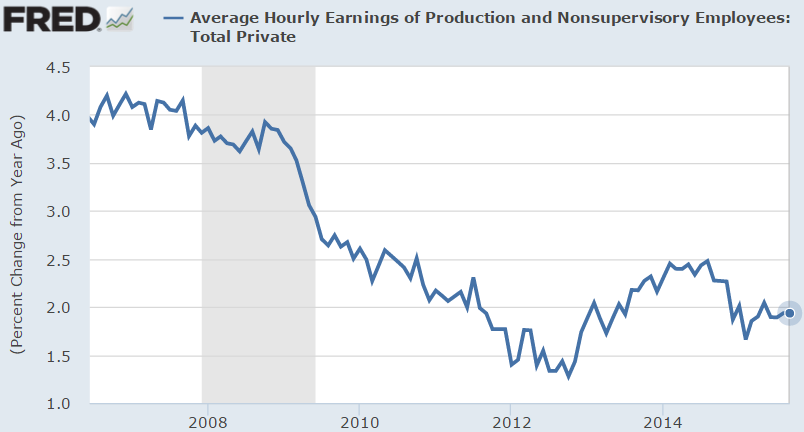
To make matters worse, the wage growth acceleration many economists (including the Fed) have been promising never materialized (at least not yet). US wages continue increasing at around 2% per year and the concerns around wage pressures seem to have been overblown.


Given this latest shift in sentiment, we would like to conduct a quick survey on the timing of liftoff in the US. It's a single question (below) and the results will be published here and in the Daily Shot.

_________________________________________________________________________

Sign up for our daily newsletter called the Daily Shot. It's a quick graphical summary of topics covered here and on Twitter (see overview). Emails are NEVER sold or otherwise shared with anyone.
_________________________________________________________________________

From our sponsor, Fitch Solutions: Sign-up for Inside Credit - a weekly wrap-up of noteworthy Fitch content delivered every Friday.

SoberLook.com

The expectations of a fed rate hike are collapsing, even in the long term

Guest post by Marcello Minenna

After the FED's decision of 17th September leaving interest rates unchanged, a great confusion has spread throughout the markets. The varied opinions have oscillated from the “disappointed” who were expecting, if not a rate increase, at least clear commitments towards a steady normalization path and the “crypto-hawks”, that have been arguing that the FED was only temporarily retreating only to accelerate the hike cycle in the following months. To be sure, Yellen and her spokespersons have not helped the markets to form a solid idea, by alternating contrasting declarations over just a week or more. Whatever the case, a view is crystallizing in the markets: the coming rate increases will be significantly smaller. This also holds true in the long term.

By looking retrospectively at the data, we have to admit that the “hold” decision was not unexpected at all by the markets (Figure 1).

Figure 1.


In fact, the implied probabilities calculated from the Futures' Prices on FED Funds tell us that the odds of a rate hike had been stable around 30% since mid-August: the markets were expecting a dovish decision and the FED was aware of it. It is interesting to analyze the main drivers of the operators' expectations, in the period July-September 2015 characterized by a frantic high volatility and a huge slip of the values on the equity side, connected with the Greek crisis (July 2015) and then with the Yuan's devaluation (August 2015).

Paradoxically, the expectations of a FED move on rates were largely unaffected from these two large regional crises at least in a direct way. The stark fact is that the markets have reacted punctually only to direct FED declarations. The perspective is perfectly logical: the FED is in charge to evaluate the broad macro-economic context while the markets follow closely the central bank guidance. In July, (see again Figure 1) one can appreciate a sensible increase of the odds of a rate hike in correspondence with the publications of the FOMC minutes the 8th of July, where the FED was shaping a definite track for the normalization of rates within the end of the year. The probabilities went up for the entire month of July, despite worsening of the Greek drama, the threats on China's slowing economy and the endless doubts about the real health of the US economy.

The second turning point that reversed in a decisive way the markets' expectations is the 18th of August; it’s worth noticing that during this day the FED released a discussed report in which it casts serious doubts on the effectiveness of the Quantitative Easing in boosting US GDP and inflation. Notably the 12th of August the People Bank of China had decided to abandon the Yuan's peg to the Dollar, igniting therefore a massive turmoil on world equity and FX markets, but the probabilities were remaining fairly constant until the FED report was published.

Again, the markets have waited for the “true interpretation” - via official documents - of the developments in the macroeconomic environment to adjust their expectations about the future evolution of interest rates. Other events affect short-term dynamics and boost expectations volatility but do not change the general trend “imposed” by FED guidance.

At the end of September, it seems that the games are done even for the FOMC October meeting (Figure 2). In this case, it’s not surprising that the main shift of expectations is given by the “hold” decision of the 17th September.

Figure 2.


The general consensus, reinforced by Yellen's declaration of the 25th of September that “a US rate rise is still likely this year”, is that the hike cycle should begin with the FOMC December meeting.

Nevertheless (Figure 3), the odds of a rates rising in December are generally decreasing. Indeed since 17th September it appears a bit more plausible that we will have the continuation of a loose monetary stance. Yellen’s statement has impacted on the numbers only to a limited extent, even if it has influenced the estimates for a few days - until the market participants have realized that no new official decisions were on the table.

Figure 3.


What’s happening on the long-term expectations? Intriguingly, irrespective of the official statements and the media gossip, they are cratering at all the time horizons analyzed (Figure 4).

Figure 4.


In less than two months, we can observe a reduction of 23% of the probability of a rate rise within the horizon of March 2016 and over 15% within the July horizon. Moreover, one can see the first significant change of expectations during the month of August and a second shock with the decision of the 17th of September. A focus on the future date of the July 2016 FOMC meeting (27th of July, 2016) confirms indeed that the August shift in long-term expectations is connected with the publication the 18th of August of the FED report on the effects of US Quantitative Easing.

Figure 5.


Figure 5 shows that markets estimate a more likely scenario to be a restrained interest rate increase, in the order of 25 basis points. The probability of a growth of the FED target rate of more than 50 basis points even on a longer time span is losing momentum  rapidly. This forecast would be coherent with the framework of a slowing world economy, persistently low commodity prices and global deflation perspectives. The FED should indeed weight the risk of being caught in a zero interest rate environment trap by the time the next recession hits the US economy.


_________________________________________________________________________

Sign up for our daily newsletter called the Daily Shot. It's a quick graphical summary of topics covered here and on Twitter (see overview). Emails are NEVER sold or otherwise shared with anyone.
_________________________________________________________________________

From our sponsor, Fitch Solutions: Sign-up for Inside Credit - a weekly wrap-up of noteworthy Fitch content delivered every Friday.

SoberLook.com

Sunday, August 23, 2015

6 reasons the FOMC is unlikely to move in September

The majority of economists still expect the Federal Reserve to begin the long-awaited liftoff next month.


However is this dovish FOMC truly prepared to "pull the trigger" this time? Here are some reasons the central bank is likely to delay the first hike.

1. While the Fed officially talks about not being focused on the currency markets, the recent dollar rally should give them some food for thought. The global "currency wars" have sent the trade-weighted US dollar to the highest levels in over a decade. This will continue to put pressure on US manufacturing (and even some services sectors) as US labor and other costs of production rise relative to other nations.


2. Commodity prices, led by crude oil and industrial metals, hit new multi-year lows, reigniting disinflationary pressures. Note that the Bloomberg Commodity Index is at the lowest level since 2002. Some at the Fed continue to view this as "transient", but the full impact of such a move is yet to be fully felt in the economy. Here is a broad commodities index.

Source: barchart

In fact as of Sunday night in NY, WTI futures are trading below $40/bbl.

Source: barchart

3. Driven to a large extent by commodity prices as well as economic weakness in China, US breakeven inflation expectations are declining sharply as well. Does this look like a great environment to begin raising rates?


4. Some point to the recent stability in "core inflation", with CPI ex food and energy remaining around 1.8% and providing support for a less accommodative policy. However the main driver of this stability is the rising cost of shelter. Core CPI excluding shelter is below 1% (YoY).

Source: Source: @boes_ )

5. The biggest argument for a rate hike is the expectation of increasing wage pressures. US labor markets continue to improve and at some point - the argument goes - wage growth will accelerate. However, we haven't seen much evidence for wage pressures thus far, as average hourly earnings continue to grow by about 2% per year (nominal). With the recent dollar strength, US corporations will speed up shifting production abroad - especially Mexico, limiting wage growth in the United States.

Moreover, rising rental costs are squeezing US households - many of whom are being priced out of the rental markets or can not keep up with increasing shelter-related expenses (chart below). The FOMC has to ask itself whether a rate hike will help the situation. The answer may be just the opposite: higher rates may put more upward pressure on rents as the cost of financing rental properties increases or construction of new rental housing slows.


6. Finally some at the Fed have been concerned about bubbles forming in the financial markets. In recent weeks however, the markets took care of that, as a healthy dose of risk aversion returns to the markets (see post).


_________________________________________________________________________

Sign up for our daily newsletter called the Daily Shot. It's a quick graphical summary of topics covered here and on Twitter (see overview). Emails are NEVER sold or otherwise shared with anyone.
_________________________________________________________________________

From our sponsor, Fitch Solutions: Sign-up for Inside Credit - a weekly wrap-up of noteworthy Fitch content delivered every Friday.

SoberLook.com

Wednesday, August 5, 2015

Beijing may question the yuan peg as the Fed prepares for liftoff

Today's ISM non-manufacturing report showed US services sector expansion considerably stronger than economists had anticipated. The strength of services sector expansion however has diverged materially from what we see in US manufacturing.

Source: St. Louis Fed, ISM

The reason for the divergence is the strength of the US dollar, which on a trade-weighted basis is at the highest level in over a decade.

Source: St. Louis Fed

Strengthening US currency has generated a significant drag on growth in the manufacturing sector. We've all read the headlines.


But haven't we seen this divergence between the services and the manufacturing sectors elsewhere? Indeed just yesterday Markit published a similar chart for China.

Source: Markit

This of course is more than a coincidence. China's currency tie to the US dollar resulted in a similar dynamic of manufacturing sector significantly underperforming. Unlike the US however, China's manufacturing is more sensitive to exports, making the slowdown far more pronounced - resulting in an outright contraction (PMI below 50 in the chart above).

In recent months the yuan has been firmly pegged to the dollar. There are a number of reasons for this linkage, including China's wish to make the yuan part of the so-called Special Drawing Rights (SDRs), a basket of currencies constructed by the IMF and held by various central banks. Beijing reasoned that the yuan's stability would help them with that cause.

Source: barchart

However, yesterday we got this headline.

Source: Reuters

Time to give up the peg? There are of course other reasons China may want to maintain the link to the dollar - one of them is to continue "rebalancing" the economy.

Source: MRB

This policy however could prove to be too costly, as competitors whose currencies have been devalued may take market share from China. Here is how the yuan has appreciated against the Mexican peso for example (chart below). With margins tightening in a number of industries, when a manufacturer decides where to build a factory, Mexico (and a number of other countries) may now be a cheaper solution.


It's unclear if China will ultimately let the peg go or if the yuan will continue tagging along with the US dollar. Will China want to wait until the 2016 IMF decision on the SDR inclusion? With the Fed getting ready for "liftoff" in September while most central banks are easing, the dollar could continue marching higher. This could slow China's economic growth materially below the current ("reported") 7% per year. In effect the tightening of monetary conditions in the US will be transmitted to China via the peg. If the dollar indeed moves higher as US rates rise, will Beijing finally run out of patience?


_________________________________________________________________________

Sign up for our daily newsletter called the Daily Shot. It's a quick graphical summary of topics covered here and on Twitter (see overview). Emails are NEVER sold or otherwise shared with anyone.
_________________________________________________________________________

From our sponsor, Fitch Solutions: Sign-up for Inside Credit - a weekly wrap-up of noteworthy Fitch content delivered every Friday.

SoberLook.com

Related Posts Plugin for WordPress, Blogger...
Bookmark this post:
Share on StockTwits
Scoop.it